Alternatives to RebusFarm in 2026: An Honest Comparison
Overview
Introduction
If you're searching for an alternative to RebusFarm, you're usually in one of two situations: you already render there and a specific need has outgrown the service — a Houdini Karma XPU pipeline, a GPU spec you want disclosed before committing a deadline, or a support window that matches your timezone — or you're comparison-shopping a large project and want the map of the managed cloud render farm category.
The honest framing upfront: we operate Super Renders Farm, so this is not a neutral directory. What we will do is keep every RebusFarm claim sourced to their own public pages or cited third-party material, present the alternatives — including farms that compete with us — on their real strengths, and say plainly where RebusFarm remains the better choice. A guide that pretends the incumbent does nothing well isn't a guide; it's an ad.
For the record, RebusFarm is an established operator, not a service people flee from: a German GmbH running since 2006 (RebusFarm GmbH, Amtsgericht Köln HRB 70387, registered in Leverkusen near Cologne), with its own German datacenter powered by Naturenergie hydropower and Farminizer, a plugin submitter dating to 2009. All RebusFarm pricing figures below come from their published /buy page, re-checked in June 2026 — if a number has changed by the time you read this, their page wins.
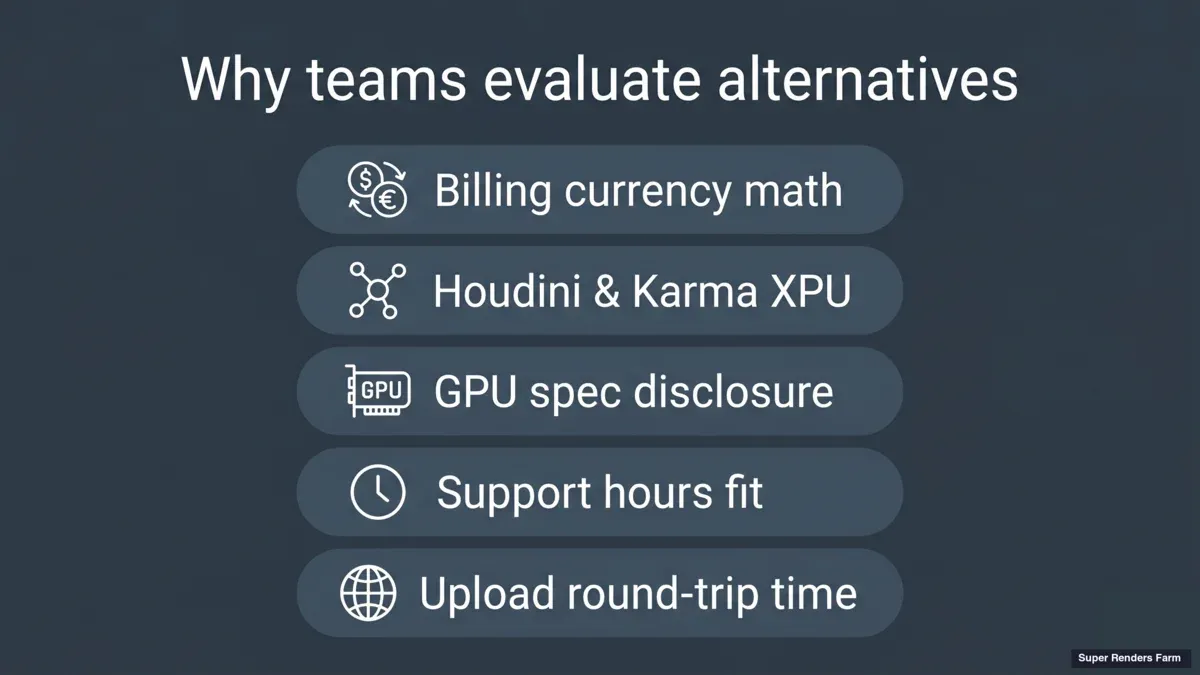 Five common reasons studios evaluate render farm alternatives in 2026
Why People Look for a RebusFarm Alternative
Across teams that migrated to us, and consistent with public review patterns, the reasons cluster into five groups — none of them "the service doesn't work."
1. RenderPoints billing math
RebusFarm bills through RenderPoints, a prepaid internal currency: 1 RenderPoint = $1.18 USD per the published /buy page (June 2026). The per-unit rates are public — 1.41 cent per GHz-hour for CPU, 0.53 cent per OctaneBench-hour for GPU — and to RebusFarm's credit, the page also states no minimum turnover, no charge for uploads, downloads, or storage, and that RenderPoints never expire. The friction is not hidden fees; it's the conversion layer — budgeting means translating RP to dollars to compute-hours, and finance teams that approve spend in plain USD dislike proprietary units.
2. Houdini pipelines
RebusFarm supports Houdini only through a standalone-export workaround: no native Farminizer plugin for Houdini, no Karma XPU, and no Arnold for Houdini (Arnold is supported for Maya), per third-party audits as of May 2026, including the VFXRendering Karma cloud-rendering guide. Karma CPU via standalone export works for some pipelines. If yours needs Karma XPU, Arnold for Houdini, or sim-cache handoff, that single gap is usually the whole reason for the search.
3. GPU hardware disclosure
RebusFarm describes its GPU fleet as "Nvidia GPU cards with up to 5 GPUs per engine" without publishing specific card models at the billing tier. The aggregate capacity claims are substantial — 92,360 GHz across 465,664 cores per their about page — but if your scene sits near a VRAM ceiling or depends on driver-specific renderer behavior, "which exact card renders my frame" matters, and a support ticket is the only way to find out.
4. Support hours in your timezone
RebusFarm advertises 24/7 support. Multiple independent reviews — on Trustpilot and in the PlainlyVideos 2025 cloud-rendering audit — report ticket responses of four hours or more outside Central European business hours, consistent with a single-office German operation — the gap you only feel at 3 a.m. before a deadline in Los Angeles or Sydney.
5. Geography and round-trip time
A single German datacenter is a genuine advantage for EU studios — and a structural constraint for everyone else. Upload and download round-trips from the Americas or Asia-Pacific are simply longer. If your team and clients are mostly in Europe, this row works in RebusFarm's favor.
Worth stating the other side: RebusFarm's 20-year heritage, SmartCheck pre-flight validation (PlainlyVideos rated it the strongest automatic scene checking in its audit), the $29.38 trial — largest in this set — an 11-DCC stack including Revit, Rhinoceros, SketchUp, and legacy Softimage XSI, deep legacy renderer version coverage, and the Naturenergie hydropower story are all real. If those map to your priorities, staying put is defensible — more in the final section.
How to Evaluate a Render Farm Alternative
Whatever you migrate to, you'll be testing it under deadline pressure eventually. Five criteria decide whether a switch holds up six months later.
Pricing model transparency. Is the billing unit a plain currency or an internal one? Are per-unit rates published without a sales call? What's bundled — engine licenses, transfer, storage? A farm can be fair on all three and still fit badly if its discounts assume prepay commitments your studio can't make. Our render farm pricing models guide breaks down the billing units.
Managed service vs. IaaS. Managed farms (RebusFarm, Super Renders Farm, GarageFarm, Fox Renderfarm) take a scene and return frames — software, licenses, and queues are the farm's problem. IaaS-style providers rent you the machine: you remote in, install your stack, and manage everything. Neither is wrong. See our managed vs DIY comparison, and the SaaS render farm vs dedicated cluster comparison for the sustained-capacity case.
DCC and renderer coverage — at version level. "Supports Maya" is not the question. The questions are your exact DCC version, renderer variant (Arnold for Maya ≠ Arnold for Houdini), plugins, and caches. Verify against the published list, then verify again with a test job.
Hardware disclosure. If a farm publishes which GPU models and VRAM sit at each billing tier, you can predict whether your scene fits in memory before you pay. If not, ask before committing a deadline.
Data handling and support reality. Retention windows, NDA availability, who can see your files, and — the one people skip — whether support answers during your working hours. Trials exist so you can test that before it matters.
Super Renders Farm as a RebusFarm Alternative
We'll apply our own framework to ourselves, including the rows where we lose.
We run a fully managed model: you upload a scene through the web dashboard, our operators validate it — missing assets, plugin versions, output settings — before render time burns, and you download frames when the job completes. No remote desktop, no software installs, no license management. The team has run render infrastructure since 2010; the company is US-registered (Super Renders Farm LLC, Santa Ana, California) — for US studios, that means US billing, US jurisdiction, and a US phone line.
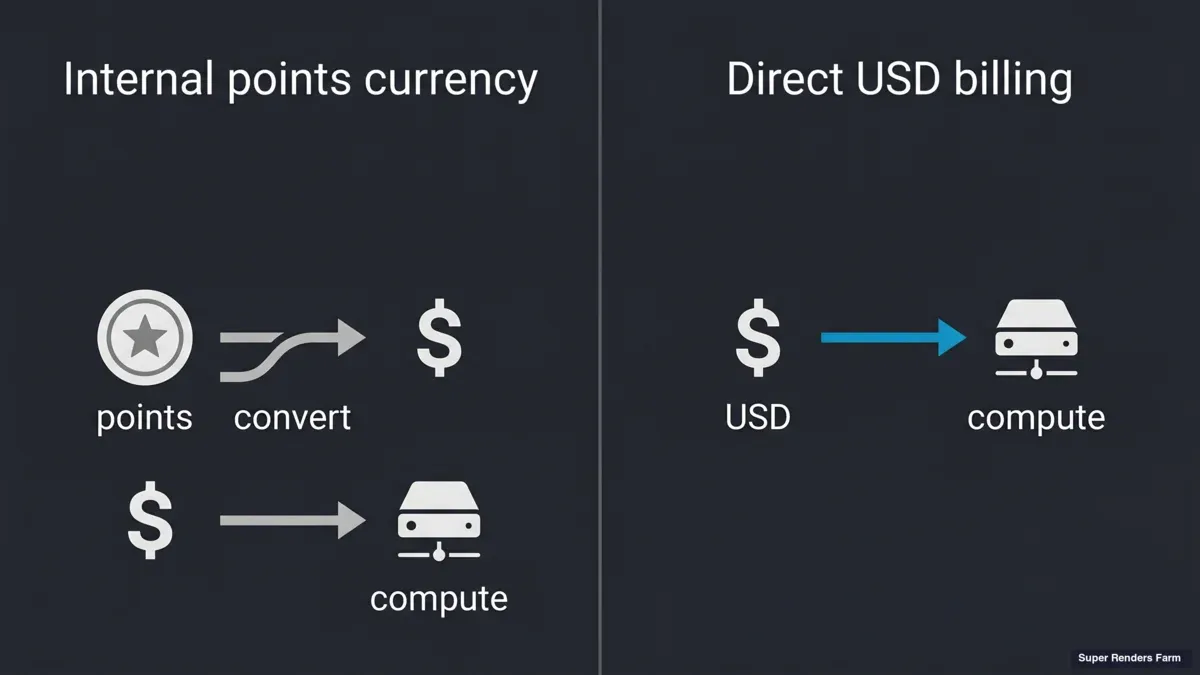 Prepaid points currency versus direct USD render farm billing models
On pricing, we publish direct USD rates with no internal currency layer: CPU at $0.004 per GHz-hour (priority tiers up to $0.016) on a Xeon fleet of 20,000+ cores, GPU at $0.003 per OctaneBench-hour on an NVIDIA RTX 5090 fleet (32 GB VRAM; RTX 4090 and RTX 3090 tiers also published). Engine licenses — V-Ray, Corona, Arnold, Redshift, Octane, Cycles — are included. Credits cost 1 credit = $1, never expire, and volume discounts scale from 5% at 100 credits to 30% at 10,000, with no prepay floor. The trial is $25 in non-expiring credits.
Against RebusFarm specifically, the differences are structural. Billing is direct USD versus an RP conversion layer — both vendors publish their rates; ours skips the translation step. We publish exact GPU card models at the billing tier; RebusFarm publishes an aggregate fleet description. Houdini is the largest functional gap: we run native Houdini with Karma XPU, Mantra, and Redshift, plus operator-managed sim cache for Pyro, FLIP, Vellum, and PDG, with V-Ray, Arnold, and Octane for Houdini provisioned on request — the stack RebusFarm covers only via CPU-bound workaround. See the Houdini cloud render farm page for the matrix. After Effects is parity territory: RebusFarm runs the HeliumX plugin set, our AE pipeline provisions eight plugin packs on request. Support runs 24/7 over live chat with a global team plus a US phone line — test it at your own working hours on trial credits.
And the rows where RebusFarm wins on the same framework: our stack is seven DCCs (3ds Max, Maya, Cinema 4D, Blender, Houdini, After Effects, NukeX) — if your pipeline needs Revit, Rhinoceros, SketchUp, LightWave, Modo, or Softimage XSI, RebusFarm covers them and we don't. On Blender, RebusFarm lists EEVEE; our Blender rendering is Cycles-only — EEVEE needs an active display context, which our headless render nodes don't provide, so we don't claim it. Their 25 RP trial ($29.38) is larger than our $25. They publish a Team Manager multi-seat studio feature; we handle multi-user setups through support. And we don't currently publish ISO 27001 or SOC 2 certification (we provide encryption in transit and at rest, role-based access, and a custom NDA for compliance-driven projects) nor a renewable-energy claim — RebusFarm's hydropower disclosure stands alone here. For the full head-to-head, our Super Renders Farm vs RebusFarm comparison goes dimension by dimension.
Other Alternatives Worth Considering
A genuine search weighs more than one candidate. Three more farms regularly shortlisted against RebusFarm:
GarageFarm — UK-registered (Companies House #07278832, operating since 2010), rendering through an ISO 27001-certified Polish datacenter run by sister company Copernicus Computing in Toruń, with a Korea support hub for Asia-Pacific hours. Pricing is three-tier per resource — CPU $0.024–$0.072 per GHz-hour, GPU $0.004–$0.012 per OctaneBench-hour — with a top-up bonus scaling to 50% at $12,500 prepay (the steepest commitment incentive here) and a $25 trial. The renderBeamer submitter covers a 10-DCC list including Vue and Terragen. The gaps run opposite to ours: no native Houdini or sim cache, and After Effects is deprecated per their FAQ. The GPU fleet is workstation and datacenter class (RTX 4000 Ada through RTX 6000 Pro Blackwell at 96 GB VRAM), presented as tiers with VRAM bands rather than card models. Strongest fit: EU studios that want formal datacenter ISO 27001, scenes needing 96 GB VRAM, Vue/Terragen pipelines, prepay-comfortable teams. Our GarageFarm vs Super Renders Farm comparison and the three-way GarageFarm vs RebusFarm vs Super Renders Farm piece go deeper.
iRender — a Vietnam-based, GPU-first provider with a different service model: IaaS-style machine rental. You rent a configured GPU machine (including multi-GPU rigs), connect remotely, install your own software and licenses, and run the render yourself, billed in direct USD per hour. That's the opposite philosophy to a managed farm — full machine control in exchange for your own setup, licensing, and monitoring — and it genuinely fits teams with unusual stacks or engines no managed farm lists. Our iRender vs Super Renders Farm comparison covers where each model makes sense.
Fox Renderfarm — a Shenzhen-based managed generalist: CPU and GPU rendering, broad mainstream DCC coverage, a $25 trial, and one of the category's largest multilingual tutorial libraries. Strongest fit: Asia-Pacific studios wanting regional proximity with a managed workflow. Our Fox Renderfarm vs Super Renders Farm comparison covers the detail.
For a direct three-way look at RebusFarm, GarageFarm, and Fox Renderfarm together, our RebusFarm vs GarageFarm vs Fox Renderfarm comparison covers pricing, hardware, and DCC support across all three.
For a wider field, our complete render farm comparison covers the 2026 landscape.
Fit Matrix: RebusFarm vs the Alternatives
The matrix compares structure, not live price tags — vendor rates move, and each pricing page is the only authoritative source. Figures quoted earlier are as of June 2026.
| Decision factor | RebusFarm | Super Renders Farm | GarageFarm | iRender | Fox Renderfarm |
|---|---|---|---|---|---|
| Service model | Fully managed (Farminizer) | Fully managed (dashboard + operator validation) | Fully managed (renderBeamer) | IaaS — rent and run the machine | Fully managed |
| Billing model | Prepaid RenderPoints (1 RP = $1.18) | Direct USD credits (1 credit = $1) | Prepaid balance, tiered rates | Direct USD per machine-hour | Direct USD, calculator-quoted |
| Published per-unit rates | ✅ cent/GHzh + cent/OBh | ✅ $/GHz-hr + $/OBh | ✅ per-tier GHz-hr + OBh | ✅ per machine-hour | ✅ via cost calculator |
| GPU models disclosed | ❌ aggregate only | ✅ RTX 5090 / 4090 / 3090 | Partial — tiers + VRAM bands | ✅ per rented config | Verify per config |
| Houdini + Karma XPU | ❌ workaround, no XPU | ✅ native + sim cache | ❌ not on primary list | DIY install | Verify your version |
| After Effects | ✅ AE 23.0+ (HeliumX) | ✅ native, 8 plugin packs on request | ❌ deprecated per FAQ | DIY | Verify current list |
| Legacy / BIM DCCs | ✅ broadest (Revit, XSI, Rhino, SketchUp) | ❌ | Partial (+ Vue, Terragen) | DIY | Verify current list |
| EU data residency | ✅ German entity + DC | ❌ US company | ✅ Polish ISO 27001 DC, UK entity | ❌ | ❌ |
| Renewable-energy disclosure | ✅ Naturenergie hydropower | ❌ | ❌ | ❌ | ❌ |
| Trial / credit expiry | $29.38 (25 RP), never expire — largest here | $25, never expire | $25; check terms | Varies; pay-per-use | $25; check terms |
| Support hours | CET (24/7 advertised; reviews note off-hours delays) | 24/7 live chat, global team + US phone | Korea hub adds APAC | Vietnam-based | APAC |
Read it by row, not by column: every farm here wins at least one row — the right answer depends on the row your production lives on.
Migrating from RebusFarm: A Practical Checklist
If you test an alternative, do it like an operator, not a shopper. The common failure mode: switching a week before a deadline on the strength of a pricing page instead of a test render.
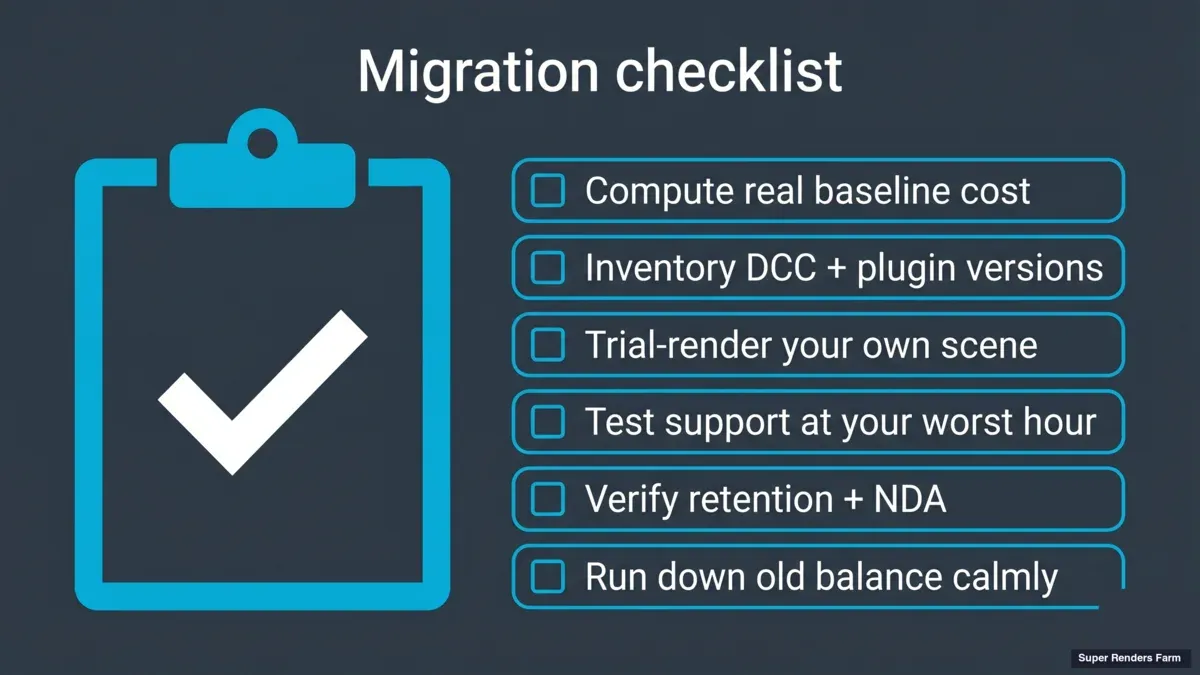 Render farm migration checklist: verify, test, compare, then move
- Compute your real baseline. Pull your last three RebusFarm invoices and convert: total RP spent × $1.18, divided into the GHz-hours or OBh consumed. That effective per-unit cost — not the headline rate — is the number to beat.
- Inventory the pipeline precisely. Exact DCC versions, renderer variants (Arnold for Maya ≠ Arnold for Houdini), every plugin, sim-cache dependencies. Check each candidate's published support list against this inventory first.
- Spend trial credits on your own scene. Every farm here offers a trial. Render the same 10-frame slice on each candidate and on RebusFarm; compare wall-clock time and per-frame cost. Vendor benchmarks — ours included — are no substitute for your scene.
- Test the support channel at your worst hour. File a real technical question at the time of day your deadlines break. Response time at 3 a.m. your time is a feature; verify it like one.
- Verify data handling. Output retention rules (ours has no fixed automatic deletion period; files are deleted on request), upload formats and archive restrictions, NDA availability, and output delivery.
- Run down your RenderPoints calmly. RebusFarm's published policy is that RenderPoints never expire — no fire-sale pressure. Keep the balance for lower-priority jobs while you validate the alternative, and move the pipeline only once test renders hold up.
When RebusFarm Is Still the Right Choice
The honest close. RebusFarm remains the stronger fit when:
- Your contracts require EU data residency under German law. It's the only farm in this comparison where both the legal entity and the rendering hardware sit in Germany.
- ESG procurement requires documented renewable energy. The Naturenergie hydropower disclosure is unique in this set; nobody else here, including us, publishes an equivalent claim.
- Your pipeline runs Revit, Softimage XSI, LightWave, Modo, Rhinoceros, or SketchUp. The 11-DCC stack covers legacy and BIM tools that neither we nor most managed competitors support.
- You depend on deep legacy renderer versions. Published support spans V-Ray 3.x through 7 and Redshift 2.0 through 2025 — coverage that matters for old scene archives.
- You render EEVEE on Blender. RebusFarm lists it; we run Cycles only.
- Your team is built around Farminizer. SmartCheck's pre-flight is independently well-reviewed, the $29.38 trial is the largest among the farms compared here, and Team Manager suits multi-seat studio accounts.
If two or more of those describe your production, the honest answer to the alternatives question may be "stay, and renegotiate your volume tier."
FAQ
Q: Why do people look for alternatives to RebusFarm? A: Five common reasons: the RenderPoints billing layer (some teams prefer native USD math), the Houdini gap (no Karma XPU, no Arnold for Houdini per third-party audits), undisclosed GPU card models at the billing tier, support response times outside Central European hours, and upload round-trips from the Americas or Asia-Pacific to a single German datacenter. None of these means the service is broken — they're fit issues, not failures.
Q: Is RebusFarm a good render farm in 2026? A: For its target profile, yes — a 20-year-old German operation with its own hydropower-powered datacenter, published pricing, a well-reviewed pre-flight scene checker, the largest free trial among the farms compared here ($29.38), and an 11-DCC stack including Revit and legacy tools. The case for an alternative is specific — Karma XPU pipelines, GPU spec disclosure, timezone-matched support, direct-USD billing — rather than general.
Q: What is the difference between RenderPoints and direct USD billing? A: RebusFarm bills in RenderPoints, a prepaid internal currency where 1 RP = $1.18 per their published /buy page; RenderPoints never expire, so an existing balance is no reason to rush a migration. Direct USD billing, which we use at Super Renders Farm, prices compute in dollars with no conversion step — 1 credit = $1, also non-expiring. Both are prepaid systems; the difference is whether you budget in the vendor's unit or your own currency.
Q: Which RebusFarm alternative supports Houdini with Karma XPU? A: Among the farms compared here, Super Renders Farm runs native Houdini with Karma XPU, Mantra, and Redshift, plus sim-cache handoff for Pyro, FLIP, Vellum, and PDG, with V-Ray for Houdini, Arnold for Houdini, and Octane for Houdini provisioned on request. GarageFarm doesn't list Houdini as a primary DCC; verify Fox Renderfarm support for your specific Houdini version. If your pipeline is Karma-CPU-only without sim cache, RebusFarm's standalone-export workaround may still serve.
Q: Is Super Renders Farm cheaper than RebusFarm? A: It depends on your scene, and we'd rather you measure than take a claim. Both vendors publish per-unit rates — RebusFarm at 1.41 cent/GHzh CPU and 0.53 cent/OBh GPU (June 2026), us at $0.004/GHz-hr CPU and $0.003/OBh GPU with engine licenses included — but effective cost depends on hardware throughput, priority tier, and discounts. Run the same frames on both trials and compare per-frame cost; that number is the only one that matters.
About Alice Harper
Blender and V-Ray specialist. Passionate about optimizing render workflows, sharing tips, and educating the 3D community to achieve photorealistic results faster.