LucidLink workflow

Render Farm for LucidLink Users

Mount your existing LucidLink filespace onto our Windows GPU render nodes — no re-uploading, per-customer cache, render in place.

Your assets stay where they are — render at Super Renders Farm.

Questions? Chat with our team — typical reply under 5 minutes
LucidLink Windows Service mountPer-customer cache isolationRTX 5090 · 32 GB VRAM GPU nodesFully managed — Super Renders Farm LLC
The problem

If your studio runs on a shared filespace, every render job on an upload-only farm forces you to re-export, repack, and push hundreds of gigabytes through the public internet before rendering can start. The data side becomes the bottleneck, not the render side.

Worked example: an 800 GB scene packed for a Cinema 4D + Redshift archviz project takes the better part of a business day to upload at 100 Mbps — before a single frame renders. Multiply across three to five weekly jobs and the upload window owns the calendar, not the GPU fleet. Versions compound the problem — a 20 GB asset swap mid-project means another re-export and another upload window.

LucidLink solves the data side cleanly: byte-range streaming over object storage, encrypted end-to-end, mounted as a local drive on every workstation in the pipeline. The artist team stops thinking about where files live.

But hyperscaler render fleets such as AWS Deadline Cloud and the equivalents on GCP require you to self-manage the fleet itself — service-account credentials, VPC topology, AMI templates, event-script lifecycle, autoscaling policies, and the operational vocabulary that goes with each. Most studios do not want to be cloud sysadmins on top of being artists.

Super Renders Farm closes the gap: bring your LucidLink filespace, we run the managed render fleet. The data workflow you already have, attached to render hardware you do not have to operate.

How it works

The integration uses LucidLink's headless Windows Service mode, designed for exactly this purpose: rendering on a node that has no interactive user session.

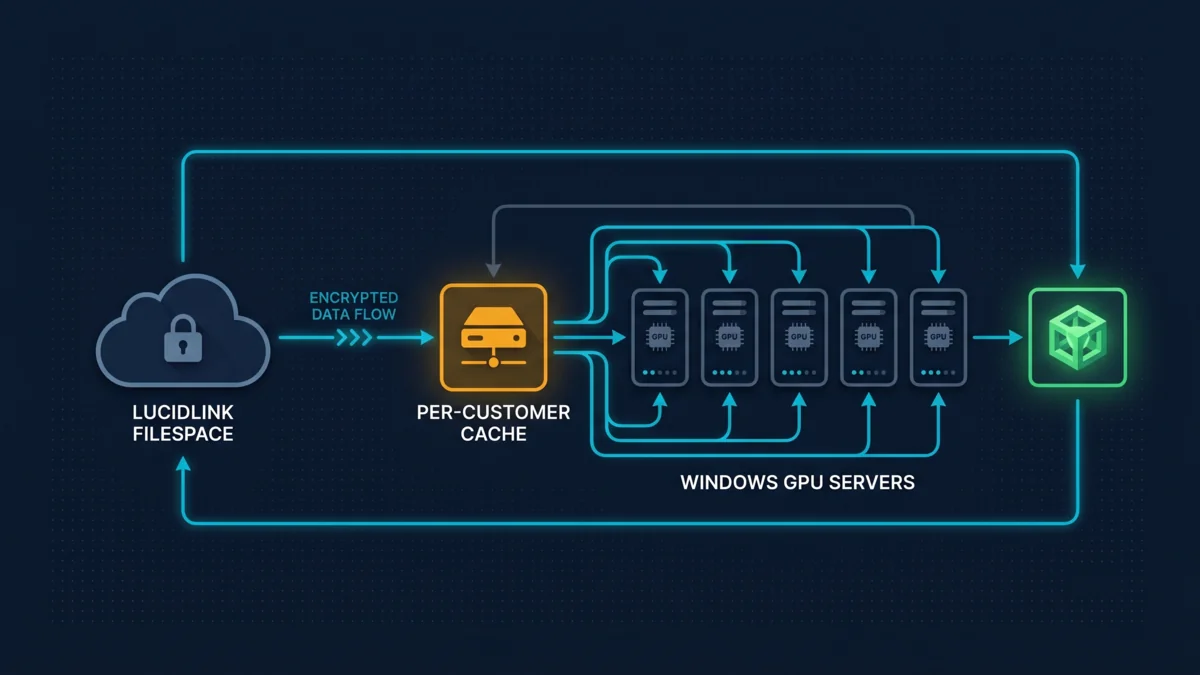
Schematic of a LucidLink filespace mounted onto Super Renders Farm Windows GPU render nodes with a per-customer cache server in front of the render fleet.
LucidLink filespace → per-customer cache → Windows GPU fleet → results back to your filespace.

Mount

LucidLink's Windows Service mode runs on each Super Renders Farm GPU node. Your filespace auto-reconnects after node reboot — no manual login, no interactive RDP session required, no fragile auto-login workaround. The mount survives the long-running, headless lifecycle that a render fleet demands.

Credential

A single service-account credential mounts your filespace for the duration of a dedicated cluster engagement, mirroring the architectural pattern LucidLink and AWS Deadline Cloud document in their joint reference. Your master credentials never leave your studio. Rotation, revocation, and access scope all stay under your control.

Cache

A dedicated per-customer cache server inside our render cluster absorbs region latency. Once an asset is fetched by the first node that needs it, subsequent reads hit local-disk speed across the fleet — the same on-cluster acceleration pattern LucidLink recommends with its TeamCache appliance, applied at the render side. A 20-node fleet that would otherwise stream the same 40 GB texture pack twenty times streams it once and reads it locally nineteen more.

Isolation

Each customer's cache lives on storage assigned only to that engagement. No pooling, no shared blocks between studios, no chance of a misconfigured permission bleeding one project into another. At engagement end, the cache server is wiped and the render nodes are reimaged. Written confirmation of data deletion is available on request.

Workflow

Submit jobs through our render management layer. The fleet mounts your filespace, renders, writes outputs back to your filespace, unmounts, and reports back. Zero re-upload before the job. Zero output download after. Your assets never leave LucidLink.

How it compares

A note on positioning: the AWS Deadline Cloud + LucidLink reference is a valid architecture for studios with a cloud platform team that wants to own the fleet — the LucidLink documentation walks through it. The space we sit in is different: studios that have the data workflow but do not want to add cloud-fleet operations to the production team's plate. We run the fleet so you run the project.

Comparison of Super Renders Farm, AWS Deadline Cloud with LucidLink, and upload-only render farms across filespace mount, managed fleet, Windows GPU nodes, per-customer cache isolation, re-upload, deployment topology, bring-your-own license, and render management.
CapabilitySuper Renders FarmAWS Deadline Cloud + LucidLinkUpload-only render farms
Filespace mount on render nodeYesYesNo
Managed fleet (no sysadmin)YesNo — DIY fleet script + VPC + Secrets ManagerYes
Windows GPU render nodesYes — RTX 5090, 32 GB VRAMLinux reference architecture onlyVaries by vendor
Per-customer cache isolationYes (cluster-side, dedicated)Self-managedNot applicable
Re-upload required per jobNoNoYes
Cross-country deployment topologyYesSelf-architect across regionsNo
Bring your own LucidLink licenseYesYesNot applicable
Render management includedYesSelf-host or DIYYes
Choosing a tier

Two paths live under the same roof, and the right one depends on how your pipeline already works.

Direct Transfer (the default tier on [render farm rental](/render-farm-rental)). Suited to one-off projects, standalone scenes, and studios that do not run a shared filespace. No third-party account required. Asset upload via Cyberduck, FTP/SFTP, or pull from Google Drive or Dropbox. A sensible starting point for solo artists, freelancers, and small studios where each project is self-contained.

Bring Your Own Filespace (this page). Designed for studios already running LucidLink in their pipeline. The right fit when you have recurring jobs, large scenes (typically more than 500 GB), tight turnarounds where the upload window would consume a meaningful share of the schedule, or a distributed team that already shares the filespace across multiple workstations and offices. The dedicated cluster engagement is the recommended commercial form for this tier, because per-customer cache isolation is a dedicated-cluster property.

Not sure which side of the line you sit on? The rule of thumb is the upload calendar. If you are scheduling around how long it takes to push a project to a render farm, the upload tax is real for you and the filespace workflow is worth a conversation. If a Friday-evening upload comfortably finishes before a Monday-morning render, the Direct Transfer tier is most likely the simpler answer.

Security

Encryption

LucidLink's zero-knowledge AES-256 architecture is preserved end to end. The cache layer in our cluster holds encrypted blocks only — plaintext is never resident on the cache. Render nodes decrypt in memory at the point of use.

Per-customer cache isolation

Each engagement runs on its own cache server. No shared storage between studios, no cross-tenant access path. This applies the TPN MPA data-segregation principle at the cluster level: the property that matters for media security is not whether a vendor holds a paper certificate, but whether the architecture makes cross-customer data exposure mechanically impossible. Per-customer cache isolation does exactly that.

Cache wipe and node reimage

At engagement end, the cache server is wiped and the render nodes are reimaged from a known-clean base image. Written confirmation of data deletion is available on request. This closes the loop on residual data — the only state that survives an engagement is the state you have already pulled back into your filespace.

NDAs

Standard mutual NDAs are available before workflow validation calls and before any project-specific architectural review.

Compliance posture

Super Renders Farm is compatible with the security posture your LucidLink subscription already provides. LucidLink itself holds independent TPN Gold Shield certification and SOC 2 audit attestation, and your project data inherits those properties end to end. Super Renders Farm does not currently hold an independent TPN certification; the per-customer cache isolation pattern is the architectural answer that supports media-pipeline security requirements today, and a Q3 2026 independent compliance roadmap is under review.

Roadmap

LucidLink is the first production-validated mount-and-render integration we run, and the page you are reading reflects that production status. Several adjacent integrations are on the 2026 roadmap as part of the same shared mount-adapter architecture.

If your studio runs on a different shared-storage stack — S3-compatible buckets such as Backblaze B2, Wasabi, or Cloudflare R2, or on-premises NAS such as Synology, QNAP, or TrueNAS reachable through a site-to-site tunnel — contact us. We can validate fit on the dedicated-cluster tier today even where the public landing page for that integration is still to come. The roadmap is real and the engineering pattern is shared; LucidLink simply shipped first.

Pricing

This page does not duplicate the pricing table — pricing for both Direct Transfer and the dedicated cluster engagement lives on the pricing page where it can stay in sync without drift.

The short version: dedicated cluster engagements are quoted per-cluster (node count, duration, region) rather than per-frame, because the per-customer cache and the service-account mount are dedicated infrastructure for the engagement window. For recurring-workload studios, a small dedicated cluster slot often comes in lower than the equivalent upload-only per-frame cost once upload time is accounted for. Talk to us before booking — we can scope a tighter estimate than a calculator can.

All render licenses are bundled — V-Ray, Corona, Arnold, Redshift, Octane, Cycles, plus all DCC apps. No license servers, no Multi-User Licenses, no per-seat fees. Render with our licenses.

Authorized partners + Licensed Nodes

Authorized partners + Licensed Nodes we operate

Authorized Maxon Render Partner
Cinema 4D · Redshift
Authorized Chaos Render Partner
V-Ray · Corona
AXYZ design — partner
anima · MetropoliX
Arnold Licensed Nodes — we operate
Octane Licensed Nodes — we operate

Forest Pack + RailClone are pre-installed and license-covered (carry-forward from Brief #9; iToo partner verification pending).

They Trust Us

Motion Adrenaline logo
Soramitsu logo
Rove Concepts logo
Insomnia Production logo
Shifting Media logo
Lionstar Films logo
Image Foundry logo
Domus Arquitetura logo
Neorama logo
YouSee Studio logo
Imminent Studio logo
Waterlemon Studios logo
One Knot One logo
Industrial 3D logo
Raf Grassetti logo
Archigraph logo
Amerra logo

Frequently Asked Questions