RebusFarm vs GarageFarm vs Fox Renderfarm: An Honest 2026 Comparison
Overview
Introduction
If you spend any time asking around for a cloud render farm — in a Blender subreddit, a Cinema 4D Discord, or an archviz forum — three names come up together more than almost any others: RebusFarm, GarageFarm, and Fox Renderfarm. They're all long-running, all genuinely capable, and all frequently recommended in the same breath, which is exactly what makes choosing between them confusing. The three-way "which is better" question rarely gets a straight answer, because the honest answer is that it depends on what you render and how you like to work.
This is a comparison of those three farms, written for buyers rather than for any one of them. We run our own render farm at Super Renders Farm, so we watch this market closely — but the body of this guide is about the three subjects, on their own terms, using facts pulled from their live public pages in 2026. Each of these companies has real strengths and real tradeoffs, and none of them is "the best" in any absolute sense. Where we fit into the picture is a short, clearly-labeled section near the end, so you can weigh us the same way you'd weigh anyone else. The goal here is a decision framework you can actually use, not a scoreboard.
 Side-by-side comparison header showing the RebusFarm, GarageFarm, and Fox Renderfarm logos above a neutral render-farm rack illustration
How These Three Farms Are Different at a Glance
Before the per-farm detail, it helps to know the axes on which they actually diverge — because "cloud render farm" hides more variation than it reveals.
- How you pay. All three bill by consumption, but the unit differs. RebusFarm and GarageFarm both meter by the second against a per-GHz-hour (CPU) and per-node-hour (GPU) rate; Fox Renderfarm publishes its rates less openly on the homepage and leans on a bonus-and-coupon structure. The billing unit changes how predictable your cost is and how easy it is to compare quotes.
- What software they run. The DCC and render-engine coverage overlaps heavily but not completely. After Effects and Houdini are the two clearest dividing lines — some of these farms support them, some don't, and if your pipeline depends on either, that single fact can decide the whole thing.
- How much hardware they disclose. One of the three names specific GPU tiers; the others describe their fleets in rounder terms. More disclosure isn't automatically better, but it matters if you're VRAM-constrained on heavy GPU scenes.
- How they handle your first deposit. Free-trial credit is roughly standardized (all three land near $25–$30), but the prepayment and referral bonus terms differ a lot, and they're where the effective price actually gets decided for a working studio.
None of these axes crowns a winner — they tell you which questions to ask. The three profiles below answer them farm by farm.
RebusFarm
RebusFarm is one of the oldest names in cloud rendering, operating for roughly two decades out of a German data center. That longevity is a genuine strength: a farm that's been running that long has seen most pipeline edge cases before, and its Farminizer plugin — which handles submission and cost estimation from inside your DCC — is mature and well-integrated.
Pricing model. RebusFarm meters render time by the second, at a published rate around 1.41 cents per GHz-hour, with a cost calculator and in-plugin estimation so you can preview a job's cost before submitting. RebusFarm's published volume ladder scales from 5% at 500 RenderPoints up to 60% at 50,000 RP (as of August 2026) — a standing schedule on the pricing page rather than a rotating promotion.
Software and engines. RebusFarm supports a broad, somewhat legacy-leaning set of DCC applications: 3ds Max, Maya, Cinema 4D, Blender, Softimage, Modo, LightWave, SketchUp, and Rhino, among others. On the engine side it covers V-Ray, Corona, Redshift, Arnold, Octane, Maxwell, and more. It also supports After Effects, which is a meaningful differentiator — not every farm in this comparison does. Houdini support exists but is more limited than a Houdini-first studio might want.
Hardware disclosure. RebusFarm names specific CPU and GPU hardware on its site — AMD Threadripper 3970X for CPU rendering and NVIDIA Quadro RTX 6000 for GPU rendering — which is more than some competitors disclose, though it doesn't publish a total node count.
Support and trial. RebusFarm offers 24/7 support and a free trial worth roughly $29.38 in render credit, no payment details required to start.
Where RebusFarm fits best: studios on established V-Ray, Corona, or Cinema 4D pipelines who value a long track record and a mature submission plugin, and anyone who needs After Effects rendering in the same farm as their 3D work.
GarageFarm
GarageFarm.net has built a strong reputation in the Blender and archviz communities, and it's frequently praised for responsive support and a broad supported-application list. On paper it advertises one of the widest DCC catalogs of any farm, and its prepayment bonus structure is unusually generous at the high end.
Pricing model. GarageFarm is pay-as-you-go with per-second billing and no subscription — you're charged for scene loading, pre-processing, rendering, and output saving, but not for queue wait, node acquisition, or software install. Published CPU rates run roughly $0.024–$0.072 per GHz-hour by priority level, and GPU rendering is billed per node-hour (OB·hour) at roughly $0.004–$0.012 by priority. The pricing is described as all-inclusive of electricity, license, and service cost.
Prepayment bonuses. This is where GarageFarm's cost story gets interesting. Its published volume-bonus schedule scales steeply: a $250 deposit adds a 2% bonus, $2,500 adds 10%, $6,500 adds 26%, $10,000 adds 40%, and $12,500 tops out at a 50% bonus (as of August 2026). For a studio prepaying large balances, that cuts the effective rate by a third — but only if your volume is high enough to justify the deposit up front.
Software and engines. GarageFarm supports 3ds Max, Maya, Cinema 4D, Blender, SketchUp, Rhino, Modo, and LightWave, with engine coverage across V-Ray (CPU and GPU), Redshift, Corona, Arnold, Cycles, FStorm, and ProRender. Two absences matter: After Effects support has been deprecated, and native Houdini is not on the supported list — so simulation-heavy or comp-in-the-farm pipelines will hit walls here.
Hardware disclosure. GarageFarm describes its fleet in aggregate — around 20,000 CPU cores and several million CUDA cores, with CPU nodes at 176 cores / 256 GB RAM and GPU nodes built on cards like the A5000, L40S, or RTX 6000 Pro — without naming a total node count.
Support and trial. GarageFarm offers real 24/7 human tech support with live chat and fast email response, and a $25 starter credit with no credit card required (trial-capped at 10 nodes and 30 jobs).
Where GarageFarm fits best: Blender and archviz studios that value responsive support and can take advantage of the steep prepayment bonuses at volume — provided they don't need After Effects or native Houdini.
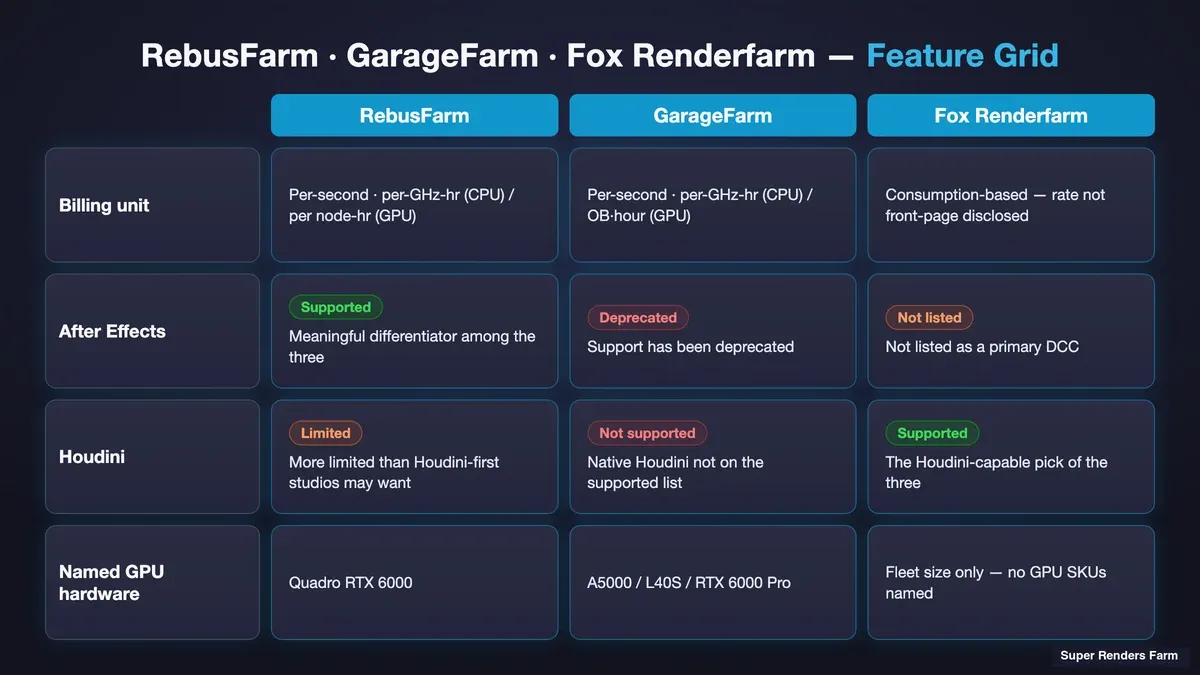 Triangulated feature grid comparing RebusFarm, GarageFarm, and Fox Renderfarm across billing unit, After Effects, Houdini, and hardware disclosure
Fox Renderfarm
Fox Renderfarm is the most brand-visible of the three, with a large content footprint, an active presence at industry events, and a reputation built partly on a steady stream of educational material and community engagement. Its scale is a real asset, and its DCC breadth is wide.
Pricing model. Fox Renderfarm publishes less pricing detail on its homepage than the other two — you'll find "flexible pricing" and a "render more, save more" framing rather than an up-front per-GHz-hour rate. What it does foreground is a bonus-and-coupon structure: an up-to-40% bonus on a first recharge made within 72 hours, plus a 50% CPU render coupon through its referral program. Because the base rate is less transparent on the front page, it's worth running an actual quote through their calculator before comparing against the metered farms.
Software and engines. Fox Renderfarm advertises broad multi-DCC support including Blender, Cinema 4D, 3ds Max, Houdini, Maya, Unreal Engine, and Nuke, with engine coverage across Arnold, V-Ray, Redshift, RenderMan, Octane, and Corona, plus plugin support for Forest Pack, RailClone, X-Particles, and more. Notably, it supports Houdini where GarageFarm doesn't — relevant if you're simulation-heavy.
Hardware disclosure. Fox describes a large fleet — on the order of 30,000 CPU and GPU servers with high-performance SSD storage — but the homepage stops short of naming specific GPU SKUs or per-tier VRAM. Some community discussion has noted that scene pre-flight validation is an area where farms with stronger automated checking pull ahead, so if you rely on a farm catching setup issues before they burn render hours, test that workflow during your trial.
Support and trial. Fox offers 24/7 live support with a fast stated response time across chat, email, and messaging apps, a $25 free trial, and the bonus and referral terms noted above.
Where Fox Renderfarm fits best: studios that want broad DCC coverage including Houdini and Unreal, value brand maturity and a large fleet, and are comfortable requesting a quote rather than reading a rate off the homepage.
Triangulated Comparison Table
Here's the three-way view in one place. Figures are from each farm's live public pages in 2026 and shift with promotions — treat them as a starting point, not a locked quote.
| RebusFarm | GarageFarm | Fox Renderfarm | |
|---|---|---|---|
| Billing unit | Per-second, per-GHz-hr (CPU) / per node-hr (GPU) | Per-second, per-GHz-hr (CPU) / OB·hour (GPU) | Consumption-based; rate not front-page disclosed |
| Published CPU rate | ~1.41¢/GHz-hr | ~$0.024–$0.072/GHz-hr by priority | Not published on homepage |
| Free trial | ~$29.38 credit, no card | $25 credit, no card (10 nodes / 30 jobs) | $25 credit |
| Deposit / referral bonus | 5% → 60% volume ladder (500 → 50,000 RP) | 2% → 50% by deposit tier ($250 → $12,500) | Rotating first-recharge coupons + 50% CPU referral coupon |
| After Effects | Supported | Deprecated | Not listed as a primary DCC |
| Houdini | Limited | Not supported | Supported |
| Named GPU hardware | Quadro RTX 6000 | A5000 / L40S / RTX 6000 Pro | Fleet size only, no SKUs |
| Submission tooling | Farminizer plugin (mature) | Web + plugin | Web + plugin |
| Support | 24/7 | 24/7 human, live chat | 24/7 live, fast response |
The table makes the real decision axes visible: the CPU rates aren't quoted in comparable units across all three, the After Effects and Houdini rows are hard yes/no gates for the pipelines that need them, and the bonus structures reward very different deposit behavior. A studio that prepays big benefits most from GarageFarm's curve; a studio that wants a named GPU and a mature plugin leans RebusFarm; a Houdini or Unreal shop leans Fox.
Decision Guidance by Workload
Rather than crowning an overall winner, here's how the choice tends to break down by what you actually render.
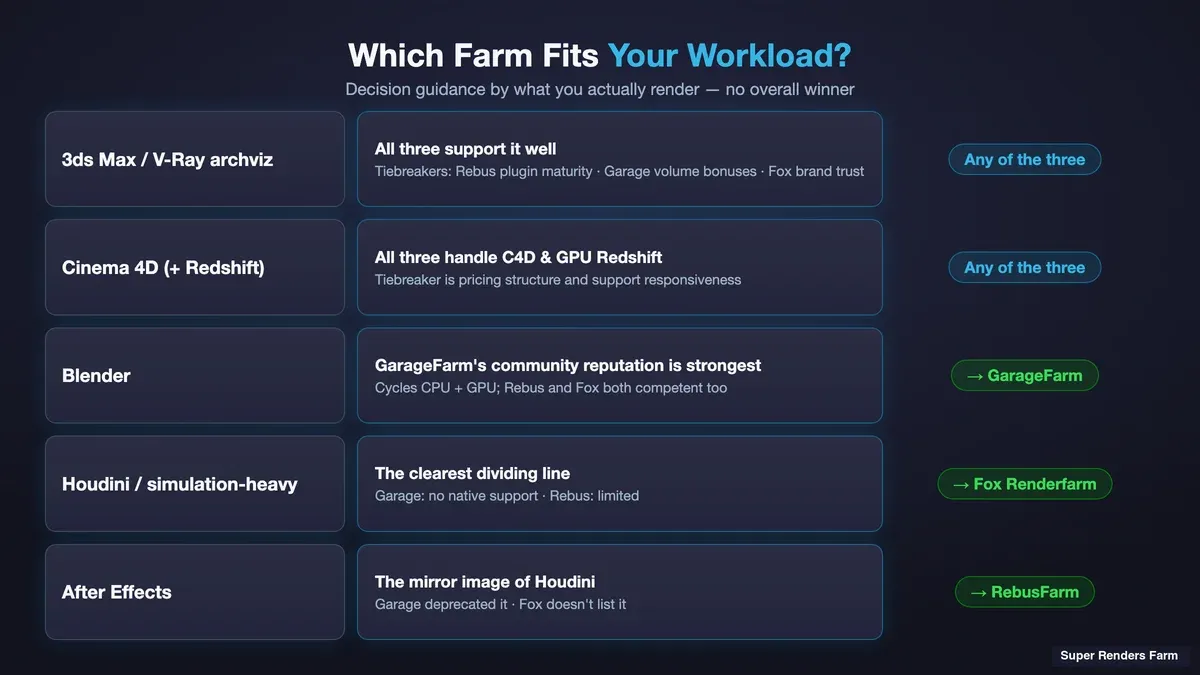 Decision matrix mapping workloads — archviz, Cinema 4D, Blender, Houdini, After Effects — to the best-fit farm among RebusFarm, GarageFarm, and Fox Renderfarm
3ds Max / V-Ray archviz. All three support this core pipeline well, so the decision comes down to secondary factors. RebusFarm's long V-Ray track record and mature Farminizer plugin are reassuring for exacting archviz work; GarageFarm's prepayment bonuses are compelling if you render at high, steady volume; Fox is viable if you already trust the brand. If your archviz work also involves After Effects for animation post, RebusFarm's AE support may consolidate two steps onto one farm. For a deeper archviz-specific breakdown, our guide to the best cloud render farm for archviz covers the workload in detail.
Cinema 4D (with Redshift or standard renderers). All three handle C4D, and all three support Redshift on GPU. GarageFarm and RebusFarm both have strong C4D followings; Fox's broader DCC list is fine here too. The tiebreaker is usually pricing structure and support responsiveness rather than capability.
Blender. Blender is where GarageFarm's community reputation is strongest, and its Cycles support (CPU and GPU) plus responsive support make it a common recommendation. RebusFarm and Fox both support Blender competently as well, so if GarageFarm's After Effects/Houdini gaps don't affect you and you render Blender at volume, its bonus curve is attractive.
Houdini / simulation-heavy VFX. This is the clearest dividing line. GarageFarm doesn't support native Houdini, and RebusFarm's Houdini support is limited — so a genuinely Houdini-first pipeline points toward Fox Renderfarm among these three. Confirm your specific simulation-cache and solver needs during a trial, since "supports Houdini" covers a wide range of completeness.
After Effects. The mirror image of Houdini: RebusFarm supports After Effects, GarageFarm has deprecated it, and Fox doesn't list it as a primary DCC. If rendering AE comps on the farm is a hard requirement, RebusFarm is the natural pick of the three. (Worth noting for the market broadly: After Effects on a render farm is a niche capability, and the farms that keep it maintained are increasingly the exception.)
Where Super Renders Farm Fits
We run our own fully managed cloud render farm at Super Renders Farm, so in fairness we're not a neutral party — we're a fourth option you'd weigh alongside these three. Rather than argue our case here, we'll keep it factual and point you to the head-to-head comparisons where we're the subject and you can judge for yourself.
On the axes above: we bill per-GHz-hour for CPU and per-OctaneBench-hour for GPU (metered, like RebusFarm and GarageFarm), we're fully managed (upload, render, download — no remote desktop or manual license setup), and we run CPU rendering as the majority of our workload with a dedicated GPU fleet for Redshift, Octane, and V-Ray GPU. Our software list covers 3ds Max, Maya, Cinema 4D, Blender, Houdini, After Effects, and NukeX. We're an official partner of Maxon, Chaos, and AXYZ design.
If you want to see us compared directly against the farms in this article, these head-to-head pieces put us next to each of them:
- GarageFarm vs RebusFarm vs Super Renders Farm — the closest triad to this one, with us added as a fourth data point.
- GarageFarm vs Super Renders Farm and Fox Renderfarm vs Super Renders Farm — the individual head-to-heads.
- Migration-focused guides if you're already on one of these and evaluating alternatives: best alternative to RebusFarm and best alternative to Fox Renderfarm.
And if you'd rather see the whole field at once — all three of these farms plus us and several others in one place — our complete 2026 render farm comparison profiles ten farms side by side.
For our own current rates, see Super Renders Farm pricing. Our render farm by industry page also breaks down how workloads like archviz, VFX, animation, and motion design map onto a managed farm, if you want to weigh the fit beyond price alone.
How to Run Your Own Comparison
Whichever way this guide points you, verify it against your own project before committing real budget. Every one of these three offers free trial credit specifically so you can do this, and the differences that matter most tend to surface only when you submit an actual scene.
- Submit one representative scene to each shortlisted farm using the free trial credit, and compare the real cost and turnaround — not the advertised rate.
- Confirm your exact DCC, engine, and plugin versions are supported before you rely on a farm, especially for After Effects, Houdini, or any less-common plugin combination.
- Test the submission tooling. A mature plugin like RebusFarm's Farminizer versus a web-upload flow is a daily-workflow difference you'll feel on every job.
- Check scene pre-flight validation. A farm that catches a missing texture or a wrong output path before rendering saves you real money versus one that renders the mistake first.
- Model your actual deposit behavior against the bonus curves. GarageFarm's prepayment bonuses only pay off at high deposit levels; Fox's are time-boxed to the first recharge; RebusFarm's promos rotate. Match the bonus structure to how you actually buy.
For the underlying methodology on comparing farms across pricing, hardware, and workflow, the complete 2026 render farm comparison walks through the full evaluation framework, and the official docs for your engine — for example Chaos V-Ray or Maxon Redshift — are the authoritative source for version-compatibility questions.
FAQ
Q: Which is better, RebusFarm, GarageFarm, or Fox Renderfarm? A: None is universally better — it depends on your workload. Choose RebusFarm for a mature V-Ray/Corona/C4D pipeline or if you need After Effects; choose GarageFarm for Blender and archviz at high volume where its steep prepayment bonuses pay off, provided you don't need After Effects or native Houdini; choose Fox Renderfarm for broad DCC coverage including Houdini and Unreal Engine. Run a representative test scene on each before deciding.
Q: Which of the three supports After Effects? A: RebusFarm supports After Effects rendering. GarageFarm has deprecated its After Effects support, and Fox Renderfarm does not list After Effects as a primary supported DCC. If rendering AE comps on the farm is a hard requirement, RebusFarm is the natural pick among these three.
Q: Which farm is best for Houdini? A: Among these three, Fox Renderfarm supports Houdini most fully. GarageFarm does not support native Houdini, and RebusFarm's Houdini support is limited. Confirm your specific simulation-cache and solver requirements during a free trial, since "supports Houdini" covers a wide range of completeness.
Q: How do the pricing models compare? A: RebusFarm and GarageFarm both meter render time by the second against a per-GHz-hour CPU rate and a per-node-hour GPU rate, so their quotes are relatively easy to compare. Fox Renderfarm publishes less rate detail on its homepage and foregrounds bonus-and-coupon terms, so you'll usually need to run an actual quote through its calculator to compare directly.
Q: Do all three offer a free trial? A: Yes. All three provide free trial credit with no payment details required to start — roughly $29.38 at RebusFarm and $25 at both GarageFarm and Fox Renderfarm. GarageFarm's trial is capped at 10 nodes and 30 jobs. Use the trial credit to submit a real scene rather than judging on the advertised rate alone.
Q: Which farm discloses the most about its hardware? A: RebusFarm names specific CPU and GPU hardware (AMD Threadripper 3970X and NVIDIA Quadro RTX 6000). GarageFarm describes its fleet in aggregate with some node specs but no total count. Fox Renderfarm publishes a large fleet size (around 30,000 servers) but stops short of naming GPU SKUs, so if you're VRAM-constrained, verify the available GPU tier during a trial.
Q: Are there other render farms worth comparing alongside these three? A: Yes — these three are frequently recommended together, but they aren't the whole market. Our complete 2026 render farm comparison profiles ten farms side by side, including these three plus Super Renders Farm and several others, using the same pricing, hardware, and workflow axes used in this guide.
About Thierry Marc
3D Rendering Expert with over 10 years of experience in the industry. Specialized in Maya, Arnold, and high-end technical workflows for film and advertising.