GarageFarm vs RebusFarm vs Super Renders Farm: A 2026 Three-Way Comparison
Overview
Introduction
If you're pricing a managed cloud render farm for a 2026 production — V-Ray archviz on Cinema 4D, Redshift motion design, Cycles on Blender, a Houdini Karma sim, or a CPU-heavy Corona animation — GarageFarm, RebusFarm, and Super Renders Farm are three of the names that come up most often. All three are fully managed services with open pricing, no forced subscriptions, and normalized-unit pricing (GHz-hour for CPU, OctaneBench-hour for GPU) rather than per-machine-hour.
The honest framing up front: we operate Super Renders Farm, so when this comparison reaches our own service we are not pretending to be neutral. What we will do is surface every documented vendor advantage and gap from each company's public pages and from third-party sources we can cite, then put our own service through the same lens. Where two services tie, we mark it as a tie. Where a competitor genuinely wins, we say so on the record.
GarageFarm has been operating since 2010 as a UK-registered company (GARAGEFARM.NET LTD, Companies House #07278832) with a Polish ISO 27001 datacenter through Copernicus Computing in Toruń and a Korea support hub. RebusFarm has been operating since 2006 as a Cologne-area German GmbH (RebusFarm GmbH, Amtsgericht Köln HRB 70387, registered in Leverkusen) with its own German datacenter powered by Naturenergie AG hydropower and the Farminizer plugin-submitter franchise dating to 2009. Super Renders Farm has been operating since 2010 as a team, with the legal entity incorporated in 2017 and headquartered in Santa Ana, California.
Everything here is sourced from each vendor's public pricing and documentation pages as of May 2026. For context on how cloud render farm billing actually works, our render farm pricing models guide covers the main billing units.
Quick Answer: Which Fits Your Use Case?
The deep dive below covers pricing, hardware, DCC coverage, geography, and trust signals. If you want the short version first, the table maps common production profiles to the service that usually fits best. The last row is an honest call-out where GarageFarm and RebusFarm publish compliance and sustainability claims we don't currently match.
| Your situation | GarageFarm fits if... | RebusFarm fits if... | Super Renders Farm fits if... |
|---|---|---|---|
| Cinema 4D motion design | You want renderBeamer's auto-asset-collect, EU-region proximity, or the 50% prepay bonus at $12,500. | You're a Farminizer user, you want broad C4D version coverage R14–2025, or you need 10-language support. | You want Maxon partner-authorized C4D + Redshift licensing, the RTX 5090 (32 GB VRAM) fleet for heavy Mograph, and operator-validated submission. |
| Archviz (V-Ray / Corona) | You need long-tail DCC coverage like Vue or Terragen in the same job, or you want EU-region datacenter proximity. | You want V-Ray version 7 and broad Redshift legacy support (2.0–2025), or you're prioritizing Naturenergie hydropower for ESG procurement. | You want Chaos authorized V-Ray and Corona licensing, dedicated Xeon CPU fleet for Corona animations, and the RTX 5090 fleet for V-Ray GPU jobs. |
| VFX studio (Houdini sim) | Skip — GarageFarm doesn't list Houdini as a primary supported DCC, and Pyro / FLIP / Vellum / PDG sim cache handoff isn't supported. | Mostly skip — RebusFarm supports Houdini only via standalone workaround per third-party audits, with no native Karma XPU and no Arnold for Houdini. | You need native Houdini with Karma XPU, Mantra, or Redshift, plus operator-managed sim cache; V-Ray for Houdini, Arnold for Houdini, and Octane for Houdini are provisioned on request. See Houdini cloud render farm. |
| Motion graphics + AE | Not the right fit — GarageFarm's /faq notes After Effects has been deprecated. | RebusFarm continues to support AE 23.0+ and the HeliumX plugin set. | Native After Effects with Element 3D, Trapcode, Red Giant Universe, Optical Flares, Sapphire, Magic Bullet, Stardust, and Plexus provisioned on request. See After Effects cloud render farm. |
| EU data residency required | Polish datacenter via Copernicus Computing (Toruń) — formal ISO 27001 certification on the infrastructure provider. | German GmbH with its own German datacenter — strongest fit for contracts that need both the legal entity and the rendering hardware inside the EU under German law. | Honest call — we're US-registered (Santa Ana, California) and don't currently publish a dedicated EU-resident datacenter. For GDPR-resident processing contracts, either EU option above is a closer fit. |
| Long-tail legacy DCC | You need Vue, Terragen, or LightWave — GarageFarm's supported-apps list is the broadest on niche DCCs. | You need Softimage XSI legacy, Revit, Modo, LightWave, or Rhinoceros — RebusFarm covers 11 DCCs including the niche stack. | Not the right fit — our seven-DCC stack focuses on mainstream tools; legacy DCCs aren't on the supported list. |
| Cost-sensitive indie | Best fit if you can prepay $12,500 — a 50% volume bonus with the lowest prepay floor of the three. | The $29.38 free trial credit is the largest of the three. The Drop & Render pricing benchmark places RebusFarm 5th of 5 (most expensive). | Best fit if you want non-expiring credits without a $12,500 prepay floor; 30% volume bonus at 10,000 credits without lock-in, $25 trial credit. |
| Compliance / sustainability | Honest call — GarageFarm has the formal ISO 27001 advantage via Copernicus Computing. | Honest call — RebusFarm publishes the Naturenergie hydropower sourcing and states ISO 27001 certification on its homepage (specific certifier and audit date not disclosed on the legal notice). | We don't currently publish formal ISO 27001, SOC 2, or TPN accreditation, and don't publish a renewable-energy sourcing claim. Request a custom NDA through /render-farm-nda for compliance-driven projects. |
The rest of the article unpacks the reasoning behind each row.
At-a-Glance Comparison
| Dimension | GarageFarm | RebusFarm | Super Renders Farm |
|---|---|---|---|
| Operating since | 2010 (UK Companies House #07278832) | 2006 (brand); GmbH 2010-10-04 (HRB 70387, Leverkusen); RebusMedia 1994 precursor | 2010 (team); 2017 (legal entity, Santa Ana, California) |
| Legal entity | GARAGEFARM.NET LTD, UK | RebusFarm GmbH, Germany | Super Renders Farm, USA |
| Headquarters | UK office + Polish datacenter (Toruń) + Korea support hub | Cologne-area Germany; own German datacenter; no second office | Santa Ana, California; global remote workforce; clients in 50+ countries |
| Service model | Fully managed (renderBeamer + web dashboard) | Fully managed (Farminizer + ControlCenter + RebusDrop) | Fully managed (web dashboard + operator-validated submission) |
| CPU billing | $0.024 / $0.036 / $0.072 per GHz-hour (Low / Med / High) | 1.41 cent per GHz-hour (single-rate published) | $0.004 per GHz-hour on dedicated Xeon fleet (20,000+ cores) |
| GPU billing | $0.004 / $0.006 / $0.012 per OctaneBench-hour | 0.53 cent per OctaneBench-hour | $0.003 per OctaneBench-hour, about $5.2 per RTX 5090 card-hour (32 GB VRAM), billed per second; one GPU price, no priority tiers |
| GPU fleet (confirmed) | RTX 4000 Ada (20 GB), RTX A5000 (24 GB), L40S (48 GB), RTX 6000 Pro Blackwell (96 GB) | "Nvidia GPU cards with up to 5 GPUs per engine" — SKUs not publicly disclosed at billing tier | RTX 5090 (32 GB VRAM) consumer-flagship class |
| Free signup credit | $25 (no credit card; trial caps at 10 nodes / 30 jobs) | $29.38 (25 RenderPoints) — largest of the three | $25 in non-expiring trial credits |
| Volume / prepay bonus | 2% at $250 → 50% at $12,500 | 5% at 500 RP (~$590) → 60% at 50,000 RP (~$59,000) | 5% at 100 credits → 30% at 10,000 credits, credits never expire |
| Engine licenses | User-installed in some cases; engine support varies | V-Ray 3.x–7, Corona, Redshift 2.0–2025, Arnold for Maya, Maxwell, Octane, Cycles, EEVEE (Arnold for Houdini NOT supported; Karma XPU NOT supported) | V-Ray, Corona, Arnold, Redshift, Octane, Cycles included |
| Supported DCCs | 3ds Max, Maya (through 2027), Cinema 4D, Blender, Modo, LightWave, Rhino, SketchUp, Vue, Terragen | 3ds Max, Maya (2014–2025), Cinema 4D (R14–2025), Blender, Modo, LightWave, Rhino, SketchUp, Revit, Softimage XSI (legacy), After Effects | 3ds Max, Maya, Cinema 4D, Blender, Houdini, After Effects, NukeX |
| Houdini support | Standalone workaround only — no native submitter, no Mantra or Karma, no sim cache | Workaround-only via standalone export; no Karma XPU per third-party audit; no Arnold for Houdini | Native Houdini with Karma XPU, Mantra, Redshift + sim cache (Pyro / FLIP / Vellum / PDG); V-Ray for Houdini, Arnold for Houdini, Octane for Houdini provisioned on request |
| After Effects | Deprecated per garagefarm.net/faq | Supported (AE 23.0+; Helium plugin set) | Native; 8 plugin packs provisioned on request |
| Submitter app | renderBeamer (auto-asset-collect, checksum delta-upload) | Farminizer (2009 launch; one-button submit; SmartCheck pre-flight validation) | Web dashboard + client app with operator-validated submission |
| Datacenter location | Single Polish datacenter (Toruń, ISO 27001 via Copernicus Computing) | Single German datacenter (Cologne / Leverkusen vicinity; provider not publicly disclosed) | Not published; US-registered company (HQ Santa Ana, CA) |
| Renewable-energy claim | Not currently published | Naturenergie AG hydropower disclosed on /company/about-us | Not currently published |
| Published partnerships | None in "official partner" framing | None in "official partner" framing | Maxon (C4D, Redshift, Red Giant), Chaos (V-Ray, Corona), AXYZ design (Anima) |
| Support channels | 24/7 live chat + phone (+82 10 9511 8937, Korea) + email | Ticket + chat + phone (+1 213-816-1964 US-relay) + ControlCenter portal | Live chat + email; proactive monitoring during active jobs |
| Site localizations | 9–10 (Korean primary) | 10 (English, Deutsch, Español, French, Portuguese, Italiano, Chinese, Russian, Japanese, Korean) | 10 (English + 9 locales) |
| Primary client regions | EU + Asia-Pacific concentration, global remote footprint | EU concentration; some Anglosphere via /buy USD display | Americas + EU concentration, global reach |
Two caveats before the deep dive. First, all three services are fully managed, not IaaS providers. The trade-offs here are about DCC coverage, GPU fleet composition, geographic proximity, and incentive structure rather than workflow model. For a managed-vs-IaaS comparison, see our iRender vs Super Renders Farm piece. Second, the three pricing models reward different studio profiles — GarageFarm's 50% bonus at $12,500 favors predictable monthly burn, RebusFarm's 60% maximum at $59,000 favors very large prepayers, and our non-expiring credits with 30% top tier favor freelancers and indie studios without a prepay floor.
Pricing Deep Dive
The section most readers skim straight to. We will be precise about what each rate covers, since that is where the real cost difference shows up.
GarageFarm: three-tier per-OctaneBench-hour and per-GHz-hour rates
GarageFarm's pricing is structured around three priority tiers per resource type. CPU rendering bills at $0.024 (Low, up to 100 nodes), $0.036 (Medium), or $0.072 (High, up to 300 nodes) per GHz-hour. GPU rendering bills at $0.004 (Low, up to 15 nodes), $0.006 (Medium, up to 30 nodes), or $0.012 (High, up to 60 nodes) per OctaneBench-hour. The renderer-agnostic rate applies whether you're running V-Ray, Corona, Redshift, Cycles, or Arnold. The graduated top-up bonus scales from 2% at $250 prepay to 50% at $12,500 (as of August 2026). Combined with the $25 free trial credit and the 10-node / 30-job trial cap, the on-ramp is competitive for new accounts willing to commit upfront.
RebusFarm: single-rate billing plus 60% maximum top-up discount
RebusFarm bills 1.41 cent per GHz-hour for CPU (a figure that has fluctuated across recent blog references — their own February 2026 pricing-overview blog mentions 1.24 cent as a discount-effective rate) and 0.53 cent per OctaneBench-hour for GPU. RebusFarm bills internally in RenderPoints at roughly 1 RP = $1.18 USD; the /buy page displays USD but the internal balance is RP-denominated. The volume top-up structure scales from 5% at 500 RP (~$590) to 60% at 50,000 RP (~$59,000) — a deeper-pocketed prepay commitment than GarageFarm's $12,500 ceiling but a shallower maximum discount. The free signup trial is 25 RenderPoints, worth roughly $29.38 USD — the largest of the three.
For a focused head-to-head that sets these two farms side by side on pricing, hardware, and DCC coverage, see our Super Renders Farm vs RebusFarm comparison.
On RebusFarm pricing context: the Drop & Render "Render Farm Pricing Compared 2026" benchmark (500-frame, 5-minute-per-frame, RTX 4090, Karma test) places RebusFarm at $535 — fifth of the five vendors compared and roughly twice GarageFarm's $270. Drop & Render is a Houdini-Karma specialist, so the benchmark methodology may skew against farms that route Karma through CPU-only paths (RebusFarm's Karma XPU is not supported per third-party audit). The benchmark is vendor-self-published rather than independently validated, so treat the ranking as directional. Run your own scene through each vendor's calculator for an authoritative number.
Super Renders Farm: per-GHz-hour and per-OctaneBench-hour rates
We use a similar normalized-unit model. CPU rendering bills at $0.004 per GHz-hour on a dedicated Xeon CPU fleet (20,000+ cores) — the bread-and-butter side of our service, since roughly 70% of our jobs are CPU (V-Ray, Corona, and Arnold on archviz and animation). GPU rendering is published at $0.003 per OctaneBench-hour on the RTX 5090 fleet. At the RTX 5090's OctaneBench 2025.2.1 score of 1,731 OB, that works out to about $5.2 per card-hour of actual render time, billed per second. GPU has one price with no priority tiers, and all render engine licenses (V-Ray, Corona, Arnold, Redshift, Octane, Cycles) are included in the rate. Credits are purchased at 1 credit = $1 USD, never expire under normal use, and volume discounts scale from 5% at 100 credits to 30% at 10,000 credits.
The structural difference vs the two EU farms is not the headline per-OBh or per-GHz-hour rate — it is the volume bonus shape, the credit-expiry posture, and which GPU SKU is disclosed at the billing tier. For studios that would rather not commit to a $12,500 or $59,000 prepay floor, the non-expiring 30%-cap structure removes lock-in friction. The trade-off: if you can commit upfront, GarageFarm's 50% bonus at $12,500 rewards larger commitments more aggressively than our 30% cap. For a deeper head-to-head on GarageFarm specifically — including bonus shape, GPU SKU posture, and DCC coverage — our GarageFarm vs Super Renders Farm comparison covers the per-vendor specifics in more detail than this three-way framing allows.
Which model fits which budget
The honest answer: it depends on tier choice, prepay commitment, and renderer. On a single OctaneBench-hour, GarageFarm's $0.006 at Medium priority, RebusFarm's 0.53 cent, and our per-OBh rate are close enough that the per-unit sticker is rarely the deciding factor on small jobs. For studios with predictable monthly burn willing to lock in a balance, GarageFarm's 50% bonus at $12,500 is the more aggressive offer at that prepay level. For very large enterprise prepayers ($30k+ render budget), RebusFarm's 60% cap at $59,000 is the deepest discount committed in absolute dollars. For freelancers and indie artists, our never-expire 30%-cap structure removes the lock-in question entirely.
What is included vs unbundled
Worth verifying on each farm before budgeting:
| Cost factor | GarageFarm | RebusFarm | Super Renders Farm |
|---|---|---|---|
| Render engine licenses | Varies; check supported-engines list | Varies per DCC; some user-side install for newer versions | V-Ray, Corona, Arnold, Redshift, Octane, Cycles included |
| Houdini renderers (Karma XPU, Mantra) | Not supported | Karma CPU workaround; Karma XPU not supported per third-party audit | Karma XPU and Mantra both supported natively |
| Arnold for Houdini | Not supported | Not supported (Arnold for Maya supported, not Houdini variant) | Provisioned on request |
| After Effects | Deprecated per /faq | Supported (AE 23.0+, Helium plugin set) | Native; 8 plugin packs provisioned on request |
| RAM beyond baseline | 120 GB (Low CPU) / 240 GB (Med + High) | 256 GB per server (per dated third-party review) | 96–256 GB per node |
| Storage egress / download | Included | "No costs for up- or download or data storing" per /buy | Included |
| Failed-frame refund | Discretionary | Not publicly disclosed | Per-job handling via support |
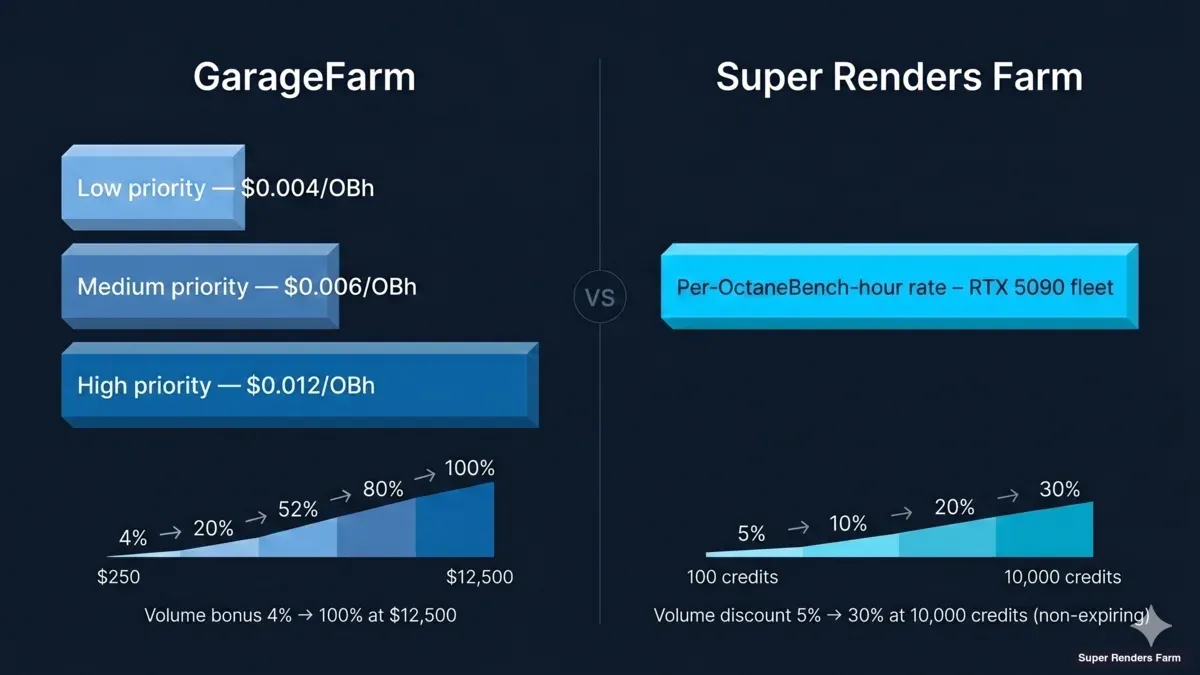 GarageFarm vs RebusFarm vs Super Renders Farm pricing comparison: per-OctaneBench-hour tiers and volume-bonus structure
GPU Hardware: Fleet Generation and VRAM
GPU hardware is one of the most visible differences between the three services, and it is the dimension where SKU disclosure matters most for users who care about VRAM footprint, OptiX feature support, or driver-dependent renderer behavior.
GarageFarm: workstation and datacenter cards
GarageFarm's confirmed GPU fleet runs on workstation and datacenter-class NVIDIA cards — RTX 4000 Ada (20 GB VRAM), RTX A5000 (24 GB), L40S (48 GB), and the RTX 6000 Pro Blackwell (96 GB) deployed in Q1 2026 as the current flagship tier. The 96 GB headroom on the RTX 6000 Pro is meaningful for very heavy archviz scenes with 16K textures, dense Mograph caches, or large volumetric simulations where consumer-class 24–32 GB VRAM would force out-of-core fallbacks. The trade-off: GarageFarm's pricing page abstracts these SKUs behind tier names (Low / Medium / High) and a VRAM band (48 GB on Low, 96 GB on Medium and High) rather than disclosing specific card models per tier.
RebusFarm: aggregate claim without per-tier SKU disclosure
RebusFarm publishes an aggregate fleet claim — 92,360 GHz across 465,664 CPU cores, 81,921 OctaneBench aggregate — and references "Nvidia GPU cards with up to 5 GPUs per engine" on /company/about-us without disclosing specific SKUs at the billing tier. A 2022 news post on RebusFarm's blog mentions the RTX 4090 as marketing commentary, but the post does not confirm RTX 4090 cards in the production fleet. The CPU side is specific (250 AMD Threadripper 3970X machines plus 64-core CPU machines); the GPU side is generic. Users who care about matching VRAM to scene requirements will need to file a support ticket for SKU confirmation rather than reading it off the billing tier.
Super Renders Farm: RTX 5090 consumer-flagship
We run a GPU fleet of NVIDIA RTX 5090 cards with 32 GB VRAM each. The 5090 is the current consumer-flagship card for GPU rendering — on Octane, Redshift, and Cycles workloads where the renderer scales linearly with GPU compute and per-frame scenes fit comfortably in 32 GB, the 5090's per-card throughput leads the per-dollar-performance leaderboard for typical archviz, motion design, and indie production scenes. For the small minority of jobs that need more than 32 GB per frame, our fleet hits a ceiling that GarageFarm's 96 GB RTX 6000 Pro tier does not.
On OctaneBench 2025.2.1, the RTX 5090 scores 1,731 OB, the score our own cost calculator uses; the RTX A5000 typically lands around 480 OB and the RTX 6000 Pro Blackwell scores meaningfully higher than the 5090 on raw OB but at a different cost-per-OB ratio because of its workstation-class pricing. RebusFarm's unspecified GPU pool cannot be benchmarked card-by-card without per-SKU disclosure. The practical takeaway: on Cycles, Redshift, Octane, and V-Ray GPU at typical 4K archviz VRAM footprints, the RTX 5090 is the per-dollar-performance leader; on 96 GB-bound flagship jobs, the RTX 6000 Pro is the only confirmed option of the three.
Card disclosure: who publishes what
We publish the specific card in our GPU fleet on the pricing and GPU pages: the NVIDIA RTX 5090 with 32 GB VRAM. GarageFarm's /gpu-render-farm page describes the fleet in tier-name plus VRAM-band format without specifying SKUs. RebusFarm publishes an aggregate "up to 5 GPUs per engine" claim without disclosing specific cards. For most scenes the disclosure delta is not a practical blocker, but for users who care about OptiX feature support, driver-dependent renderer features, or scenes that sit at the VRAM edge, the difference matters.
Workflow: Three Different Submitter Pipelines
All three services are fully managed — none asks you to RDP into a rented machine or install render engines yourself. The differences are in the submitter applications and how scene validation is handled.
GarageFarm's submission pipeline centers on renderBeamer, a proprietary submitter app with plugins for Blender, Cinema 4D, 3ds Max, Maya, Modo, Rhino, SketchUp, LightWave, Terragen, and Vue. The app does auto-asset-collect from inside the DCC and uploads via a checksum delta-upload that avoids re-uploading unchanged assets. The 2026 beta refresh added Dark Mode, faster job cloning, Blender still-image strip support, and Maya 2027 compatibility.
RebusFarm's submission pipeline centers on Farminizer, the 2009-launched plugin-submitter. Farminizer ships plugins for 3ds Max, Maya, Cinema 4D, Blender, Softimage XSI, Modo, LightWave, Maxwell, Rhino, SketchUp, and Revit. The app's SmartCheck pre-flight validation catches missing textures and asset path mismatches before render starts; PlainlyVideos cites this as the "best automatic scene checking" of the audited set. After upload, jobs land in the ControlCenter browser portal where users monitor progress, download frames, or use RebusDrop (drag-and-drop project upload).
Our submission pipeline starts in the Render Dashboard — you upload a scene, our operators validate the scene against the target DCC and render engine, check for missing assets, verify plugin versions, configure the render on the appropriate hardware, monitor progress during the job, and flag issues before they waste hours of render time.
Three submitter styles, three target audiences:
- renderBeamer fits if you've already invested in renderBeamer's workflow, your pipeline uses one of the long-tail DCCs (Vue, Terragen, LightWave, Rhino, SketchUp), or you prefer a self-managed submission flow with minimal operator touch.
- Farminizer fits if you've used Farminizer on prior projects, you need broad niche-DCC plugin coverage (Revit, Softimage XSI, LightWave, Modo), or you want pre-flight SmartCheck validation baked into submission.
- Our dashboard + operator validation fits if you would rather have human eyes on the scene before the render starts, your project uses Houdini or After Effects (both of which GarageFarm does not cover natively, and which RebusFarm covers only partially), or your pipeline is built around the mainstream Chaos, Maxon, and Autodesk engines where partner-authorized licensing is already in place.
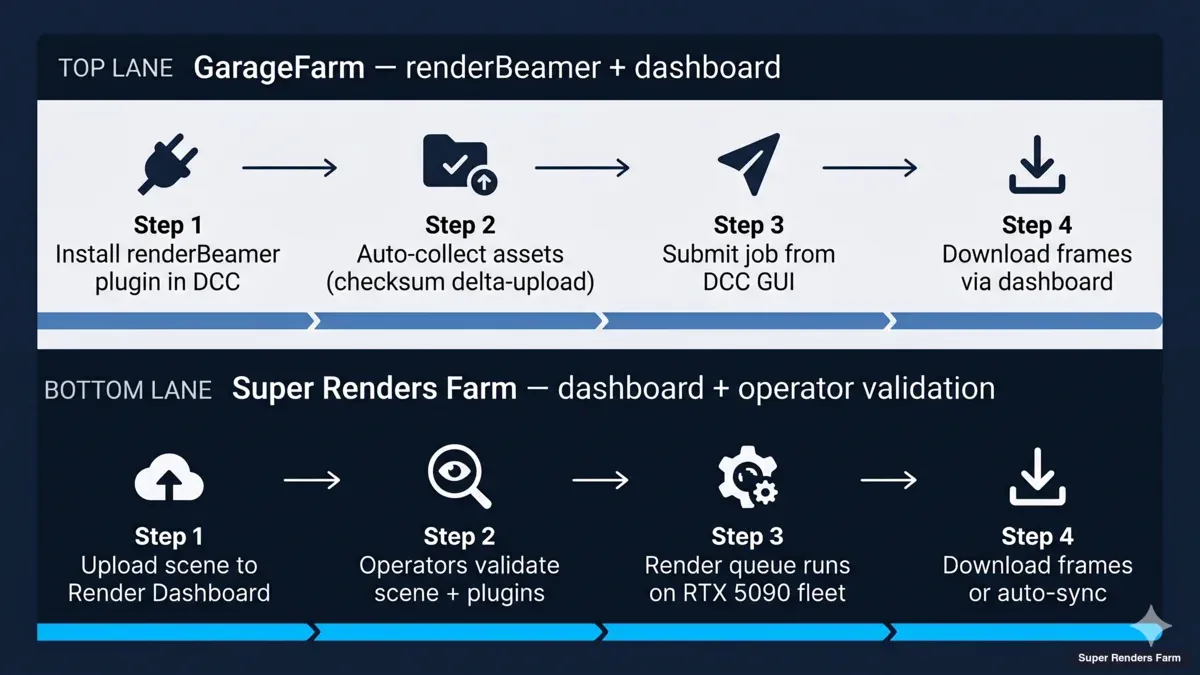 GarageFarm renderBeamer vs RebusFarm Farminizer vs Super Renders Farm dashboard: managed submission workflow steps compared
Supported DCCs and Render Engines
This is where the most material difference between the three services shows up.
GarageFarm publishes a broad 10-DCC supported list — 3ds Max (2013–2023+), Maya (2014–2027), Cinema 4D (R18–2023+), Blender (2.63–3.3+), Modo, LightWave 3D, Rhinoceros 3D, SketchUp Pro/Studio, E-on Vue, and Planetside Terragen. For studios working in niche long-tail DCCs — particularly Vue and Terragen for landscape visualization, or LightWave for legacy pipelines — this is the broadest stack of the three. Houdini and After Effects are not on the primary supported list, and After Effects is explicitly deprecated per /faq.
RebusFarm publishes an 11-DCC supported list — 3ds Max (2013–2025+), Maya (2014–2025), Cinema 4D (R14 through 2025), Blender (2.79b through 5.0.1), Softimage XSI (legacy), Modo, LightWave, Rhinoceros (5–8), SketchUp, Revit, and After Effects (23.0+). The Revit and extreme-legacy XSI coverage is unique to RebusFarm among the three — for studios with an active Softimage pipeline still in production, or that need cloud rendering of Revit BIM workflows, RebusFarm is the only confirmed fit. Houdini is supported only as a workaround — standalone scene export works for Mantra-CPU and Karma-CPU engines, but no native Farminizer plugin exists for Houdini, no Karma XPU is available, and no Arnold for Houdini is supported per third-party audits.
Super Renders Farm's supported list is narrower but covers the two production tools the EU farms do not fully cover: Houdini (native, with full sim cache handoff) and After Effects (native, with eight plugin packs provisioned on request). Houdini support runs on Karma XPU, Mantra, and Redshift, with V-Ray for Houdini, Arnold for Houdini, and Octane for Houdini provisioned on request — documented on the Houdini cloud render farm page. After Effects support runs on AE 2024–2026, with Element 3D, Trapcode Suite, Red Giant Universe, Optical Flares, Sapphire, Magic Bullet Suite, Stardust, and Plexus provisioned on request — documented on the After Effects cloud render farm setup guide.
On the render engine side, all three cover the major engines: V-Ray, Corona, Redshift, Arnold (Maya variant), Cycles, EEVEE. GarageFarm adds ProRender, Mental Ray, FStorm, and LuxCoreRender. RebusFarm adds Maxwell Render standalone, Mental Ray, the Cinema 4D Advanced and Physical Renderers, Cycles4D, LuxCoreRender, and FurryBall. We cover V-Ray, Corona, Arnold, Redshift, Octane, and Cycles with included licenses. The notable deltas: GarageFarm covers FStorm; RebusFarm covers Maxwell standalone and Cycles4D; we cover Karma XPU natively and provision Arnold for Houdini on request (which neither EU farm currently does).
Geographic Footprint and Latency
GarageFarm renders through a single ISO 27001-certified Polish datacenter operated by Copernicus Computing in Toruń, with a Korea support hub for Asia-Pacific. For EU-based studios — particularly archviz studios in Germany, France, Italy, and the Nordics — the published Polish datacenter location keeps upload-and-download round-trip times short for EU traffic; we don't publish our datacenter locations. The Korea office is the only dedicated Asia-Pacific support hub of the three.
RebusFarm renders through a single German datacenter (Cologne / Leverkusen vicinity; the specific colocation provider is not publicly disclosed). The datacenter is powered by Naturenergie AG hydropower, which RebusFarm positions on /company/about-us as a sustainability differentiator — neither of the other two vendors compared here currently publishes an equivalent renewable-energy sourcing claim. The German legal entity (RebusFarm GmbH) plus German rendering infrastructure is the strongest combination for studios that need both the contract counterparty and the rendering hardware inside the EU under German law. RebusFarm does not have a dedicated Asia-Pacific support hub.
We are headquartered in Santa Ana, California, with a global remote workforce and clients across 50+ countries. The Americas + EU client concentration reflects the US headquarters; Asia-Pacific coverage benefits from the team's global support hours.
The honest framing: if your studio sits in Western or Central Europe and most projects are EU-sourced going to EU-based clients, both EU farms are a closer geographic fit than we are. Between the two EU options, GarageFarm has the Korea hub for Asia-Pacific coverage; RebusFarm has the Naturenergie hydropower sourcing claim. For studios in the Americas, our US registration keeps contracts, billing, and support inside a US jurisdiction. For studios planning multi-week or multi-month sustained capacity rather than burst-priced SaaS submissions, our dedicated GPU cluster rental options are designed for exactly that workload profile.
Compliance, Trust Signals, and Independent Verification
Super Renders Farm publishes three software-vendor partnerships on the company About page: Maxon (Cinema 4D, Redshift, Red Giant, Universe — partner verification at maxon.net/en/partners?category=980717), Chaos (V-Ray, Corona, Vantage, Phoenix FD — partner verification at chaos.com/render-farms), and AXYZ design (Anima). Neither GarageFarm nor RebusFarm publicly lists software-vendor partnerships in the same explicit "official partner" framing — both lean on their operating history and submitter-tooling legacy rather than partner-authorized licensing.
GarageFarm's infrastructure provider (Copernicus Computing) publishes formal ISO 27001 certification on the Polish datacenter — the most explicit compliance signal of the three. RebusFarm states ISO 27001 certification on its homepage marketing copy; the specific certifying body and audit date are not publicly disclosed on its /legal-notice Impressum, and we were not able to locate a third-party certifier registry listing during research. The neutral framing: RebusFarm publishes the ISO 27001 claim, and the supporting documentation is not currently publicly disclosed — studios that need formal verification should request the audit certificate PDF directly from RebusFarm before committing. We do not currently publish formal ISO 27001, SOC 2, or TPN accreditation; for compliance-driven productions, request a custom NDA through /render-farm-nda before committing.
RebusFarm publishes a Naturenergie AG hydropower sourcing claim on /company/about-us. Neither GarageFarm nor Super Renders Farm currently publishes an equivalent renewable-energy sourcing claim. For studios with ESG procurement requirements on render infrastructure, RebusFarm is the only currently confirmed fit of the three.
All three services have third-party review platform presence. Super Renders Farm is published on SaaSHub (4.9 stars, 76 reviews), Capterra, Software Advice, GetApp, G2, Crunchbase, and Wikidata (Q139378935). GarageFarm has profiles on G2, SaaSHub, AlternativeTo, SourceForge, Slashdot, and Trustpilot. RebusFarm has profiles on Trustpilot (19 reviews), reviews.io (209 reviews), SourceForge, Slashdot, SaaSHub, Tracxn, and Crunchbase; no G2 or Capterra profile surfaced as of May 2026.
For studios doing due diligence before a large commitment, all three have public legal-entity records: GarageFarm at UK Companies House #07278832 (incorporated 2010-06-09); RebusFarm at Amtsgericht Köln HRB 70387 (formal incorporation 2010-10-04, sole Geschäftsführer Ralph Huchtemann); Super Renders Farm at Santa Ana, California (Wikidata Q139378935).
Frequently Asked Questions
Q: Are GarageFarm, RebusFarm, and Super Renders Farm all fully managed render farms?
A: Yes — all three are fully managed. None asks you to Remote Desktop into a rented machine or manage software licenses manually. You submit a scene through the submitter (renderBeamer for GarageFarm, Farminizer for RebusFarm, our web dashboard for Super Renders Farm), and the service handles the render. This puts all three in a different category from IaaS providers like iRender.
Q: Which of the three has the strongest Houdini support?
A: Super Renders Farm supports Houdini natively with Karma XPU, Mantra, and Redshift, plus sim cache handoff for Pyro, FLIP, Vellum, and PDG; V-Ray for Houdini, Arnold for Houdini, and Octane for Houdini are provisioned on request. GarageFarm does not list Houdini as a primary supported DCC and does not support sim cache handoff. RebusFarm supports Houdini only via standalone workaround — Karma CPU works for some pipelines, but Karma XPU is not available per third-party audit, and Arnold for Houdini is not supported (Arnold for Maya is). If your Houdini pipeline is fully Karma CPU and you don't need sim cache handoff, RebusFarm's standalone export may work for your scene profile.
Q: Does GarageFarm or RebusFarm support After Effects rendering?
A: GarageFarm's /faq notes that After Effects support has been deprecated as of May 2026. RebusFarm continues to support AE 23.0+ with the HeliumX plugin set. We support After Effects natively, with Element 3D, Trapcode, Red Giant Universe, Optical Flares, Sapphire, Magic Bullet, Stardust, and Plexus provisioned on request. For motion-graphics pipelines that combine 3D rendering with AE compositing, RebusFarm and Super Renders Farm are both fits; GarageFarm is not.
Q: How do the three GPU fleets compare in 2026?
A: GarageFarm's confirmed GPU fleet includes RTX 4000 Ada (20 GB), RTX A5000 (24 GB), L40S (48 GB), and the workstation-flagship RTX 6000 Pro Blackwell (96 GB), abstracted behind tier names rather than per-tier SKU disclosure. RebusFarm publishes an aggregate "up to 5 GPUs per engine" claim without disclosing specific SKUs. We run a fleet of consumer-flagship RTX 5090 cards (32 GB VRAM each) with the specific card disclosed. For typical 4K archviz, motion design, and indie production scenes within 32 GB VRAM, the RTX 5090 leads on per-dollar performance for Cycles, Redshift, and Octane. For scenes that need more than 32 GB per frame, the RTX 6000 Pro Blackwell on GarageFarm is the only confirmed option of the three.
Q: Which farm offers the largest free trial credit?
A: RebusFarm's 25 RenderPoints trial works out to roughly $29.38 USD — the largest of the three. GarageFarm and Super Renders Farm both offer $25 in free trial credits. GarageFarm's trial caps usage at 10 nodes and 30 jobs during the trial period. Our $25 trial credit applies to new accounts and does not expire under normal use.
Q: Does any of the three publish ISO 27001 or SOC 2 compliance certification?
A: GarageFarm renders through Copernicus Computing's ISO 27001-certified Polish datacenter — the most explicit compliance signal of the three. RebusFarm states ISO 27001 on its homepage; the certifying body and audit date are not publicly disclosed on its legal notice. We do not currently publish formal ISO 27001, SOC 2, or TPN accreditation. For compliance-driven productions, request a custom NDA through the relevant farm's process before committing.
Q: What is the volume discount structure on each service?
A: GarageFarm scales from 2% at $250 prepay to 50% at $12,500 — reaching its cap at the lowest prepay floor of the three. RebusFarm scales from 5% at 500 RenderPoints (~$590) to 60% at 50,000 RP (~$59,000) — the deepest percentage cap, but at a far larger commitment. Our volume discounts scale from 5% at 100 credits to 30% at 10,000 credits, with credits that never expire under normal use. GarageFarm's 50% bonus rewards upfront commitment at the lowest floor; our non-expiring credits avoid the lock-in question entirely.
Q: Where are the datacenters for each service?
A: GarageFarm renders through a single Polish datacenter (Toruń, ISO 27001 via Copernicus Computing). RebusFarm renders through a single German datacenter (Cologne / Leverkusen vicinity) powered by Naturenergie AG hydropower. We don't publish our datacenter locations; the company is US-registered and headquartered in Santa Ana, California. For EU-based studios, both EU farms are geographically closer; for Americas-based studios, our US registration keeps contracts, billing, and support in a US jurisdiction. GarageFarm's Korea support hub is the only dedicated Asia-Pacific regional office of the three.
About This Comparison's Scope
This article focuses specifically on GarageFarm, RebusFarm, and Super Renders Farm — three managed render farms that share enough operational overlap (fully managed model, normalized-unit pricing, mainstream DCC coverage) to make a like-for-like comparison meaningful for studios evaluating these specific vendors.
Other established peer farms operate in adjacent territory but with materially different positioning that benefits from dedicated analysis rather than inclusion here:
-
Ranch Computing (Paris, France) — French SAS founded 2006, Karma XPU full support, EUR-only billing, Blender Foundation corporate member, sustainability-certified. Closer comparison fit for EU studios prioritizing French legal jurisdiction or Karma XPU production.
-
iRender (Hanoi, Vietnam) — IaaS model (remote desktop into rented GPU instances, not fully managed submission), which makes per-frame normalized billing comparison non-equivalent. Stronger fit for technical users comfortable with self-managed Windows VM workflows.
-
Fox Renderfarm (Shenzhen, China) — Larger Asia-Pacific operation with significant educational content footprint but different commercial pricing structure and partnership disclosure pattern.
-
For how RebusFarm, GarageFarm, and Fox Renderfarm compare directly against each other, see our RebusFarm vs GarageFarm vs Fox Renderfarm comparison.
-
Drop & Render (Dordrecht, Netherlands) — Cinema 4D + Houdini specialist (SideFX official partner), narrower DCC stack (no Maya, 3ds Max, or After Effects) which makes inclusion in a generalist 3-way table misleading.
For comparisons that include these vendors, see our broader render farm pricing models guide and the upcoming /article/render-farm-comparison-2026-complete (publishing W23) which covers all eight major managed render farms on a single transparent methodology.
About Alice Harper
Blender and V-Ray specialist. Passionate about optimizing render workflows, sharing tips, and educating the 3D community to achieve photorealistic results faster.