GarageFarm vs Super Renders Farm: A 2026 Side-by-Side Comparison
Overview
Introduction
If you're pricing a fully managed render farm for a 2026 production — V-Ray archviz on Cinema 4D, Redshift motion design, Cycles on Blender, or a CPU-heavy Corona animation — GarageFarm and Super Renders Farm are two of the names that come up most often. Both are managed services with open pricing, both bill in normalized units (GHz-hour for CPU, OctaneBench-hour for GPU) rather than per-machine-hour, and both target the same core audience of freelancers and small-to-mid studios who'd rather submit a scene than maintain a remote workstation.
GarageFarm has been operating since 2010 as a UK-registered company with a Polish ISO 27001 datacenter and a Korea-based customer service hub. Super Renders Farm has been operating since 2010 as a team, with the legal entity incorporated in 2017 and headquartered in Santa Ana, California. The two services solve the same managed-rendering problem in slightly different ways — different DCC coverage, different GPU fleet composition, different geographic footprints, different volume incentives. Neither is universally better; the right fit depends on what you're rendering and where your studio sits.
Everything in this comparison is sourced from each company's public pricing and documentation pages as of May 2026. Pricing tiers and hardware fleets can change between releases, so check the live pages before committing to a project. For broader context on how cloud farm billing works, our render farm pricing models guide covers the main billing units and why two farms can quote different numbers for the same job.
Quick Answer: Which Fits Your Use Case?
The deep dive below covers pricing, hardware, DCC coverage, and workflow in full. If you want the short version first, the table below maps common production profiles to the service that usually fits better. Two rows are explicit ties — neither service has a clear edge — and Row 6 is an honest call-out where GarageFarm has a real published compliance advantage that Super Renders Farm doesn't currently match.
| Your situation | GarageFarm is the better fit if... | Super Renders Farm is the better fit if... |
|---|---|---|
| Archviz studio (V-Ray / Corona) | You need niche long-tail DCC coverage like Vue or Terragen in the same job, or you want EU-region proximity to the rendering hardware. | You want partner-authorized Chaos licensing on the V-Ray and Corona engines, RTX 5090 32 GB VRAM headroom on 8K-texture scenes, and a CPU-first fleet for Corona animations. |
| Game cinematics studio | Your pipeline is built around standalone Redshift, V-Ray, or Cycles batches with no real-time engine integration. | You need native Houdini rendering with Karma, Mantra, or Redshift (V-Ray and Arnold for Houdini provisioned on request), and you want operators handling the simulation handoff. See Houdini cloud render farm. |
| VFX studio (Houdini simulation) | Tied / skip — GarageFarm doesn't list Houdini as a primary supported DCC and doesn't support Pyro / FLIP / Vellum / PDG sim cache handoff. | You need native Houdini with Mantra, Karma XPU, or Redshift (V-Ray for Houdini and Octane for Houdini provisioned on request), plus operator-managed sim cache handoff. |
| Cinema 4D motion design | You're a long-time renderBeamer user, you want EU-region datacenter proximity, or you need the steep volume prepay bonus on a multi-project commitment. | You want Maxon-partner authorized Cinema 4D + Redshift licensing, an RTX 5090 32 GB fleet for heavy Mograph + volumetrics, and a Red Giant / Universe plugin chain provisioned on request and validated by operators. |
| Indie or single artist (Blender) | You want the slightly larger $25 free trial credit, niche DCC coverage (Vue, Terragen, LightWave, Modo, Rhino, SketchUp), or you're prioritizing the EU datacenter location. | You want included Redshift / Octane / V-Ray licenses, $25 in non-expiring trial credits, native Houdini and After Effects coverage, and CPU-heavy Corona or V-Ray support without a license bring-your-own step. |
| Enterprise / compliance-driven (named ISO 27001 / SOC 2 / TPN) | You need a render farm whose infrastructure provider publishes formal ISO 27001 certification — GarageFarm renders through Copernicus Computing's certified Polish datacenter. | Honest call — Super Renders Farm doesn't currently publish formal ISO 27001 / SOC 2 / TPN accreditation. Request a custom NDA and security review before committing on compliance-driven work. The /render-farm-nda page is the starting point. |
The rest of the article unpacks the reasoning behind each row — pricing math, hardware deltas, DCC coverage, geographic trade-offs, and trust signals — so you can sanity-check the recommendation against your own scene profile.
At-a-Glance Comparison
| Dimension | GarageFarm | Super Renders Farm |
|---|---|---|
| Operating since | 2010 (UK Companies House #07278832, incorporated 2010-06-09) | 2010 (team), 2017 (legal entity) |
| Legal / trading entity | GARAGEFARM.NET LTD, UK private limited company | Super Renders Farm, Santa Ana, California, USA |
| Headquarters | UK-registered office (West Sussex) + Polish datacenter via Copernicus Computing (Toruń) + Korea support hub | Santa Ana, California, USA |
| Service model | Fully managed render farm (scene submission via renderBeamer or web dashboard) | Fully managed render farm (scene submission via dashboard or client app) |
| Submitter app | renderBeamer (auto-asset-collect, checksum delta-upload, plugins for major DCCs) | Web dashboard + client app with auto-download |
| CPU billing | $0.024 / $0.036 / $0.072 per GHz-hour (Low / Medium / High priority) | $0.004 per GHz-hour on dedicated CPU fleet (20,000+ Xeon cores) |
| GPU billing | $0.004 / $0.006 / $0.012 per OctaneBench-hour (Low / Medium / High priority) | Per-OctaneBench-hour billing on RTX 5090 fleet (32 GB VRAM) |
| GPU fleet (confirmed SKUs) | RTX 4000 Ada (20 GB), RTX A5000 (24 GB), L40S (48 GB), RTX 6000 Pro Blackwell (96 GB) | RTX 5090 (32 GB VRAM) consumer-flagship class |
| Free signup credit | $25 (no credit card required; capped at 10 nodes / 30 jobs during trial) | $25 in non-expiring trial credits |
| Volume / prepay bonuses | 2% at $250 → 50% at $12,500 graduated top-up bonus | 5% at 100 credits → 30% at 10,000 credits, credits never expire |
| Render engine licenses | User-installed in some cases; engine support varies (V-Ray, Corona, Redshift, Arnold, ProRender, Cycles, Mental Ray, EEVEE, FStorm, LuxCoreRender) | V-Ray, Corona, Arnold, Redshift, Octane, Cycles licenses included |
| Supported DCCs | 3ds Max, Maya (through 2027), Cinema 4D, Blender, Modo, LightWave, Rhinoceros, SketchUp, Vue, Terragen | 3ds Max, Maya, Cinema 4D, Blender, Houdini, After Effects, NukeX |
| Houdini support | Standalone workaround only — no native submitter, no Mantra / Karma, no Pyro / FLIP / Vellum / PDG sim cache | Native Houdini with Karma XPU, Mantra, and Redshift; V-Ray, Arnold, and Octane for Houdini provisioned on request |
| After Effects support | Deprecated per garagefarm.net/faq | Native After Effects; 8 plugin packs provisioned on request (Element 3D, Trapcode, Red Giant Universe, Optical Flares, Sapphire, Magic Bullet, Stardust, Plexus) |
| Datacenter location | Single Polish datacenter (Toruń, ISO 27001 via Copernicus Computing) | Not published; US-registered company (HQ Santa Ana, CA) |
| Published partnerships | None publicly listed on the supported-apps or homepage | Chaos (V-Ray / Corona), Maxon (Cinema 4D / Redshift / Red Giant), AXYZ design (Anima) |
| Failed-frame refund | Discretionary; not guaranteed in all cases | Handled via support on a per-job basis |
| Support channels | 24/7 live chat + phone (+82 10 9511 8937, Korea office) + email | Live chat + email (proactive monitoring during active jobs) |
| Primary client regions | EU + Asia-Pacific (Korea support hub), with global remote footprint | Americas + EU concentration, global reach |
Two caveats worth flagging before the deep dive.
First, both services are fully managed render farms, not IaaS providers. Neither requires Remote Desktop access, neither asks you to install software on a rented machine, and neither bills per-machine-hour. That makes this comparison closer in shape than a managed-vs-IaaS comparison like our iRender vs Super Renders Farm piece — the trade-offs here are about DCC coverage, GPU fleet generation, geographic proximity, and incentive structure rather than workflow model.
Second, GarageFarm's GPU fleet skews datacenter-class (RTX 4000 Ada, RTX A5000, L40S, RTX 6000 Pro Blackwell), while Super Renders Farm's GPU fleet runs RTX 5090 consumer-flagship cards. The two fleets have different cost-per-performance shapes on different renderers, and we unpack the math in the GPU Hardware section below.
Pricing Deep Dive
This is the section most readers skim straight to. We'll be precise about what each rate covers, since that's where the real cost difference shows up.
GarageFarm: tier-based per-OctaneBench-hour and per-GHz-hour rates
GarageFarm's pricing is structured around three priority tiers per resource type. CPU rendering bills at $0.024 (Low priority, queue-tolerant, up to 100 nodes), $0.036 (Medium, the default), or $0.072 (High priority, front-of-queue, up to 300 nodes) per GHz-hour. GPU rendering bills at $0.004 (Low, up to 15 nodes), $0.006 (Medium, up to 30 nodes), or $0.012 (High, up to 60 nodes) per OctaneBench-hour. The same renderer-agnostic rate applies regardless of whether you're running V-Ray, Corona, Redshift, Cycles, or Arnold — engine choice doesn't change the price per normalized unit.
On top of the base rates, GarageFarm offers a graduated top-up bonus that scales from 2% at $250 prepay to 50% at $12,500 (as of August 2026). Combined with the $25 free trial credit (no credit card required), the on-ramp is competitive for new accounts willing to commit to a larger initial top-up.
Super Renders Farm: per-GHz-hour and per-OctaneBench-hour rates
Super Renders Farm uses a similar normalized-unit model. CPU rendering bills at $0.004 per GHz-hour on a dedicated CPU fleet of 20,000+ Xeon cores — the bread-and-butter side of the service, since roughly 70% of jobs are CPU (V-Ray, Corona, and Arnold on archviz and animation). GPU rendering bills per OctaneBench-hour on the RTX 5090 fleet, with all render engine licenses (V-Ray, Corona, Arnold, Redshift, Octane, Cycles) included in the rate. Credits are purchased at 1 credit = $1 USD, never expire, and volume discounts scale from 5% at 100 credits to 30% at 10,000 credits. The $25 trial credit applies to new accounts and doesn't expire under normal use.
Which model is cheaper?
The honest answer: it depends on tier choice, prepay commitment, and what you're rendering. On a single OctaneBench-hour of GPU at Medium priority, GarageFarm's $0.006 rate and Super Renders Farm's rates are close enough that the per-OBh sticker is rarely the deciding factor. The bigger lever is volume bonus depth — GarageFarm tops out at 50% at $12,500 prepay (adding half again to your render budget if you can commit upfront), while Super Renders Farm caps at 30% at 10,000 credits but keeps credits non-expiring without a lock-in commitment.
For studios with predictable monthly burn, GarageFarm's 50% prepay bonus at $12,500 is the more aggressive offer in absolute terms. For freelancers and indie artists who'd rather avoid a lump-sum commitment, Super Renders Farm's never-expire credits and 30% top tier without a $12,500 prepay floor is the lower-friction option. Both serve real use cases — they just structure the incentive differently.
What's included vs unbundled
Worth verifying on either farm before budgeting:
| Cost factor | GarageFarm | Super Renders Farm |
|---|---|---|
| Render engine licenses (V-Ray, Corona, Redshift, Arnold) | Engine support varies; check supported-engines list | V-Ray, Corona, Arnold, Redshift, Octane, Cycles included |
| Houdini-specific renderers (Karma, Mantra) | Not supported | Karma XPU and Mantra both supported natively |
| After Effects rendering | Deprecated per /faq | Native AE; 8 plugin packs provisioned on request |
| RAM beyond baseline | 120 GB (Low CPU tier) / 240 GB (Medium and High) | 96–256 GB per node, depending on workload |
| Storage egress / download | Included | Included |
| Failed-frame refund | Discretionary | Per-job handling via support |
| Priority surcharge | Built into Low / Medium / High tier rate | Per-job priority handling |
A concrete 500-frame example (May 2026 snapshot)
To put the pricing into a real number, third-party benchmark data from Drop & Render's 2026 pricing-compared post (500-frame Karma animation, 5-minute-per-frame target on a 1× RTX 4090 normalization rig) places GarageFarm at $270 for the full 500-frame batch, sitting third of the five farms benchmarked — about 29% more than Drop & Render's own $209 figure and roughly half the cost of Rebus Farm's $535 quote (our RebusFarm vs GarageFarm vs Fox Renderfarm comparison breaks down all three farms side by side). Super Renders Farm doesn't publish a direct comparable in that exact benchmark, but the per-OBh and per-GHz-hour math is in the same band depending on render engine and tier choice. The two takeaways: GarageFarm sits in the middle of the published price range, and the headline rate per OBh isn't a reliable predictor of total cost without running your own scene through both calculators. Numbers above are a category-level reference; the live /cost-calculator on each site is the source of truth for your scene.
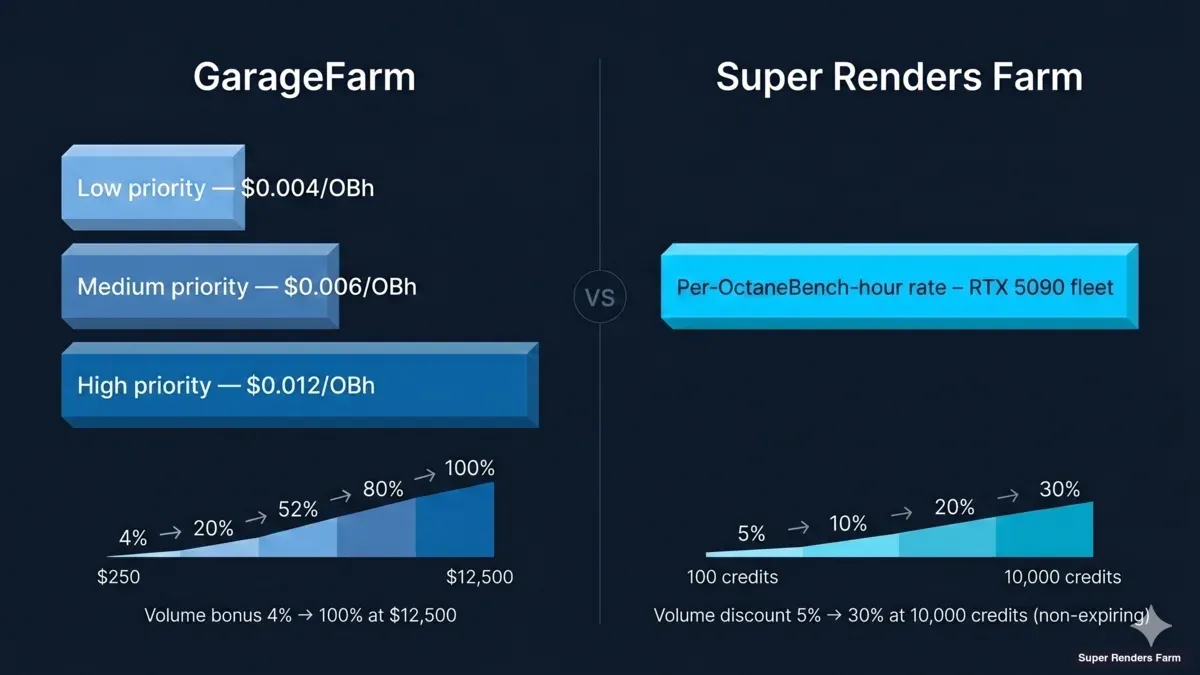 GarageFarm vs Super Renders Farm pricing comparison: per-OctaneBench-hour tiers and volume-bonus structure
GPU Hardware: Fleet Generation and VRAM
GPU hardware is one of the most visible differences between the two services.
GarageFarm's GPU fleet: workstation and datacenter cards
GarageFarm's confirmed GPU fleet runs on workstation and datacenter-class NVIDIA cards — RTX 4000 Ada (20 GB VRAM), RTX A5000 (24 GB), L40S (48 GB), and the RTX 6000 Pro Blackwell (96 GB) deployed in Q1 2026 as the current flagship tier. The 96 GB headroom on the RTX 6000 Pro is meaningful for very heavy archviz scenes with 16K textures, dense Mograph caches, or large volumetric simulations where consumer-class 24–32 GB VRAM would force out-of-core fallbacks. The trade-off: GarageFarm's pricing page abstracts these SKUs behind the Low / Medium / High tier names and a VRAM band (48 GB on Low, 96 GB on Medium and High) rather than disclosing specific card models per tier.
Super Renders Farm's GPU fleet: RTX 5090 consumer-flagship
Super Renders Farm runs a GPU fleet of NVIDIA RTX 5090 cards with 32 GB VRAM each. The 5090 is the current consumer-flagship card for GPU rendering — on Octane, Redshift, and Cycles workloads where the renderer scales linearly with GPU compute and where per-frame scenes fit comfortably in 32 GB, the 5090's per-card throughput leads the per-dollar-performance leaderboard for typical archviz, motion design, and indie production scenes. For the small minority of jobs that need more than 32 GB per frame (some 16K archviz interiors with displacement-heavy assets, very dense Houdini sim caches, or layered AOV stacks at 4K with heavy depth-of-field passes), the GPU fleet hits a ceiling that GarageFarm's 96 GB RTX 6000 Pro tier doesn't.
Per-card benchmark snapshot (May 2026, driver-dependent)
On OctaneBench testing, the RTX 5090 lands at approximately 1,050–1,100 OB depending on driver and scene; the RTX A5000 typically lands around 480 OB and the RTX 6000 Pro Blackwell scores meaningfully higher than the 5090 on raw OB but at a different cost-per-OB ratio because of its workstation-class pricing. The RTX 4000 Ada and L40S sit between the A5000 and the 5090 on Octane workloads. The practical takeaway: on Cycles, Redshift, Octane, and V-Ray GPU at typical 4K archviz and motion design VRAM footprints, the RTX 5090 is the per-dollar-performance leader; on 96 GB-bound flagship jobs (16K textures, very dense sim caches), the RTX 6000 Pro is the only option of the two. Per-card OctaneBench scores fluctuate ±3–5% across driver releases, so treat these as a category-level reference rather than a fixed throughput contract.
Card disclosure: who publishes what
Worth noting because it affects how scene-fit decisions are made before submission: Super Renders Farm publishes the specific RTX cards in its fleet on the pricing and GPU pages, which lets users match VRAM to scene requirements before submitting. GarageFarm's /gpu-render-farm page describes the fleet as "hundreds of NVIDIA RTX and AMD Epyc nodes" without specifying RTX SKUs at the billing tier — users see the tier name (Low / Medium / High) and a VRAM band, not the exact card. For most scenes this isn't a practical blocker, but for users who care about OptiX feature support, specific driver-dependent renderer features, or VRAM-edge scenes, the disclosure delta matters.
Workflow: Managed Submitter Differences
Both services are fully managed — neither asks you to RDP into a rented machine or install render engines yourself. The differences are in the submitter applications, the asset-collect step, and how scene validation is handled.
GarageFarm: renderBeamer + web dashboard
GarageFarm's submission pipeline is centered on renderBeamer, a proprietary submitter app with plugins for Blender, Cinema 4D, 3ds Max, Maya, Modo, Rhino, SketchUp, LightWave, Terragen, and Vue. The app does auto-asset-collect from inside the DCC — analyzing the project, gathering linked files, and uploading them via a checksum delta-upload that avoids re-uploading unchanged assets between job submissions. The 2026 beta refresh added Dark Mode, faster job cloning, Blender still-image strip support, and Maya 2027 compatibility. After upload, the job runs on GarageFarm's render queue and frames download back through renderBeamer or the web dashboard.
Super Renders Farm: dashboard submit + operator validation
Super Renders Farm's submission pipeline starts in the Render Dashboard — you upload a scene, our operators validate the scene against the target DCC and render engine, check for missing assets, verify plugin versions, configure the render on the appropriate hardware, monitor progress during the job, and flag issues before they waste hours of render time. For Cinema 4D + Redshift, Maya + Arnold, 3ds Max + V-Ray, Blender + Cycles, Houdini + Karma, and After Effects + AE plugins, the operator validation step catches the same class of common failures we see across managed-rendering work — missing Forest Pack textures, wrong V-Ray version mismatches, scenes built in a newer service pack than the target worker, render-element naming collisions.
Which submitter style fits which team
Both submitter styles work well for their target audience, but they suit different team profiles.
- Choose GarageFarm's renderBeamer if you've already invested in renderBeamer's workflow on prior projects, your pipeline uses one of the long-tail DCCs (Vue, Terragen, LightWave, Rhino, SketchUp), or you prefer a self-managed submission flow with minimal operator touch.
- Choose Super Renders Farm's dashboard + operator validation if you'd rather have human eyes on the scene before the render starts, your project uses Houdini or After Effects (neither of which GarageFarm covers natively), or your pipeline is built around the mainstream Chaos and Maxon engines where partner-authorized licensing is already in place.
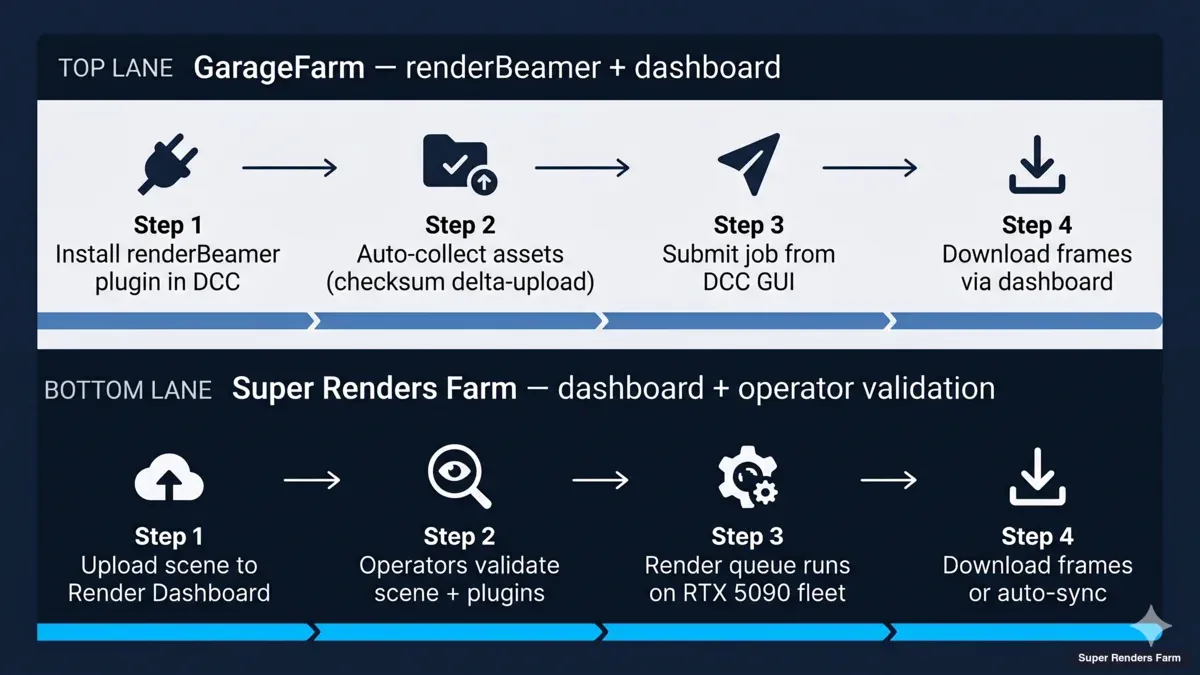 GarageFarm renderBeamer vs Super Renders Farm dashboard: managed submission workflow steps compared
Supported DCCs and Render Engines
This is where the most material difference between the two services shows up.
GarageFarm publishes a broad 10-DCC supported list — 3ds Max (2013–2023+), Maya (2014–2027 per the Jan–Apr 2026 software updates blog), Cinema 4D (R18–2023+), Blender (2.63–3.3+), Modo (801–16+), LightWave 3D (11.6–2020+), Rhinoceros 3D (5 SR13–7+), SketchUp Pro/Studio (2017–2021+), E-on Vue (2015.2+), and Planetside Terragen (2.5–4.0+). For studios working in niche long-tail DCCs — particularly Vue and Terragen for landscape visualization, or LightWave for legacy pipelines — this is the broader stack of the two services.
Super Renders Farm's supported list is narrower but covers the two production tools GarageFarm doesn't: Houdini and After Effects. Houdini support is native, with Karma XPU, Mantra, and Redshift available on the Houdini cloud render farm page, and V-Ray for Houdini, Arnold for Houdini, and Octane for Houdini provisioned on request. After Effects support is native, and eight third-party plugin packs are provisioned on request (Element 3D, Trapcode Suite, Red Giant Universe, Optical Flares, Sapphire, Magic Bullet Suite, Stardust, Plexus). The After Effects cloud render farm setup guide covers the AE submission workflow. GarageFarm's /faq notes that After Effects support has been deprecated, and the supported-apps list doesn't include Houdini as a primary supported DCC — workarounds exist for standalone Redshift or V-Ray scene files exported from Houdini, but the sim cache pipeline (Pyro, FLIP, Vellum, PDG) isn't supported.
On the render engine side, both services cover the major engines: V-Ray (3.4–6+ on GarageFarm), Corona (1.2–8+ on 3ds Max and 0.6–8+ on Cinema 4D), Redshift, Arnold, ProRender, Cycles, Mental Ray (legacy), EEVEE, FStorm, and LuxCoreRender on GarageFarm; V-Ray, Corona, Arnold, Redshift, Octane, and Cycles on Super Renders Farm. The notable engine deltas: GarageFarm covers FStorm and LuxCoreRender (niche but real for some studios), while Super Renders Farm covers Octane (which GarageFarm doesn't, despite billing in OctaneBench-hours) and the Houdini-specific renderers (Karma, Mantra) that GarageFarm doesn't.
Geographic Footprint and Latency
GarageFarm renders through a single ISO 27001-certified Polish datacenter operated by sister-company Copernicus Computing in Toruń, with a customer service hub in Korea handling Asia-Pacific support during local business hours. For EU-based studios — particularly archviz studios in Germany, France, Italy, and the Nordics — the published EU datacenter location keeps upload-and-download round-trip times short for EU traffic; Super Renders Farm doesn't publish its datacenter locations.
Super Renders Farm is headquartered in Santa Ana, California, with a global remote workforce and clients across 50+ countries. The Americas + EU client concentration reflects the US headquarters location, while Asia-Pacific coverage benefits from the team's global support hours. Upload-and-download throughput depends on the customer's local network and the project's total asset size more than on raw geographic distance for most production-scale jobs.
The honest framing: if your studio sits in Western or Central Europe and most of your projects are EU-sourced assets going to EU-based clients, GarageFarm's Polish datacenter is closer. If your studio sits in the Americas or you're working with US-based archviz, motion design, or VFX clients, Super Renders Farm's US registration keeps contracts, billing, and support inside a US jurisdiction. For studios in Asia-Pacific, both services have support coverage, but neither publishes a dedicated Asia-Pacific compute datacenter.
Partnerships and Trust Signals
Published software partnerships
Super Renders Farm publishes three software-vendor partnerships on the company About page and across relevant landing pages: Maxon (Cinema 4D, Redshift, ZBrush, Red Giant, Universe — partner verification at maxon.net/en/partners?category=980717), Chaos (V-Ray, Corona, Vantage, Phoenix FD — partner verification at chaos.com/render-farms), and AXYZ design (Anima crowd / people animation plugin). For studios that value partner-authorized licensing on the major DCC + engine combinations — particularly Cinema 4D + Redshift, Maya + Arnold, 3ds Max + V-Ray, and Corona on either Max or C4D — the explicit partner verification is a trust signal worth checking before commitment.
GarageFarm's supported-apps and homepage do not publicly list software-vendor partnerships in the same explicit "official partner" framing — their positioning is built around DCC breadth and the 16-year operating history rather than partner-authorized licensing.
Review platform aggregation
Both services have third-party review platform presence. Super Renders Farm is published on SaaSHub (4.9★, 76 reviews), Capterra, Software Advice, GetApp (all under Gartner Digital Markets), G2 (2 reviews as of April 2026), and Crunchbase, with a Trustpilot profile claimed. GarageFarm has profiles on G2, SaaSHub, AlternativeTo, SourceForge, Slashdot, and Trustpilot, with broader aggregator-page coverage from the 16-year operating history.
Independent verification
For studios doing due diligence before a large commitment, both services have public legal-entity records — GarageFarm at UK Companies House (#07278832, incorporated 2010-06-09, VAT GB991835769) and Super Renders Farm at the Santa Ana, California postal address with a Wikidata entry (Q139378935) cross-referenced across LinkedIn, Crunchbase, and the published partner verification URLs above. The honest call-out from the Quick Answer table holds here too: GarageFarm's infrastructure provider (Copernicus Computing) publishes formal ISO 27001 certification on the Polish datacenter; Super Renders Farm does not currently publish formal ISO 27001 / SOC 2 / TPN accreditation. For compliance-driven productions, that's a meaningful delta — request a custom NDA via /render-farm-nda if you need to discuss security posture in detail before committing.
Frequently Asked Questions
Q: Are GarageFarm and Super Renders Farm both fully managed render farms?
A: Yes — both services are fully managed. Neither asks you to Remote Desktop into a rented machine, install render engines yourself, or manage software licenses manually. You submit a scene through the submitter app or web dashboard, and the service handles the render. This puts both farms in a different category from IaaS providers like iRender, where the user rents a whole GPU machine and drives the render session over RDP.
Q: Which service has better Houdini support?
A: Super Renders Farm supports Houdini natively with Karma XPU, Mantra, and Redshift, plus V-Ray for Houdini, Arnold for Houdini, and Octane for Houdini provisioned on request, and sim cache handoff for Pyro, FLIP, Vellum, and PDG workflows. GarageFarm's supported-apps page does not list Houdini as a primary supported DCC; a workaround exists for standalone Redshift or V-Ray scene files exported from Houdini, but the sim cache pipeline isn't supported. If your studio is Houdini-heavy, Super Renders Farm is the closer fit.
Q: Does GarageFarm support After Effects rendering?
A: As of May 2026, GarageFarm's /faq notes that After Effects support has been deprecated. Super Renders Farm supports After Effects natively, and eight third-party plugin packs are provisioned on request (Element 3D, Trapcode, Red Giant Universe, Optical Flares, Sapphire, Magic Bullet, Stardust, Plexus); tell the operators which plugins your comp uses and they confirm the setup before the render is dispatched. For motion-graphics pipelines that combine 3D rendering with AE compositing, the AE coverage delta is worth checking before committing.
Q: How do the GPU fleets compare in 2026?
A: GarageFarm's confirmed GPU fleet includes RTX 4000 Ada (20 GB), RTX A5000 (24 GB), L40S (48 GB), and the workstation-flagship RTX 6000 Pro Blackwell (96 GB). Super Renders Farm runs a fleet of consumer-flagship RTX 5090 cards (32 GB VRAM each). For typical 4K archviz, motion design, and indie production scenes that fit within 32 GB VRAM, the RTX 5090 leads on per-dollar performance for Cycles, Redshift, and Octane workloads. For scenes that need more than 32 GB per frame (very dense sim caches, 16K-texture archviz interiors), the RTX 6000 Pro Blackwell is the option of the two.
Q: Which farm offers a bigger free trial?
A: Both services offer $25 in free trial credits. GarageFarm's trial caps usage at 10 nodes and 30 jobs during the trial period and doesn't require a credit card to start. Super Renders Farm's $25 trial credit applies to new accounts and doesn't expire under normal use. The structural difference: GarageFarm's trial has node and job caps, while Super Renders Farm's trial credits behave like prepaid balance.
Q: Does either service publish ISO 27001 or SOC 2 compliance certification?
A: GarageFarm renders through Copernicus Computing's ISO 27001-certified Polish datacenter. Super Renders Farm does not currently publish formal ISO 27001 / SOC 2 / TPN accreditation. For compliance-driven productions, request a custom NDA and security review through /render-farm-nda before committing.
Q: What's the volume discount structure on each service?
A: GarageFarm offers a graduated top-up bonus that scales from 2% at $250 prepay to 50% at $12,500 — a prepay incentive for studios willing to commit to a larger upfront balance. Super Renders Farm offers volume discounts scaling from 5% at 100 credits to 30% at 10,000 credits, with credits that never expire under normal use. The trade-off: GarageFarm's 50% bonus rewards larger upfront commitments more aggressively; Super Renders Farm's non-expiring credits avoid the lock-in.
Q: Where are the data centers for each service?
A: GarageFarm renders through a single Polish datacenter (Toruń, operated by sister-company Copernicus Computing). Super Renders Farm doesn't publish its datacenter locations; the company is US-registered and headquartered in Santa Ana, California, USA. For EU-based studios, GarageFarm's datacenter is geographically closer; for Americas-based studios, Super Renders Farm's US registration keeps contracts, billing, and support in a US jurisdiction. Neither service currently publishes a dedicated Asia-Pacific compute datacenter.
About Alice Harper
Blender and V-Ray specialist. Passionate about optimizing render workflows, sharing tips, and educating the 3D community to achieve photorealistic results faster.