Alternatives to Fox Renderfarm in 2026: An Honest Comparison
Overview
Introduction
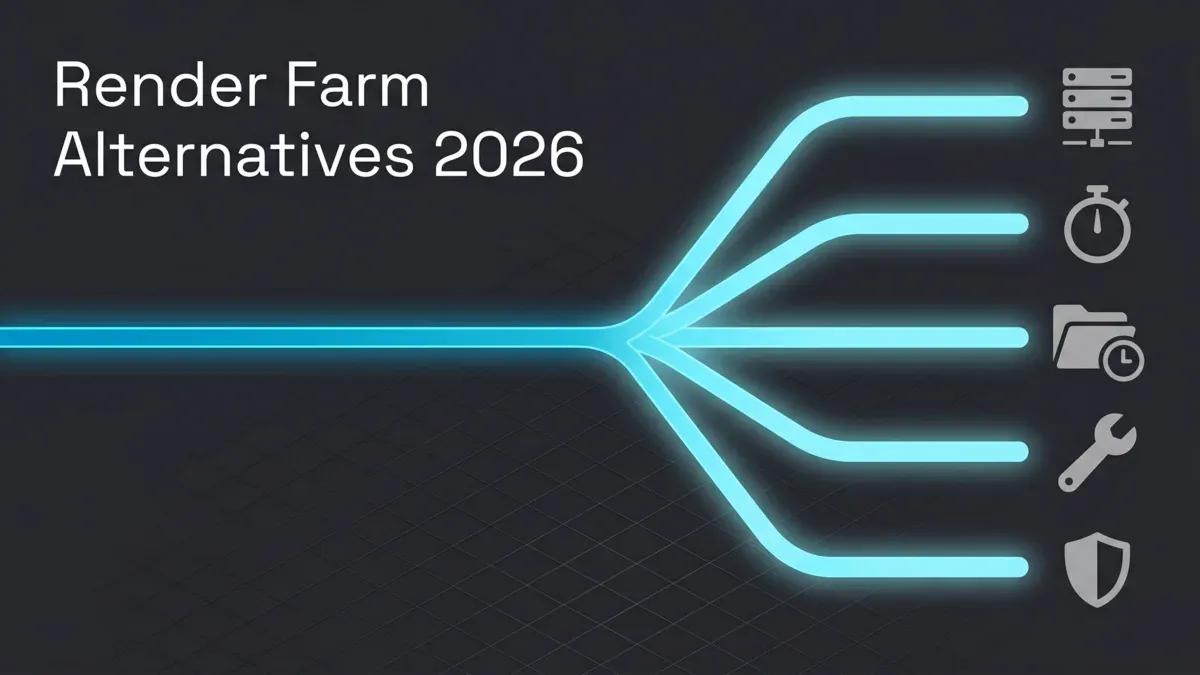
If you're researching alternatives to Fox Renderfarm, you're probably not angry at the service — you're re-checking fit. Maybe next quarter's render budget is hard to forecast, maybe a 20-day download window collided with a client revision cycle, maybe your one technical artist is tired of midnight wrangling. "Alternative" searches are usually fit questions, not failure questions, and this guide treats them that way.
Disclosure first: we operate Super Renders Farm, so this is not a neutral directory. Three rules keep it useful anyway. Every Fox Renderfarm claim below comes from Fox's own public pages — about, pricing, support documentation, Terms of Service — re-checked in June 2026; if anything has changed since, their pages win. We compare billing structures, not competitor dollar rates, because vendor rates move and a stale number is worse than none. And we say plainly where Fox remains the stronger choice, because if a comparison can't name what the incumbent does well, it's marketing copy, not guidance.
Fox has earned its shortlist position: operated by Shenzhen Rayvision Technology Co., Ltd. and running since 2011, it is among the largest managed rendering operations by its own published numbers. So rather than argue anyone off the platform, this guide maps the decision: what Fox does well, where the friction comes from, and which alternative — ours included, but not only ours — fits which workflow.
What Fox Renderfarm Does Well in 2026
Any honest alternatives guide starts with why the incumbent is hard to replace.
Scale and track record. Fox's about page reports 30,000+ physical servers, 60 million+ rendered frames per month, and 400,000+ clients across 100+ countries. Those are Fox's own figures, but fifteen years of continuous operation at volume is not something a new entrant can fake.
Production credits, as Fox presents them. Fox maintains a public works page listing projects associated with the farm: it currently leads with Ne Zha 2 (2025) — described there as the highest-grossing animated film of all time — alongside Ne Zha (2019), the Oscar-winning short Mr. Hublot (rendered on their farm, per Fox's news archive), Netflix's Three Robots from Love, Death & Robots, Wish Dragon, Kingsglaive: Final Fantasy XV, and Baahubali 2. The full list is on Fox's works page; feature animation at that level is a real credential.
Content-security accreditation. Fox advertises TPN (Trusted Partner Network) vendor status and ISO27001 certification, and describes alignment with the MPA's published content-security practices. The TPN program is the Motion Picture Association's content-security framework, and for pre-release episodic and streaming work that contractually mandates a TPN-assessed vendor, this single line item can decide the vendor list by itself.
A genuinely deep knowledge ecosystem. Fox runs a large tutorial and support library covering its supported software, a long-running artist interview series, and the FGT community — a monthly FGT Art program plus recurring FGT 3D challenges with render-credit prizes. It is also a Blender Development Fund member. If your artists learn from vendor content, that is real onboarding value — and broader than ours.
Support, programs, and pricing aids. Fox advertises 24/7 support across WhatsApp, email, live chat, and Telegram with a 15-minute response target — multi-channel coverage that broad is unusual in this category. A published cost estimator, the GoCloud education program, and freelancer discounts are documented on their site, and their about page adds an environmental claim: a green datacenter with PUE under 1.2 on wind and water power.
None of that is faint praise — if it lines up with your production, the last section of this guide is about staying put.
Why Teams Still Shop for an Alternative
Across studios that evaluated us after rendering at Fox, the friction clusters into four areas — every one of them documented on Fox's own pages, none of them a scandal.
Billing geometry. Fox's published CPU formula is (unit price × thread count) × (1 + RAM increase) × render hours + software license fee. GPU jobs price per node-hour keyed to a default two-card configuration — half the unit price for one card, double for four. The unit price itself depends on your membership tier, five levels from Ordinary to Diamond unlocked by cumulative recharge; RAM above the 64 GB default adds a multiplier, and some applications add a license fee at submission. Every variable is documented and the math is honest — but forecasting per-frame cost means holding four moving variables, and the effective rate shifts as your recharge history grows. Teams budgeting in plain compute units find one flat published rate easier to defend in a quarterly forecast — a structural preference, not a gotcha.
The 20-day file window. Fox's Terms of Service state that customer file assets are automatically deleted 20 days after rendering completion, and the same document advises downloading output as soon as possible. Fine for render-and-archive work; tight for long-poll projects — a director's cut returning for re-renders six weeks later, an archviz client approving frame 400 in month two. Retention rules differ on every farm (ours has no fixed automatic deletion period; check each vendor's terms), and the discipline is universal: download promptly and keep your own archive.
Self-serve wrangling load. Fox's documented flow: submit through the desktop client or web manager, add the software configuration, run analysis, set render parameters, then export and download. The platform automates transfer and analysis between steps — but the person driving them is you. For a studio with a pipeline TD, that control is a feature. For a solo archviz artist at midnight before a deadline, being your own wrangler is the part of cloud rendering they hoped to outsource.
Procurement and jurisdiction. Fox's Terms of Service state that the service is operated by Shenzhen Rayvision Technology Co., Ltd., governed by the law of the People's Republic of China, with disputes brought in the PRC. For many teams this is a non-issue. For studios whose clients impose vendor-jurisdiction requirements or whose procurement runs formal vendor-risk review, contracting jurisdiction is an audited checkbox — and Fox's TPN and ISO27001 disclosures are its counter-evidence in exactly that review. Weigh it per your contracts and move on.
Match the Farm to Your Workflow, Not the Brand
The render farm market sorts more cleanly by workflow than by brand. Before comparing vendors head-to-head, find your profile below.
CPU-heavy archviz and animation (V-Ray, Corona, Arnold). This is the volume workhorse of the category. What matters: a predictable per-unit compute price, engine licenses included so nothing surprises you at submission, and RAM headroom for scatter-heavy scenes without a multiplier conversation. On our farm this profile runs on 20,000+ CPU cores at a flat published $0.004 per GHz-hour (priority tiers to $0.016), licenses included. Fox serves it well at sustained volume — higher recharge tiers improve its thread-hour economics. The deciding question: earn a discount through accumulated spend, or price every project at the same flat unit.
GPU work with VRAM exposure (Redshift, Octane, V-Ray GPU). Once a scene flirts with a VRAM ceiling, "which exact card renders my frame" stops being trivia. We publish our GPU fleet at the billing tier — NVIDIA RTX 5090, 32 GB VRAM, $0.003 per OctaneBench-hour — on the GPU render farm page. Fox prices GPU per node-hour but does not itemize card models per host on its public pricing page — VRAM-bound teams should confirm assigned hardware with Fox sales before committing a deadline. A disclosure difference, not a quality verdict.
Houdini pipelines. Version parity is everything: your exact Houdini build, your renderer variant, and your cache workflow. We run native Houdini — Karma XPU, Mantra, and Redshift, plus V-Ray, Arnold, and Octane for Houdini provisioned on request, with operator-managed simulation caches — detailed on the Houdini cloud render farm page. Fox publishes its own Houdini render farm page; verify your build and renderer variant against their current list. Whatever farm you test, pilot a sim-dependent shot, not a clean one.
Pre-release episodic and streaming work under TPN mandates. If your contract requires a TPN-assessed vendor, Fox's accreditation is the differentiator in this entire comparison — we don't publish TPN or ISO27001, and TPN accreditation is rare among managed farms. We handle confidential work under a custom NDA with encryption in transit and at rest — enough for many studio contracts, not for a hard TPN clause. Match the vendor to the contract language.
Unusual stacks and full control. If your pipeline needs an engine no managed farm lists, exotic plugin combinations, or root access for custom tooling, a managed service is the wrong shape entirely. iRender rents you a dedicated GPU machine — remote desktop in, install any software and version; licensing is largely yours to bring (their site lists Cinema 4D and Redshift as preinstalled) — metered per machine time, with offices listed in Singapore and Hanoi. You become wrangler and license manager; that is precisely the appeal. Our iRender comparison maps where rental beats managed, and our managed vs DIY cloud rendering guide covers the tradeoff in depth.
European center of gravity or legacy DCCs. RebusFarm runs a fully managed service from its own German datacenter via the Farminizer plugin, billing through a prepaid RenderPoints currency at per-GHz-hour and per-OctaneBench-hour rates, with a notably broad DCC list — SketchUp, Rhino, MODO, LightWave, Softimage — legacy coverage neither we nor Fox match; our RebusFarm comparison goes dimension by dimension. GarageFarm, UK-registered as GarageFarm.NET Ltd., runs a managed model through its renderBeamer client with three priority tiers priced per GHz-hour and per OctaneBench-hour, licenses all-inclusive; our GarageFarm comparison covers the detail.
For a direct three-way look at GarageFarm, RebusFarm, and Fox Renderfarm together, our RebusFarm vs GarageFarm vs Fox Renderfarm comparison covers pricing, hardware, and DCC support across all three.
The Alternative-Decision Matrix
The matrix compares structure, not live price tags — vendor rates move, and each vendor's pricing page is the only authoritative source. Rows re-checked against published pages, June 2026.
| Decision factor | Fox Renderfarm | Super Renders Farm | RebusFarm | GarageFarm | iRender |
|---|---|---|---|---|---|
| Service model | Self-serve — desktop client or web manager | Fully managed — operator scene validation | Fully managed — Farminizer plugin | Fully managed — renderBeamer client | IaaS — rent a GPU machine, run it yourself |
| Billing unit | CPU per thread-hour; GPU per node-hour (two-card default) | CPU per GHz-hour; GPU per OctaneBench-hour | Prepaid RenderPoints currency; per GHz-hour / per OBh | Prepaid balance; per GHz-hour / per OBh | Machine time, metered per minute |
| Rate shape | Unit price varies by recharge tier (Ordinary → Diamond) | Flat published: $0.004/GHz-hr CPU, $0.003/OBh GPU | Flat published per-unit rates in RP | Three priority tiers, rates published | Per-rig rates published |
| Engine licenses | Bundled for most; some apps add a fee at submission | Included (V-Ray, Corona, Arnold, Redshift, Octane; Cycles open-source) | Check their current page | All-inclusive per their pricing page | Bring your own (C4D + Redshift listed as included on their site) |
| RAM policy | 64 GB default; bigger nodes via multiplier | Up to 256 GB per node, no separate RAM line | Check their current page | Node RAM scales with priority tier | You choose the rig spec |
| GPU model disclosure | Fleet not itemized per host on public pages | RTX 5090, 32 GB VRAM, published | Check their current page | Check their current page | Exact cards listed per config |
| Output retention | 20 days after render completion (their ToS) | No fixed automatic deletion period (download at any time) | Check their current page | Check their current page | Your rented machine, your schedule |
| Entity and governing law (as published) | Shenzhen Rayvision Technology Co., Ltd.; PRC law per ToS | Super Renders Farm LLC; California, USA | RebusFarm GmbH; own German datacenter | GarageFarm.NET Ltd.; UK-registered | Offices listed in Singapore and Hanoi |
| Support (as advertised) | 24/7 — WhatsApp, email, live chat, Telegram; 15-minute target | 24/7 live chat and email; US phone line | Check their current page | Scales with priority tier | Check their current page |
Use it row-first rather than column-first: each of the five farms wins somewhere, and the farm worth shortlisting is whichever column carries the rows that matter for your production.
Where Super Renders Farm Fits — and Where It Doesn't
Applying the same framework to ourselves, including the rows we lose.
We run a fully managed model: you upload a scene through the dashboard, our operators validate it — missing assets, plugin versions, output settings — before render time burns, and you download finished frames. No remote desktop, no software installs, no license management. The team has operated render infrastructure since 2010, and the company is a US legal entity — Super Renders Farm LLC, headquartered in Santa Ana, California — which for US studios means US billing, US contracting jurisdiction, and a US phone line alongside 24/7 live chat.
Pricing is one flat published unit per hardware class — the CPU and GPU rates in the matrix above, engine licenses included. Credits are 1 credit = $1, never expire, with volume discounts from 5% at 100 credits to 30% at 10,000. Nodes carry up to 256 GB RAM with no separate RAM billing line, output stays available for download with no fixed automatic deletion period, and the trial is $25 in non-expiring credits.
And the rows Fox wins on the same framework. Our stack is seven DCCs — 3ds Max, Maya, Cinema 4D, Blender (Cycles, EEVEE, Standard), Houdini, After Effects, and NukeX. Fox's published list is wider — Unreal Engine and Clarisse appear on Fox's pages; neither runs on our farm. We publish no TPN or ISO27001 certification, so a hard TPN clause rules us out where it rules Fox in. Fox's tutorial library, interview series, and FGT community are larger content ecosystems than ours. Teams centered in Asia-Pacific may simply find Fox's regional footprint and multi-messenger support a more natural fit. The full head-to-head lives in our Fox Renderfarm vs Super Renders Farm comparison.
Before You Switch Any Farm: A Six-Step Pilot Protocol
Whatever direction you're leaning, run the switch like an operator, not a shopper. The common failure mode is migrating a week before a deadline on the strength of a pricing page.
- Compute your real baseline. Pull your last two or three invoices on your current farm and divide total spend by delivered frames. That per-frame number — not any vendor's headline rate — is what an alternative has to beat. Our render farm cost-per-frame guide walks through the method.
- Inventory the pipeline at version level. Exact DCC builds, renderer variants (Arnold for Maya is not Arnold for Houdini), every plugin, every cache dependency. Check each candidate's published support list against this inventory before spending a trial credit.
- Rehearse the file path. Archive formats and transfer methods differ — on our farm, projects go up as unpacked folders (no archive is extracted), via web or the client app. Time a real scene's round-trip on each candidate, not a synthetic speed test.
- Render the same 10-frame slice everywhere. Same scene, same engine build, on each candidate and on Fox. Compare wall-clock time, per-frame cost, and the frames themselves — mismatched engine builds cause subtle differences that surface in comp.
- Probe support at your worst hour. File a real technical question at the time of day your deadlines actually break. Response speed at 3 a.m. your time is a feature; test it like one.
- Wind down calmly. Keep your existing balance for lower-priority jobs while the pilot proves out, and check recharge and refund terms before final cutover. A migration you can reverse for two weeks is a migration with no drama.
When Staying with Fox Is the Right Call
The honest close. Fox Renderfarm remains the stronger fit when:
- Your contract mandates a TPN-assessed vendor. Fox advertises that accreditation; we and most managed competitors don't.
- Your pipeline includes Unreal Engine or Clarisse rendering. Fox's published software list covers tools missing from our seven-DCC stack.
- Your production's center of gravity is Asia-Pacific. Regional proximity, multi-messenger support, and Fox's ecosystem presence line up.
- You're already deep in the recharge tiers. Upper membership levels may make Fox's unit economics hard for any flat-rate alternative to beat at your volume — run the per-frame math before assuming otherwise.
- Your team leans on Fox's learning ecosystem. The tutorial library, FGT challenges, and interview content have onboarding value no competitor matches today.
If two or more of those describe your production, the rational move may be to stay — and to use the pilot protocol above as a periodic health check rather than an exit plan.
FAQ
Q: Why do people look for alternatives to Fox Renderfarm? A: Four fit reasons dominate: billing geometry (a per-thread-hour formula with RAM multipliers, per-app license fees, and tier-dependent unit prices is harder to forecast than one flat rate), the 20-day automatic file deletion after render completion stated in their Terms of Service, a self-serve workflow that keeps render wrangling on your team, and procurement reviews involving contracting jurisdiction. None of these is a failure — Fox's scale, credits, and accreditation are real.
Q: Is Fox Renderfarm a good render farm in 2026? A: By its published record, yes. The operation has run since 2011 under Shenzhen Rayvision Technology Co., Ltd., reports 30,000+ servers and 400,000+ clients, advertises TPN vendor status and ISO27001, lists major film and series credits on its works page, and maintains one of the deeper tutorial ecosystems in the category. Teams move for specific reasons — billing predictability, retention windows, managed workflow, jurisdiction — not general dissatisfaction.
Q: What is the difference between per-thread-hour and per-GHz-hour billing? A: Per-thread-hour pricing (Fox's published CPU model) charges for each CPU thread allocated per hour, with the unit price varying by membership tier and multipliers for extra RAM. Per-GHz-hour pricing (our model at Super Renders Farm) charges one flat published rate — $0.004 — per gigahertz of clock speed per hour, licenses included. Neither is automatically lower for a given scene; the structural difference is how many variables you hold when forecasting, which is why a 10-frame pilot on your own scene beats any rate-card comparison.
Q: Which Fox Renderfarm alternative keeps a fully managed workflow? A: Super Renders Farm, RebusFarm, and GarageFarm all run managed models — you submit a scene and the farm handles software, licenses, and queueing, with different submitters (operator-validated dashboard, Farminizer, renderBeamer respectively). iRender is the deliberate exception: an IaaS model where you rent a GPU machine, remote in, and run everything yourself. If the wrangling load is your reason for leaving, shortlist managed farms; if control is, shortlist IaaS.
Q: Is Super Renders Farm cheaper than Fox Renderfarm? A: We genuinely can't promise that, and you should distrust any farm that does. Fox publishes tier-based thread-hour rates with RAM and license variables; we publish flat rates of $0.004 per GHz-hour CPU and $0.003 per OctaneBench-hour GPU with engine licenses included. Which lands lower depends on your scene, RAM needs, software list, and accumulated tier on Fox. Render the same 10-frame slice on both trials and divide spend by frames — that number settles it for your pipeline, not ours.
Q: How do I switch render farms without risking a deadline? A: Never cut over inside a delivery window. Baseline your real per-frame cost from invoices, verify version-level parity for your DCCs and renderer variants, rehearse upload and download with a real scene, pilot the same 10-frame slice on each candidate, and test support at the hour your crises actually happen. Keep your existing balance for low-priority jobs during the transition — Fox's files auto-delete 20 days after each render per their Terms, so archive outputs as you go.
About Thierry Marc
3D Rendering Expert with over 10 years of experience in the industry. Specialized in Maya, Arnold, and high-end technical workflows for film and advertising.