3ds Max Licensing in 2026: Subscription, Flex, and Per-Seat for Studios
Overview
Introduction
3ds Max's standard annual subscription costs $2,010 a year in the US, or $168 a month if that year is paid up front. Those two figures are both Autodesk's, printed side by side on the same buy page, and they don't quite agree: $168 x 12 comes to $2,016, six dollars over the annual total Autodesk states. That gap is Autodesk's own rounding of the monthly equivalent, not an error introduced here; the $2,010 figure is the one you are billed. Paying month to month instead runs $255/month. A third path, Flex tokens, bills by the day you actually open 3ds Max rather than by a fixed term. These figures are measured directly on Autodesk's own buy page, dated 12 September 2026, US pricing.
This guide does not re-cover 3ds Max Indie eligibility or pricing — that already lives in our Autodesk Indie license guide, which covers who qualifies under the $100,000 revenue cap. The scope here is 3ds Max's three commercial plans, whether a multi-year commitment is worth it, the "perpetual license" question studios with older seats still ask, and what license-per-seat actually costs once you're running more than one machine.
3ds Max Pricing in 2026 (US, Measured 12 September 2026)
| Plan | Price (US) | Best for |
|---|---|---|
| Annual subscription | $2,010/year ($168/month, billed annually) | Ongoing production use across the year |
| Monthly subscription | $255/month | Short, defined engagements where you don't want a year-long commitment |
| Flex (token-based) | $99 minimum for 33 tokens ($3/token); 3ds Max draws 6 tokens per day of use, per Autodesk's Flex rate sheet | Occasional or irregular use, well under two weeks a month |
Autodesk's buy page also offers a 3-year term on the annual plan, priced at $6,025 for one user — worth reading closely, because it doesn't do what most people assume a multi-year commitment does. As it happens, the 1-year, monthly and Flex list prices match what our Maya cost guide measured on 3 September 2026, plan for plan, seat for seat; that guide did not measure a 3-year Maya rate, so the $6,025 figure below is stated for 3ds Max only.
Two notes on how this was measured. The direct URL you'd expect for a pricing page returns a product overview instead; the live prices sit at autodesk.com/products/3ds-max/buy. And the price panel on that page renders in after the page itself loads — reading it too early can show placeholder blocks instead of numbers, so give it a few seconds. The page also prompts US visitors to switch to a regional store; the figures here are the US store's numbers, not a global rate.
Is the 3-Year Commitment Worth It? Almost No Discount
A 3-year term for one 3ds Max seat costs $6,025, which works out to $2,008.33 a year. Compared against the 1-year term's $2,010/year, that's a difference of $1.67 a year, about 0.08%. Locking in for three years fixes the rate against a future price increase, but it does not meaningfully discount today's rate the way a multi-year commitment does in most other software categories.
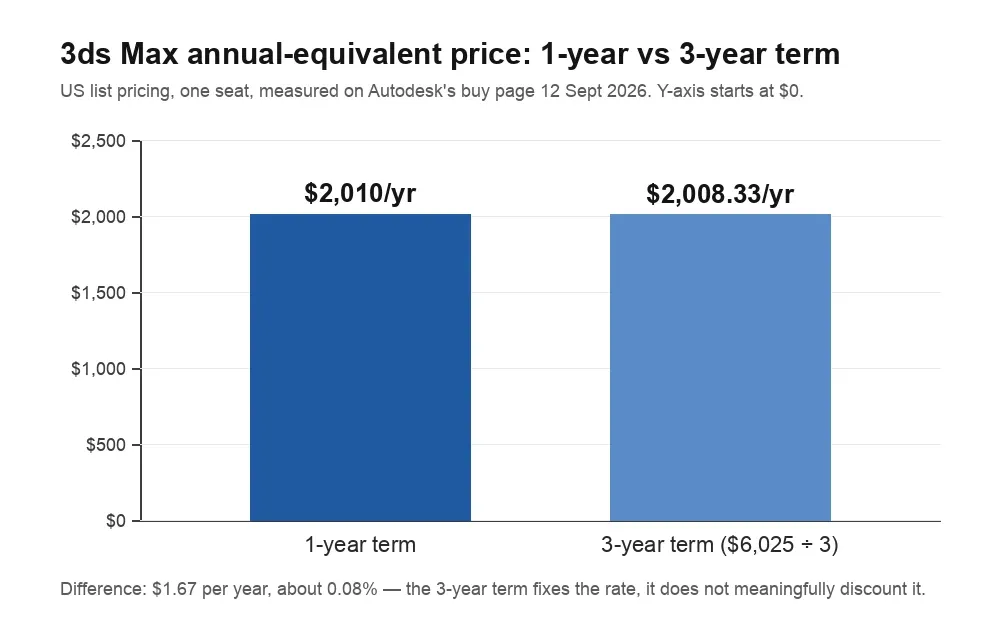 Bar chart comparing 3ds Max's annual-equivalent price on a 1-year term ($2,010/year) against a 3-year term ($2,008.33/year), showing a difference of $1.67 per year
Monthly versus annual is a bigger gap, and it resolves the same way it does for every Autodesk product sold this way: monthly never wins on cost, only on flexibility. A full year on the monthly plan costs $3,060 ($255 x 12) against $2,010 paid annually — a $1,050 difference, or roughly 52% more for the same twelve months of access. Monthly earns that extra cost specifically when you don't yet know how many months you'll need the seat; committing to a year you might not use isn't automatically the cheaper choice either.
Flex changes the shape of the question, because it's the only plan that bills by the day rather than by the term. Tokens cost $99 for a minimum pack of 33 ($3/token), and 3ds Max draws 6 tokens for every day it's opened, a rate Autodesk publishes on its Flex rate sheet (read 12 September 2026, where the same row shows an estimated $18/day). That per-day figure is arithmetic from the published token rate, and Autodesk notes on the same sheet that it may change token rates at any time.
| Roughly how many days a month you open 3ds Max | Cheapest of the three |
|---|---|
| Up to 9 days (about $162 or less in tokens) | Flex |
| 10 days or more | Annual subscription |
| Past about 14 days | Annual subscription — Flex now costs more than even the monthly plan |
The monthly plan's real case sits outside that table entirely: a short, defined engagement where the alternative is committing to a year you won't fully use, not a per-month cost comparison it can ever win.
Where the Indie Line Sits, and Why the Rest of This Guide Is on the Other Side of It
3ds Max Indie is a separate commercial license, capped at gross annual creative revenue under $100,000 USD, one project cap of the same amount, sold on an annual term only. Our Autodesk Indie license guide covers the full eligibility rules and — like Maya Indie — the fact that Autodesk doesn't publish an Indie price on either campaign page; the figure only surfaces once you're inside checkout with eligibility confirmed.
Everything below this point is written for studios and freelancers past that $100,000 threshold, where the three plans in the table above are what's actually being negotiated, purchased, or multiplied across a render room.
License-Per-Seat for Multi-Machine Studios
Autodesk's buy page prices exactly one seat. For a second seat, a third, or a render room's worth, the page offers no self-serve volume pricing at all — only a "Talk to our sales team" link in place of an "Add to cart" button once you're past what a single-seat checkout is built for.
That absence is worth being direct about, because it means the only honest per-seat math available without a sales conversation is straightforward multiplication of the single-seat price:
| Seats | Annual term (1 year, at $2,010/seat) | Monthly term (at $255/seat) |
|---|---|---|
| 2 | $4,020/year | $510/month |
| 5 | $10,050/year | $1,275/month |
| 10 | $20,100/year | $2,550/month |
| 25 | $50,250/year | $6,375/month |
Nothing on Autodesk's public pages says that math is wrong, and nothing on them says a studio buying 10+ seats gets a published discount either — a real negotiated rate for that volume is a "Talk to sales" conversation, not a number anyone can quote from the buy page. Treat the table above as the honest public-price floor, not a promise that it's the best rate a studio that size will actually pay.
One place that per-seat multiplication doesn't apply is rendering itself. A studio doesn't need a 3ds Max license on every machine that renders a scene — only on the machines where artists actively work in the software. On our nodes, 3ds Max licensing for rendering is covered through Autodesk Flex, so a render room scaling to more machines isn't the same math problem as a studio buying more artist seats.
Legacy and Perpetual 3ds Max Licenses
Autodesk stopped selling new perpetual licenses of most individual products, 3ds Max included, after 31 January 2016 (its own September 2015 announcement set the date, and its current support article confirms it no longer sells stand-alone perpetual licenses at all). Any perpetual seat still in use today predates that cutoff, and the question that comes up isn't whether Autodesk sells one — it doesn't — it's whether a scene authored on one of those older, pre-2016 versions still renders somewhere other than the original machine.
For 3ds Max versions from 2013 through 2020, that's handled through version templates provisioned on request rather than a version every render node carries by default. The commercial subscription plans above run 3ds Max 2013 through 2027 on our farm; a legacy perpetual seat, once you know which release it's actually running, sits inside that same range.
For what's actually new in the current release rather than the licensing question, our 3ds Max 2027 feature guide covers that separately.
Renderer Licensing That Comes With the Subscription
Neither V-Ray nor Corona ships inside a 3ds Max subscription itself — Autodesk's plans above cover the application, not the renderer. On our farm, both are bundled and covered on the node side, so a 3ds Max scene built in either engine doesn't need a separate render-side license purchase just because the rendering moved to rented hardware.
The Real Cost of Running 3ds Max: License Plus Machine
Every figure above is the cost of the software license. It isn't the cost of producing anything in 3ds Max, and treating it as the whole answer is where a pure licensing breakdown quietly stops short.
Viewport performance and GPU-accelerated renderers both lean on the graphics hardware underneath 3ds Max, so the workstation the license runs on is a real, ongoing cost of its own — and which part of that hardware bill matters most depends on which render engine the work actually runs. V-Ray and Corona's CPU paths lean on core count and system memory; GPU-accelerated work shifts the weight onto the graphics card and its VRAM, and a scene that outgrows available VRAM doesn't just render slower, it can fail outright. None of that shows up in Autodesk's $2,010, $255, or $18-a-day figures, and none of it is optional once a studio is producing something rather than just holding a license to do it.
Renting Render Capacity Instead of Buying More Machines
A category of provider sells rendering compute directly, billed by the hour or by the job rather than as a fixed asset sitting idle between projects. Super Renders Farm is one such provider; on the 3ds Max side, V-Ray and Corona are already covered on our nodes, so a scene built in either engine doesn't add a separate render-side license bill on top of what's covered here. Our general render farm pricing guide covers the render-cost side of that math, current rates and a per-job cost calculator are published rather than quoted per client, and the 3ds Max-specific coverage sits on the 3ds Max render farm page.
3ds Max sits alongside two other DCCs with the same licensing-cost shape: see our breakdowns for Maya and Houdini.
For those three next to Cinema 4D and Blender on one page, see what 3D software costs in 2026.
FAQ
Q: How much does 3ds Max cost per year in 2026? A: $2,010/year on the standard annual subscription, or $168/month if that year is paid up front, as measured on Autodesk's buy page on 12 September 2026 (US pricing). The two figures are Autodesk's own and do not quite reconcile ($168 x 12 = $2,016); the $2,010 annual total is what you are billed, the monthly figure is Autodesk's rounding. Paying month to month instead costs $255/month, or $3,060 across a full year.
Q: Is a 3-year 3ds Max subscription cheaper than a 1-year one? A: Barely. The 3-year term costs $6,025 for one user, which works out to $2,008.33/year against the 1-year term's $2,010/year — a difference of $1.67/year, about 0.08%. It locks in today's rate for three years; it does not meaningfully discount it.
Q: What are Flex tokens, and how many does 3ds Max use per day? A: Flex is Autodesk's pay-by-use option: tokens cost $99 for a minimum pack of 33, and 3ds Max draws 6 tokens for every day it's opened. That works out to roughly $18 per day of actual use, which is this guide's own calculation from the published rate rather than a figure Autodesk states directly.
Q: Does Autodesk offer volume pricing for studios buying multiple 3ds Max seats? A: Not on the public buy page. Past a single seat, the page replaces its checkout button with a "Talk to our sales team" link, and no self-serve volume discount is published. The honest public-price floor for N seats is N times the single-seat price; any better negotiated rate for a large studio comes out of that sales conversation, not the buy page.
Q: Does a render farm need one 3ds Max license per rendering machine? A: No, and that's a different question from how many artist seats a studio buys. On our farm, 3ds Max licensing for rendering is covered through Autodesk Flex on the node side, so scaling render capacity isn't the same per-seat math as licensing more artists to work in the application.
Q: Can an old, perpetual 3ds Max license still render on a farm? A: Depends on the version. 3ds Max 2013 through 2020 is handled through version templates provisioned on request rather than something every node carries by default; the commercial subscription plans above cover 3ds Max 2013 through 2027. Autodesk itself stopped selling new perpetual licenses of individual products, 3ds Max included, after 31 January 2016 (per its September 2015 announcement; its support pages confirm it no longer sells stand-alone perpetual licenses), so any perpetual seat in production today predates that change.
Q: Are V-Ray and Corona included in a 3ds Max subscription? A: No — Autodesk's subscription plans cover the application, not the renderer. On our nodes, both V-Ray and Corona are bundled and covered separately, so a 3ds Max scene built in either engine doesn't need its own render-side license purchase to run on a render farm.
Q: Who is 3ds Max Indie for, and does this guide cover it? A: Indie is for buyers under $100,000 in gross annual creative revenue with no single project over that amount; it's covered separately in our Autodesk Indie license guide. This guide covers the three commercial plans on the other side of that threshold.
About Thierry Marc
3D Rendering Expert with over 10 years of experience in the industry. Specialized in Maya, Arnold, and high-end technical workflows for film and advertising.