How Much Does Houdini Cost - Apprentice vs Indie vs Core vs FX
Overview
Introduction
"How much does Houdini cost" doesn't have one answer, because Houdini isn't one product with one price. SideFX sells five tiers, and only two of them are fully commercial, and the gap between its lowest-priced paid tier and its most expensive one is over $3,200 a year. Pick the wrong one and you either overpay for tools you'll never touch, or you buy a license that can't do the job you bought it for.
This guide walks through what each tier actually costs, and more usefully, who each tier is actually built for, since the price alone doesn't tell you that. We also cover two things most pricing pages skip entirely: the Karma render licenses SideFX quietly bundles into Core and FX for free, and a licensing trap around Houdini Engine that is easy to walk into, because two products with almost identical names behave completely differently. All prices below were read directly from SideFX's own store on 3 September 2026. Houdini pricing shifts with major version releases, so treat these as a snapshot, not a permanent number, and check the store page before you buy.
| License | Type | Price (1-year rental, as measured 3 September 2026) | Karma licenses bundled |
|---|---|---|---|
| Apprentice | Non-commercial | Free | 1 |
| Indie | Workstation | $299/year | 2 |
| Education (students) | Global Access | $95/year | 10 + 1 Engine license |
| Core | Workstation | $1,475/year | 5 |
| FX | Workstation | $3,505/year | 5 |
At the time of writing, the current shipping release is Houdini 22, with active "What's New in H22" documentation covering everything from Gaussian Splats to characters to world building. SideFX's own store page still carries a line about Houdini 21 pricing, but read in context, that line is a historical note about when Long-Term Rental and Annual Upgrade Plan prices were last adjusted, not a claim that 21 is the current version. Don't take that sentence out of context and repeat it as "the latest version is 21."
Apprentice vs Indie vs Core vs FX
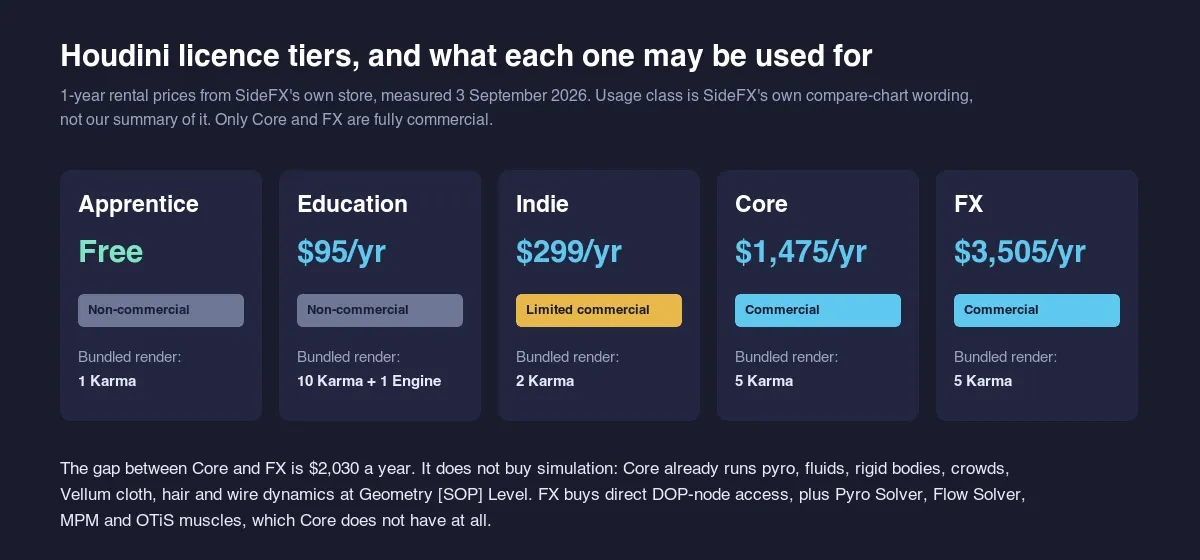 Comparison of Houdini's five licence tiers showing 1-year rental price, usage class and bundled Karma render licences: Apprentice free, Education $95, Indie $299, Core $1,475, FX $3,505
Apprentice: for learning, not for client work
Apprentice is who you are if you're a student, a hobbyist, or anyone teaching yourself procedural workflows without a paying client on the other end. It's free, and it carries the full Houdini toolset rather than a stripped-down demo, which is genuinely useful for actually learning the software properly. The trade-off is that it's strictly non-commercial: renders come out watermarked, and it saves in its own non-commercial file format. Treat it as a sandbox for learning rather than a way to produce work you plan to sell.
Indie: for freelancers and small studios doing real commercial work
Indie is the first tier where output is genuinely commercial. As measured on 3 September 2026, it's $299 a year, workstation-licensed, capped at 3 licenses per studio, with 2 Karma render licenses bundled in. It's aimed at freelancers and small studios: SideFX labels the Indie tab on its own store "revenue under 100K USD". Check the full eligibility terms directly if you're near that line. If you qualify, Indie is a genuinely different economic proposition than Core, since it isn't a cut-down version of Core's toolset, it's priced and gated by who you are and how much you make, not by which tools you're allowed to touch.
Core: for studios and generalists who don't need heavy simulation
Core is where most mid-size studios and generalist artists land: modeling, animation, look-dev, lighting, rendering and procedural pipeline work, plus the VFX solvers SideFX exposes at Geometry [SOP] Level. As measured on 3 September 2026, Core is $1,475 a year, workstation-licensed, capped at 5 workstations per studio, with 5 Karma render licenses bundled in for free. If your simulation work is driven through those prepared SOP-level tools rather than built from the underlying DOP nodes, Core is very likely the tier that matches what you actually do day to day.
FX: for the simulation and effects work Houdini is famous for
FX is the full tier, and it's who you are if you need to build simulations at the node level rather than drive them from prepared tools. SideFX's own compare chart is precise about this: Core carries a long list of VFX solvers at what it calls Geometry [SOP] Level, including pyro, fluids, rigid bodies, crowds, Vellum cloth, hair and fur, clouds and wire dynamics. FX is what adds the Pyro Solver, Flow Solver, MPM and OTiS muscles outright, and unlocks the underlying DOP nodes for all of them. As measured on 3 September 2026, FX is $3,505 a year, workstation-licensed, capped at 5 workstations per studio, with the same 5 Karma render licenses as Core bundled in for free. If your simulation work needs the DOP nodes directly, or specifically needs the Pyro Solver, Flow Solver, MPM or OTiS muscles, FX is the tier that has them and Core is not. If your simulation work runs through the SOP-level tools, Core already covers it however central it is to your pipeline.
One more option worth knowing, even though it sits outside this four-way comparison: SideFX also sells an Education tier for students, at $95/year on a Global Access license, with 10 Karma licenses and 1 Engine license bundled in, as measured on 3 September 2026. SideFX lists it for students specifically, and its compare chart marks it non-commercial, so it's worth checking whether you qualify if you're enrolled somewhere.
What the $2,030 Gap Between Core and FX Actually Buys
Do the subtraction and the FX premium comes out to $3,505 minus $1,475, or $2,030 a year, as measured on 3 September 2026, which is more than Core's entire licence costs on its own. That's a large enough gap that it's worth being precise about what it buys, instead of treating FX as "the expensive one you should probably get just in case."
What it buys is depth of access to the simulation layer, not the existence of it. Core and FX share modeling, terrain, character, animation, Solaris layout and look-dev, Karma rendering, Copernicus and volumes. Core also already runs pyro, fluids, rigid bodies, crowds, Vellum cloth, hair and fur, clouds and wire dynamics at Geometry [SOP] Level. SideFX puts the dividing line in its own words: if those prepared tools don't meet your needs and you want to work with the DOP nodes directly, then Houdini FX is required. FX additionally carries the Pyro Solver, Flow Solver, MPM and OTiS muscles, which Core does not have at all. If your actual daily work is procedural modeling, look-dev, lighting setups, or building tools and assets that don't involve simulating physical behavior, you can do that work entirely on Core and the $2,030 buys you nothing you'll ever open.
Who genuinely needs FX is narrower than the marketing copy around Houdini's reputation might suggest: effects artists, technical directors building destruction or fluid setups from the DOP nodes, and studios whose simulation work is authored at that level rather than driven from the SOP tools. If you're not sure which camp you're in, look at your last few months of actual project work rather than what you'd like to be capable of. A studio whose simulation needs are met by the SOP-level solvers does not need an FX seat at all, however often those shots come up. What decides the tier is the level you build at, not the frequency. If you are not sure, the honest test is whether you have ever needed to open a DOP network, not how much simulation work you do. If you have not, Core already covers your simulation work, and putting every artist on a $3,505 licence they mostly use for modeling is money spent on access you are not using.
Karma: Five Render Licenses You Already Paid For
Here's a detail buried on SideFX's own pricing page that's easy to miss: both Core and FX come bundled with 5 Karma render licenses, for free, on top of the workstation license itself (Indie gets 2, Education gets 10). At $195/year for a standalone Karma license as measured on 3 September 2026, that's up to $975 a year in render licensing that's simply included, not an upsell you have to opt into.
What makes this worth calling out specifically is where those bundled licenses can be used. In SideFX's own words, describing the bundling program: the bundled licenses can be used both locally and on your render farm or cloud. That's not a small detail, and it is what makes running Karma XPU on a cloud render farm a licence question you have usually already answered. It means the Karma render capacity that shipped with your Core or FX purchase isn't limited to the machine you installed Houdini on; it's licensing you can point at distributed render capacity, whether that's your own render nodes or a third-party farm, without buying a separate render license for that use case.
There's a caveat worth knowing if you or your studio holds an older perpetual license rather than the annual rental model priced above: SideFX's own terms state that Karma tokens bundled with perpetual licenses are available only as long as the Annual Upgrade Plan (AUP) is active, and that if AUP expires, those tokens are no longer available. If your studio is still running on a perpetual Houdini license from before SideFX moved to the current rental structure, keeping AUP current isn't just about getting version upgrades, it's what keeps your bundled Karma render capacity alive.
The Houdini Engine Trap: Unreal, Unity, and What "Free" Doesn't Cover
Two products on this page have almost identical names and behave completely differently, which makes this an easy piece of Houdini licensing to get wrong.
Houdini Engine for Unreal & Unity, as measured on 3 September 2026, is free, licensed as Global Access, and capped at 10 per studio. That free price tag leads a lot of people to assume it's a general-purpose way to bring Houdini Digital Assets into any other application, including the Maya and 3ds Max pipelines those same studios already run. It isn't. Houdini Engine for Unreal & Unity does not run the Houdini GUI or Houdini Batch mode for other Engine plug-ins such as Maya or 3ds Max. If your actual goal is driving Houdini Digital Assets inside Maya or 3ds Max, the free Unreal & Unity edition simply won't do that job; you need the regular Houdini Engine license, which as measured on 3 September 2026 is $525/year, workstation-licensed, capped at 5 per studio.
The host licence is a separate line item from the engine: what a 3ds Max seat itself costs, on subscription or Flex, is set out in our 3ds Max licensing breakdown.
The second trap sits right next to the first: Houdini Engine for Unreal & Unity is explicitly not meant to be paired with an Indie or Education base license. SideFX's own guidance is direct on this point: do not use Houdini Engine for Unreal & Unity with Houdini Indie or Houdini Education. SideFX pairs each base licence with its own counterpart: Houdini Indie uses Engine Indie, and Houdini Education uses Engine Education. Its compare chart lists them separately under "Create Assets for Engine", so the two are not interchangeable. Getting this pairing wrong doesn't just risk a support headache; it's a license-terms mismatch, not a technical inconvenience, so it's worth checking which "free Engine" you actually need before you install anything.
Render Cost Is a Separate Line Item
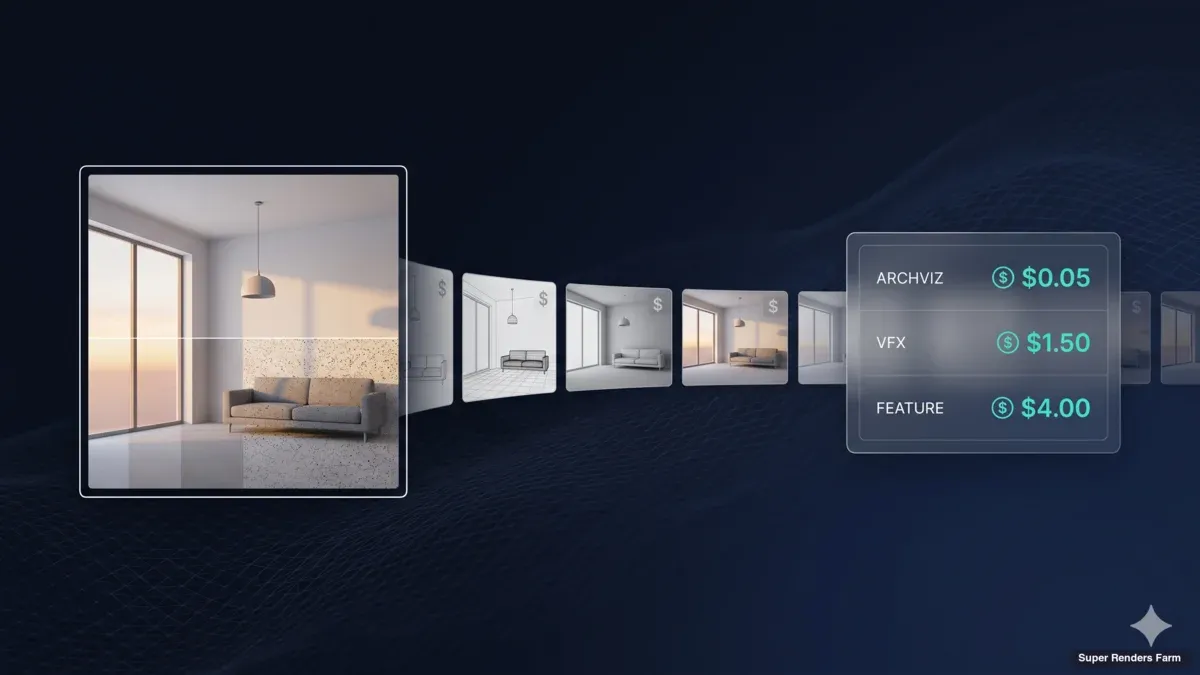
Everything above is what SideFX charges for the license itself. None of it includes the cost of actually rendering your frames once you've built the scene, and that's a genuinely separate expense whether you render on your own workstation's power bill or send jobs out to a distributed render farm. This is exactly why the Karma bundling detail above matters in practice: a render license that only worked locally would be far less useful than one SideFX explicitly says can be pointed at a render farm or cloud.
Worth knowing if you're planning to actually use that farm-eligible Karma license somewhere other than your own workstation: support for Houdini's render engines isn't identical across every render farm, including ours. On our own farm, Karma, Karma XPU, Mantra, and Redshift are ready to use on every node without any setup step; Arnold, V-Ray, and Octane for Houdini are supported too, but provisioned on request rather than available by default, so it's worth confirming those specifically before you upload a job that depends on them. We support Houdini 21.0 or newer, which already covers the current Houdini 22 release. That's a detail worth checking with any farm you're considering, not just ours, since "we support Houdini" and "we support the specific engine your scene actually uses" aren't always the same claim.
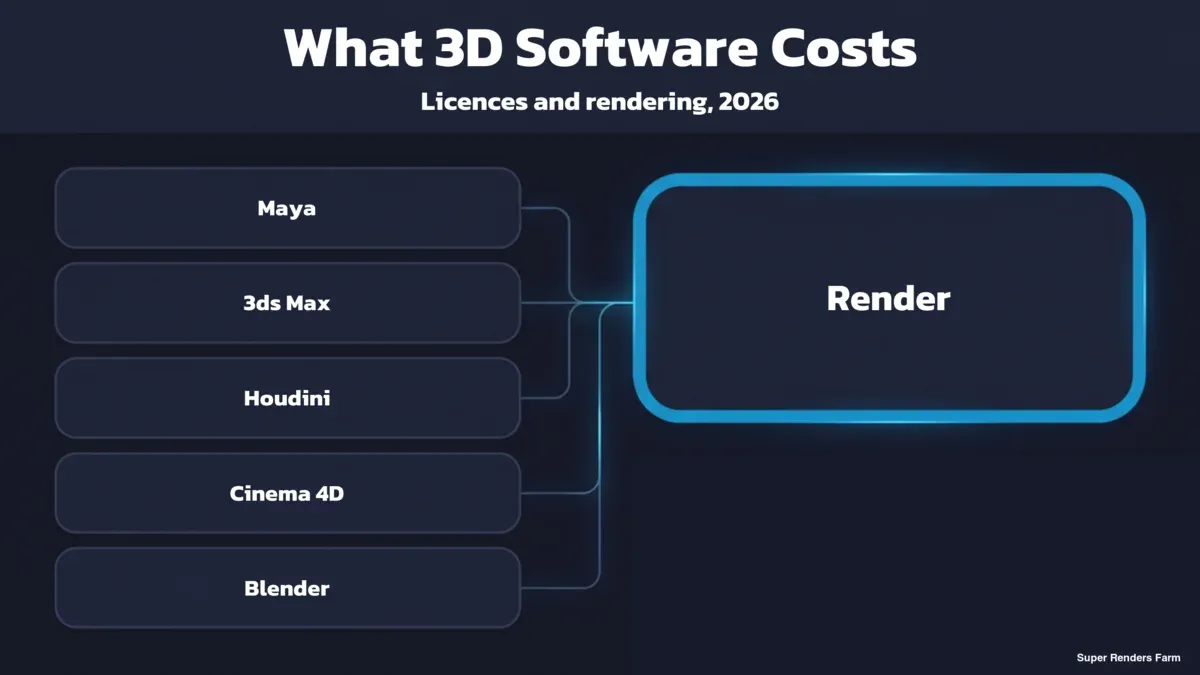
To see a Houdini seat priced next to Maya, 3ds Max, Cinema 4D and Blender, with the cost of rendering set beside the cost of each seat, read our overview of what 3D software costs in 2026.
FAQ
Q: How much does Houdini Indie cost? A: As measured on SideFX's store on 3 September 2026, Houdini Indie is $299/year, workstation-licensed, capped at 3 licenses per studio, with 2 Karma render licenses bundled in for free.
Q: How much does Houdini Core cost compared to FX? A: As measured on 3 September 2026, Core is $1,475/year and FX is $3,505/year, both workstation-licensed and capped at 5 workstations per studio. The gap is $2,030/year. It does not buy simulation as such, because Core already runs pyro, fluids, rigid bodies, crowds, Vellum cloth and hair at Geometry [SOP] Level. It buys direct DOP-node access to those solvers, plus the Pyro Solver, Flow Solver, MPM and OTiS muscles, which Core does not include.
Q: Is Houdini Apprentice really free, and can I use it commercially? A: Apprentice is free and carries the full Houdini toolset, but it's strictly non-commercial. Renders come out watermarked, and it's built for learning, not for client work you plan to sell or deliver.
Q: Does buying Houdini Core or FX include a render license? A: Yes, partially. SideFX bundles 5 Karma render licenses free with both Core and FX (2 with Indie, 10 with Education). SideFX states those bundled licenses can be used both locally and on a render farm or cloud, not just on the machine where Houdini is installed. SideFX's bundling covers Karma. Third-party engines such as Arnold, V-Ray or Octane for Houdini are licensed by their own developers, separately from Houdini itself.
Q: What happens to bundled Karma licenses if my Annual Upgrade Plan expires? A: This specifically concerns perpetual Houdini licenses rather than the annual rental model. SideFX's terms state that Karma tokens bundled with a perpetual license are available only as long as AUP stays active, and that once AUP expires, those bundled tokens are no longer available.
Q: Is Houdini Engine for Unreal & Unity the same as the regular Houdini Engine license? A: No, and the near-identical names make this an easy one to get wrong. The free Unreal & Unity edition does not run the Houdini GUI or Houdini Batch mode for other Engine plug-ins such as Maya or 3ds Max. If you need Houdini Digital Assets working inside Maya or 3ds Max, you need the standard $525/year Houdini Engine license instead.
Q: Can I use Houdini Engine for Unreal & Unity with an Indie or Education license? A: No. SideFX explicitly advises against pairing Houdini Engine for Unreal & Unity with Houdini Indie or Houdini Education. Each of those base licenses has its own counterpart instead: Houdini Indie pairs with Engine Indie, and Houdini Education pairs with Engine Education. SideFX's compare chart lists the two separately under "Create Assets for Engine".
Q: Is Houdini 22 out, or is 21 still the current version? A: Houdini 22 is the current shipping release, with active documentation covering what's new in H22. A line on SideFX's own store page referencing "the release of Houdini 21" is a historical note about a past price adjustment, not a claim that 21 is the latest version.
About Thierry Marc
3D Rendering Expert with over 10 years of experience in the industry. Specialized in Maya, Arnold, and high-end technical workflows for film and advertising.