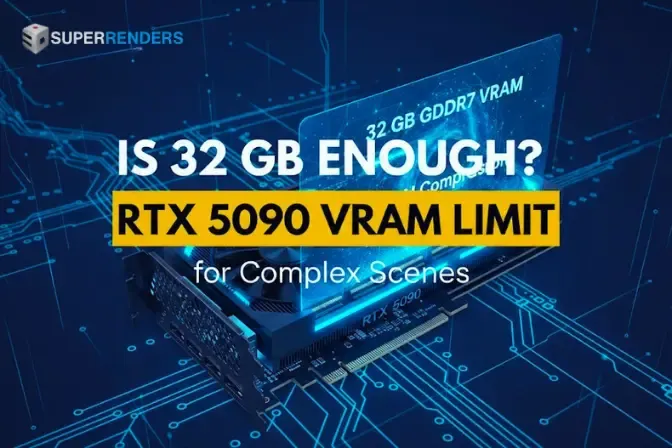
¿Son 32 GB suficientes? Límite de VRAM de RTX 5090 para escenas complejas
Resumen
Introducción
La NVIDIA RTX 5090 llega con 32 GB de VRAM GDDR7, el doble de los 24 GB de la RTX 4090, conectados a través de un bus de memoria de 512 bits que entrega hasta 1,79 TB/s de ancho de banda. Para artistas 3D y estudios que evalúan renderizado por GPU, la pregunta inmediata es práctica: ¿son realmente 32 GB suficientes para escenas complejas de nivel profesional?
Hemos estado ejecutando GPUs RTX 5090 en nuestra granja de render desde principios de 2026, procesando miles de trabajos de renderizado por GPU en Redshift, Octane, V-Ray GPU y Arnold GPU. Esto nos proporciona un conjunto de datos del mundo real que va más allá de los benchmarks sintéticos: vemos qué consumen realmente las escenas de producción en términos de VRAM, dónde alcanzan los límites y qué técnicas de optimización marcan la diferencia entre un renderizado exitoso y un fallo por falta de memoria.
Este artículo presenta esos datos operacionales junto con benchmarks verificados para darte una respuesta práctica a la cuestión de los 32 GB.
RTX 5090 vs RTX 4090: Comparación de rendimiento y VRAM
Antes de profundizar en los detalles específicos de VRAM, aquí le mostramos cómo se compara la RTX 5090 con su predecesora en cargas de trabajo de renderizado:
| Especificación | RTX 4090 | RTX 5090 |
|---|---|---|
| VRAM | 24 GB GDDR6X | 32 GB GDDR7 |
| Bus de memoria | 384-bit | 512-bit |
| Ancho de banda de memoria | 1.008 GB/s | 1.792 GB/s |
| Núcleos CUDA | 16.384 | 21.760 |
| Arquitectura | Ada Lovelace | Blackwell |
| Núcleos RT | 3ª generación | 4ª generación |
| Núcleos Tensor | 4ª generación | 5ª generación |
| TDP | 450W | 575W |
El aumento del 33% en capacidad de VRAM (24→32 GB) es importante, pero el aumento del 78% en ancho de banda de memoria es posiblemente más impactante para el renderizado. Un mayor ancho de banda significa que las texturas y la geometría se pueden mover dentro y fuera de la VRAM más rápido, lo que beneficia directamente el rendimiento del renderizado fuera del núcleo cuando las escenas superan la memoria disponible.
Los benchmarks de Puget Systems y Chaos Group confirman que la RTX 5090 supera a la RTX 4090 en un 30-40% en pruebas de renderizado del mundo real. En escenas pesadas de Blender y Maya, el uso de VRAM regularmente alcanza 20+ GB, y las escenas profesionales de archiviz o VFX frecuentemente superan los 28 GB.
¿Cuánta VRAM utilizan realmente los diferentes motores de render?
El consumo de VRAM varía significativamente según el motor de render, la complejidad de la escena y la eficiencia con la que el motor gestiona la memoria de GPU. Aquí le mostramos lo que observamos en nuestra flota de GPU:
| Motor | Escena típica | Uso de VRAM | Notas |
|---|---|---|---|
| Redshift | Interior de archiviz, texturas 4K | 14–22 GB | Fuera del núcleo eficiente; elegante con desbordamiento de VRAM |
| Redshift | Exterior pesado con vegetación | 24–30 GB | Las instancias de dispersión fuerzan la VRAM |
| Octane | Visualización de productos | 10–18 GB | Modelo de memoria compacto para escenas simples |
| Octane | Escena VFX con volumétricos | 22–28 GB | Los volumétricos son intensivos en VRAM en Octane |
| V-Ray GPU | Interior con materiales mixtos | 16–24 GB | V-Ray GPU maneja bien el fuera del núcleo |
| V-Ray GPU | Exterior urbano denso | 26–32 GB | En el borde: puede necesitar optimización |
| Arnold GPU | Personaje con SSS + cabello | 12–20 GB | Eficiente para escenas con muchas superficies |
| Arnold GPU | Escena de bosque con desplazamiento | 24–32 GB | Los desplazamientos subdividen el consumo de VRAM rápidamente |
La respuesta práctica: 32 GB cubre aproximadamente el 85-90% de las escenas de producción que procesamos sin requerir optimización especial. El 10-15% restante (exteriores urbanos densos, tomas VFX pesadas en texturas 8K, simulaciones volumétricas pesadas) puede necesitar optimización o se beneficiará del soporte de renderizado fuera del núcleo.
Arquitectura Blackwell: Compresión de texturas neurales
La arquitectura Blackwell de la RTX 5090 introduce Compresión de Texturas Neurales (NTC), que utiliza redes neuronales ejecutadas en núcleos Tensor para comprimir texturas a tan solo el 4-7% de su huella de VRAM original manteniendo fidelidad visual.
Lo que esto significa en la práctica:
- Una escena con 20 GB de datos de texturas podría teóricamente consumir menos de 2 GB de VRAM para texturas con NTC habilitado
- La descompresión se ejecuta en núcleos Tensor dedicados, por lo que no compite con el renderizado en núcleos CUDA y RT
- NTC es más efectivo con mapas difusos, normales y de rugosidad; menos aplicable a texturas procedimentales generadas en tiempo de renderizado
Estado actual (marzo de 2026): NVIDIA ha lanzado NTC en su SDK, y los desarrolladores de motores de render (incluyendo Maxon para Redshift, OTOY para Octane, Chaos para V-Ray GPU y Autodesk para Arnold GPU) están trabajando en la integración. Esperamos un soporte de motor más amplio a finales de 2026.
Las mejoras adicionales de memoria de Blackwell incluyen actualizaciones del controlador GDDR7 y escalado dinámico de voltaje, ambas reducen la latencia de acceso a memoria y mejoran el ancho de banda sostenido bajo cargas de renderizado pesadas.
Estrategias de optimización de VRAM para escenas complejas
Cuando su escena se aproxima o supera los 32 GB, estas estrategias de optimización (extraídas de nuestra experiencia en solución de problemas) pueden marcar la diferencia:
Gestión de texturas
Las texturas son el consumidor singular más grande de VRAM en la mayoría de escenas. Pasos prácticos:
- Convertir a formatos nativos del motor — .tx para Arnold, .rstexbin para Redshift, .orbx para Octane. Estos formatos utilizan mipmapping en mosaico que carga solo el nivel de resolución necesario por píxel, reduciendo dramáticamente el uso de VRAM.
- Auditar resolución de texturas — un hallazgo común en escenas que solucionamos: objetos de fondo usando texturas 8K cuando 2K sería visualmente idéntico. Una auditoría sistemática de texturas puede liberar el 30-50% de VRAM.
- Usar UDIM inteligentemente — flujos de trabajo UDIM con muchas baldosas por objeto multiplican el uso de VRAM. Consolidar donde sea posible.
Optimización de geometría
- Usar instancias, no copias. Una granja de render procesa esta distinción a nivel del motor: 1.000 árboles instanciados usan la VRAM de un árbol, mientras que 1.000 árboles copiados usan 1.000× la VRAM. Esta es la optimización singular más impactante para escenas pesadas en vegetación.
- Reducir niveles de subdivisión. La subdivisión adaptativa puede generar millones de polígonos en tiempo de renderizado. Bajar el nivel máximo de subdivisión un nivel puede reducir a la mitad el uso de VRAM de geometría con impacto visual mínimo.
- Objetos proxy para plugins de dispersión. Forest Pack, Chaos Scatter y GrowFX todos soportan carga de proxy en tiempo de renderizado. Asegúrese de que se usen proxies en lugar de geometría completa para objetos dispersados.
Configuración específica del motor
- Redshift: Habilite el modo "Out-of-Core" en la pestaña de memoria. Redshift maneja el desbordamiento de VRAM más elegantemente que la mayoría de motores: pagina a RAM del sistema con una penalización de rendimiento manejable (típicamente 20-40% más lento, no un fallo).
- Octane: Use la opción de textura "Out of Core" y habilite "Compact Global Textures." El fuera del núcleo de Octane es menos maduro que el de Redshift, así que mantener texturas dentro de VRAM es preferible.
- V-Ray GPU: Habilite "Resident Textures Limit" para limitar cuánta VRAM pueden consumir las texturas, forzando niveles mipmap de resolución más baja para texturas distantes.
- Arnold GPU: Habilite renderizado fuera del núcleo (disponible desde Arnold 7.2). Arnold pagina tanto texturas como geometría cuando se supera la VRAM.
Cuándo 32 GB no es suficiente
Algunas cargas de trabajo genuinamente requieren más de 32 GB, y ninguna cantidad de optimización lo cambiará:
Simulaciones volumétricas extremas. Simulaciones grandes de fluido, fuego o humo cacheadas como secuencias VDB pueden consumir 40-60 GB de VRAM. Estos flujos de trabajo se siguen renderizando principalmente por CPU por esta razón.
Salida 8K completa con texturas 8K en todas partes. Un renderizado 8K con texturas de fuente 8K en docenas de materiales y geometría densa es un caso extremo que puede superar 32 GB. La mayoría del trabajo de producción a resolución 4K con resoluciones de textura mixtas se mantiene bien dentro de los límites.
Escenas de entrenamiento de aprendizaje automático. La generación de datos sintéticos para entrenar redes neuronales a veces requiere renderizar grandes lotes con variación máxima: estas escenas son intencionalmente complejas y con mucho consumo de memoria.
Para estos casos, las opciones son:
- Renderizado por CPU — nuestra flota de CPU con 20.000+ núcleos y 96-256 GB de RAM por máquina maneja escenas limitadas por VRAM sin restricciones de memoria
- GPUs profesionales — la NVIDIA RTX PRO 6000 (48 GB VRAM) y GPUs de centro de datos A100/H100 ofrecen pools de memoria más grandes a un costo significativamente mayor
- Optimizar y re-renderizar — la mayoría de escenas pueden llevarse por debajo de 32 GB con las técnicas descritas arriba
Retroalimentación de usuarios del mundo real
La retroalimentación de comunidades profesionales (r/Blender, r/vfx, r/NVIDIA, foros de CGArchitect) se alinea con nuestros datos operacionales:
Los artistas que trabajan en archiviz y visualización de productos reportan consistentemente que 32 GB maneja sus proyectos típicos cómodamente. El espacio de VRAM comparado con los 24 GB de la RTX 4090 elimina la mayoría de errores de "falta de memoria" que enfrentaban anteriormente.
Los artistas VFX que trabajan con simulaciones de partículas pesadas y volumétricos reportan que 32 GB ayuda pero no resuelve completamente sus restricciones de VRAM: estos flujos de trabajo permanecen divididos entre renderizado GPU y CPU según los requisitos de escena.
El consenso es que 32 GB representa el punto óptimo práctico para 2026: suficiente para la gran mayoría del trabajo de producción, con Compresión de Texturas Neural extendiendo su capacidad efectiva aún más a medida que el soporte del motor madura.
Renderizado en RTX 5090 a través de una granja de render en la nube
Para artistas que necesitan rendimiento RTX 5090 pero no quieren invertir $2.000+ en una GPU local:
En nuestra granja, ejecutamos nodos GPU RTX 5090 dedicados con 32 GB de VRAM cada uno, soportando Redshift, Octane y V-Ray GPU para renderizado de producción; Arnold GPU está disponible para lookdev, previews y finals aptos para GPU hasta aproximadamente 28 GB de VRAM por frame, con Arnold CPU recomendado para finals pesados, salida deep-EXR y shaders personalizados. La granja maneja la gestión de controladores, compatibilidad de versiones CUDA/OptiX y configuración de tiempo de espera TDR: todos los detalles operacionales que pueden causar fallos de renderizado en máquinas locales.
Un flujo de trabajo práctico: pruebe su escena localmente en cualquier GPU que tenga, anote el consumo de VRAM, y si está por debajo de 28 GB puede estar confiado de que se renderizará limpiamente en nuestros nodos RTX 5090. Si está por encima de 28 GB, aplique las técnicas de optimización arriba antes de enviar, o use nuestra flota de renderizado por CPU para escenas que superan los límites de memoria de GPU.
Para datos de rendimiento en motores específicos y tipos de escena, consulte nuestro artículo detallado de rendimiento de renderizado en la nube RTX 5090.
FAQ
Q: ¿Es 32 GB de VRAM en la RTX 5090 suficiente para renderizado de archiviz? A: Sí. Basándose en nuestros datos de producción, interiores y exteriores de archiviz típicos utilizan 14-26 GB de VRAM dependiendo de la resolución de texturas y complejidad de geometría. 32 GB proporciona espacio de cabecera cómodo para la gran mayoría de escenas de archiviz sin optimización. Los exteriores densamente cubiertos de vegetación pueden aproximarse al límite pero raramente lo superan.
Q: ¿Qué sucede cuando una escena supera 32 GB de VRAM? A: El comportamiento depende de su motor de render. Los motores con soporte fuera del núcleo (Redshift, V-Ray GPU, Arnold 7.2+) pagina datos a RAM del sistema, lo que previene fallos pero ralentiza el renderizado en un 20-40%. Los motores sin soporte fuera del núcleo pueden fallar con un error de "falta de memoria de GPU". Optimizar texturas e usar instancias son las formas más efectivas de reducir el consumo de VRAM.
Q: ¿Cómo afecta la Compresión de Texturas Neural al límite de 32 GB? A: La Compresión de Texturas Neural (NTC) de NVIDIA puede reducir el uso de VRAM de texturas hasta un 90% comprimiendo texturas en núcleos Tensor dedicados. Cuando se integra completamente en motores de render, esto extiende efectivamente la capacidad de VRAM utilizable de la RTX 5090 significativamente. A partir de marzo de 2026, NVIDIA ha lanzado NTC en su SDK y los desarrolladores de motores de render, incluyendo Maxon (Redshift) y otros, están trabajando activamente en la integración, con soporte más amplio esperado a finales de 2026.
Q: ¿Debo elegir RTX 5090 o una RTX PRO 6000 profesional para renderizado? A: Para escenas que caben dentro de 32 GB de VRAM, la RTX 5090 ofrece rendimiento de renderizado comparable a una fracción del costo. La RTX PRO 6000 (48 GB VRAM) tiene sentido cuando sus escenas consistentemente requieren más de 32 GB, o cuando necesita memoria ECC y soporte de controladores certificados para pipelines de producción críticos. La mayoría de artistas 3D encuentran la RTX 5090 suficiente.
Q: ¿Puedo usar múltiples GPUs RTX 5090 para combinar VRAM? A: No directamente. Los motores de renderizado GPU generalmente no pueden agrupar VRAM en múltiples GPUs: cada GPU debe mantener los datos de escena completa en su propia VRAM. Múltiples GPUs aceleran el renderizado dividiendo fotogramas o cubetas entre tarjetas, pero cada tarjeta aún necesita suficiente VRAM para la escena completa. Algunos motores (como Octane) soportan renderizado multi-GPU donde cada GPU mantiene una copia de los datos de escena independientemente.
Q: ¿Cómo se compara la VRAM de RTX 5090 con la RTX 4090 para renderizado? A: Los 32 GB de la RTX 5090 son un aumento del 33% sobre los 24 GB de la RTX 4090, y su ancho de banda de memoria un 78% mayor (1,79 TB/s vs 1,0 TB/s) mejora el rendimiento de renderizado fuera del núcleo. En la práctica, escenas que causaban errores de falta de memoria en la RTX 4090 a menudo se renderizan limpiamente en la RTX 5090 sin ninguna modificación de escena.
Recursos relacionados
- Rendimiento de renderizado en la nube GPU RTX 5090 — benchmarks detallados en V-Ray, Redshift, Arnold y Octane
- Granja de render en la nube GPU — servicio de renderizado GPU de Super Renders Farm
- Errores de renderizado GPU: Corrige los 5 fallos más comunes — solución de problemas de fallos por VRAM, tiempos de espera TDR y problemas de controladores
- Especificaciones NVIDIA RTX 5090 — especificaciones oficiales de NVIDIA
Última actualización: 2026-03-17
About Alice Harper
Blender and V-Ray specialist. Passionate about optimizing render workflows, sharing tips, and educating the 3D community to achieve photorealistic results faster.