Monthly Subscription vs Pay-Per-Use Render Farm: 2026 Decision Guide
Overview
Introduction
Most studios begin the conversation the same way: "Should we lock in a monthly render farm subscription, or stay on pay-per-use?" The framing feels intuitive — software, hosting, and most SaaS tools run on monthly plans, so render farms should fit the same mental model.
But the moment you start comparing real billing pages in 2026, the question gets more interesting. Among the render farms that meter you per render, a true recurring monthly subscription is rare. What gets marketed as a "subscription" is, in most cases, a volume-discount tier applied to a top-up — you still pay per render, just at a better effective rate after spending more. A handful of providers do break that pattern: at least one sells a genuinely flat-rate, unlimited-within-limits monthly plan aimed at Blender artists, and the IaaS-style farms rent you a whole machine by the hour, day, or month. So "subscription" is not a myth — but it almost never means what a SaaS buyer assumes it means.
We have been running distributed rendering at Super Renders Farm since 2017, and the studios that ask us this question are usually trying to solve a different problem: predictability. They want a billing model their finance team can forecast, not a specific contractual structure. This guide breaks down what each model actually means in 2026, where each fits, and the worked math for a 500-frame V-Ray archviz job so you can see the numbers in context.
How Render Farm Billing Models Differ in 2026
The industry uses a handful of patterns, and the language around them is misleading. It helps to separate the billing structure (do you pay a recurring fee, or only for what you use?) from the billing unit (what exactly gets metered?).
On structure, four shapes show up:
True monthly subscription charges a fixed recurring fee in exchange for a render allocation or an unlimited-within-limits plan. Overage above the allocation is billed separately, and unused allocation typically does not roll over. This is the model SaaS buyers are familiar with — Adobe Creative Cloud, GitHub Teams — and a small number of farms genuinely offer it (most visibly a flat-rate, shared-queue plan targeted at Blender users, with per-job time caps rather than a frame allocation).
Pay-per-use (metered billing) charges only for compute actually consumed. No recurring fee, no allocation, no overage. The buyer tops up a credit balance and draws it down as jobs run. This is the dominant model among managed render farms.
Volume-discount pay-per-use sits in between, and is what most of the market actually offers. The base unit is still metered, but larger top-ups unlock better effective rates. Some farms expose discounts as cumulative-spend membership tiers (lifetime); others apply them per-purchase (the bonus resets each top-up). The headline numbers can look dramatic — deposit bonuses run from roughly 5% in normal spend ranges up to 50–100% bonus credit at the very largest prepay tiers — but a "bonus" is not a "discount." A 100% credit bonus is a 50% effective saving, not 100%, because you paid for half the credits you received. Read the fine print before you anchor on the big number.
Machine-time rental (IaaS) is a different animal again: you rent a whole node by the hour, day, week, or month, and you manage the render yourself.
Our own dedicated GPU cluster rental option sits closer to this category — a customer-managed cluster on a monthly commit rather than a metered per-job bill. The recurring monthly option some IaaS providers offer is a time commitment, not a metered top-up, and the meter runs on the clock — including boot, upload, idle, and download time — not on render output.
On the unit side, the meter can be denominated several ways, and it pays to know which one a quoted rate uses:
- GHz-hour — CPU compute, used by several managed farms (this is the unit we bill CPU rendering in).
- OctaneBench-hour (OBh) — GPU compute, normalized to a benchmark score.
- Per-core-hour — a different CPU unit some farms use; it is not interchangeable with GHz-hour, so quoted rates are not directly comparable across the two.
- Per-frame — a flat rate per rendered frame, common for fixed-cost quotes.
- Per-node-hour / per-machine-time — the IaaS rental unit (whole machine, by the clock).
- Credit or points abstraction — many farms sell an internal currency (RenderPoints, render-credits) that sits on top of the underlying GHz-hour or OBh meter. Useful for the vendor; an extra conversion step for you when you try to compare real costs. For a fuller taxonomy of how these pricing models stack up, see our render farm pricing guide.
In 2026 the "subscription" language is mostly marketing inertia from the SaaS era. When a render farm page advertises "subscription plans," scroll down and read the unit math: in most cases the underlying meter is still per-hour or per-point, with no recurring obligation if you stop using the service.
On our farm we run pure pay-per-use, metered to the GHz-hours a job actually consumes, at a base rate of $0.004 per GHz-hour for CPU rendering — with all render-engine licensing (V-Ray, Corona, Arnold, Redshift, Octane) included in the rate and render credits that never expire. We have no plans or membership tiers, and every account pays the same base per-unit price. The one exception is volume: larger credit top-ups get an automatic volume discount of up to 30% off, applied at checkout with no code needed. The other lever that moves the rate is render priority — choosing faster queue placement raises the per-unit price (you trade cost for speed) — but the structure stays metered, with no recurring fee. The current rate card lives on our pricing page. We made the pure-metered choice in 2017 and have kept it — the workloads we serve rarely fit a fixed allocation.
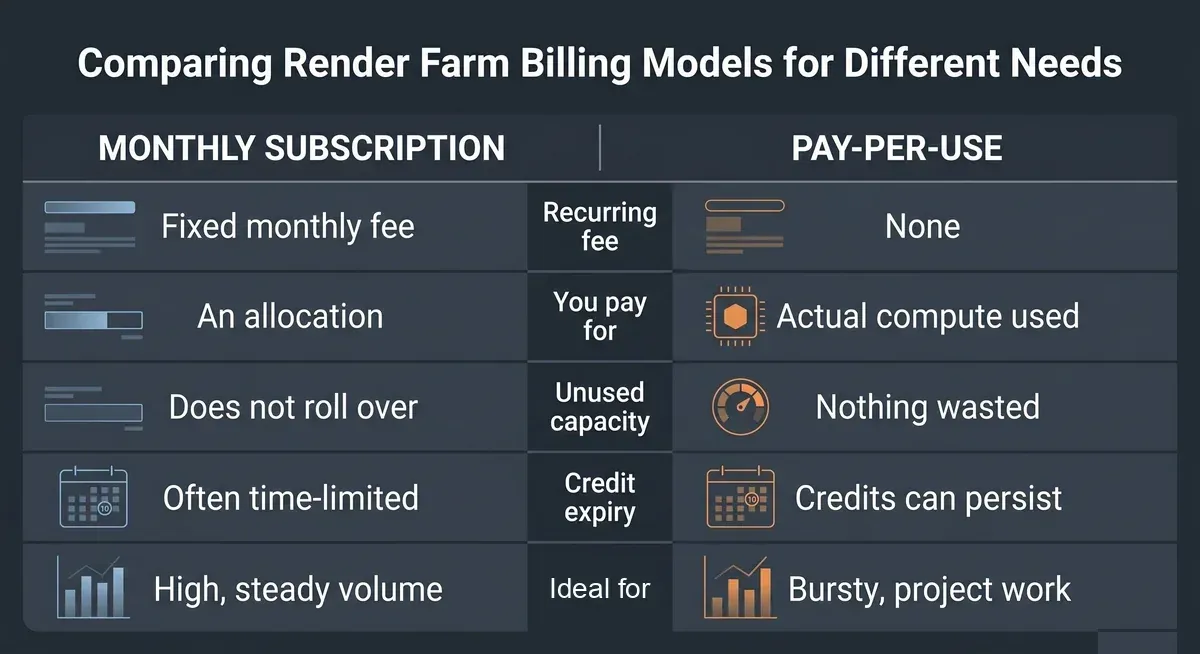 Comparison of monthly subscription versus pay-per-use render farm billing across recurring fee, what you pay for, unused capacity, credit expiry, and which workloads each model fits.
When a Subscription Actually Fits
A true monthly subscription — the recurring-fee kind — is the right tool for a real, if narrow, buyer profile. It is worth naming the conditions clearly.
The first is a high-volume, predictable workload. If a studio renders consistently above a known floor every month (say, 80,000–120,000 frames of archviz turntables for a long-running real estate client), a fixed allocation or flat-rate plan can match the demand curve. Predictable demand is the prerequisite — without it, the buyer pays for capacity they may not use.
The second is finance-team forecast pressure. Some studios cannot procure pay-per-use because their accounting treats variable opex differently from fixed opex, or because the project budget was approved as a flat monthly line item. In those environments, a recurring fee — even at a premium over metered billing — clears procurement faster.
The third is risk transfer. Some subscription contracts include guaranteed turnaround SLAs that pure pay-per-use models do not. A studio rendering against a hard broadcast deadline might pay for guaranteed priority access rather than rely on first-come capacity.
There is also a fourth, more specific case: a single-tool, high-utilization artist. The flat-rate unlimited plans that do exist tend to target one ecosystem (Blender, most visibly) and run on a shared queue with no priority guarantee and per-job time caps. For a solo artist or tiny studio that renders Blender almost every day and can live within those caps, a flat monthly fee can pencil out — the plan is effectively all-you-can-render for one engine.
These conditions describe a small minority of the studios we work with. They are real, but they are not the modal customer. Most are better served by a metered model where the bill matches the work done.
When Pay-Per-Use Wins
Pay-per-use fits the much larger market: anyone whose render demand is bursty, project-shaped, or below a high consistent floor.
Indie artists and freelancers rarely render every month. A motion designer might submit three weeks of intense Cinema 4D work, then go quiet for two weeks while iterating on storyboards for the next pitch. A subscription bills through those two quiet weeks; pay-per-use does not.
Project-shaped studios — most archviz shops, most VFX vendors below 30 people, almost all freelance compositors — render in cycles tied to client deadlines. Three jobs land in the same week, then nothing for ten days. Metered billing matches the actual cost curve; a fixed subscription forces them to pay an averaged rate that smooths over work they did not do.
Burst rendering — long simulation caches that need to finish overnight, last-minute revision sprints before a client review — benefits from on-demand access to large parallel capacity without contractual commitment. A pay-per-use farm with the spare nodes to absorb a 200-frame burst at 2am bills you only for that burst.
There is a fourth profile worth naming: studios in transition. A small studio that just won a larger contract does not yet know whether the new client volume will sustain. Pay-per-use lets them scale without a contract decision they cannot reverse if the renewal does not come. We have onboarded a number of studios in exactly this position, and they typically stay on metered billing even after the contract proves stable — the predictability turned out to be less valuable than the flexibility.
Billing Models Mapped to Buyer Profiles
The table below maps the most common buyer profiles to the billing model that matches their workload pattern. "Tied" means either model can work and the deciding factor is finance-team preference or contract structure rather than billing efficiency.
| Buyer profile | Subscription fit | Pay-per-use fit | Why |
|---|---|---|---|
| Archviz studio (5–20 artists, real-estate clients) | Tied | ✅ Better | Burst cycles around deadlines; idle weeks between projects make metered cheaper |
| Game cinematics / trailer team | — | ✅ Better | Intense short campaigns followed by long quiet periods; metered tracks the burst |
| VFX simulation team (Houdini, fluid/destruction) | — | ✅ Better | Cache sims spike compute for hours, then idle; an allocation never matches the sim profile |
| Cinema 4D motion design shop | — | ✅ Better | Mixed-volume client work; metered billing protects against short revision cycles |
| Solo Blender artist, renders daily | Tied | ✅ Better | A flat-rate single-engine plan can fit; metered still wins if volume is uneven |
| Enterprise studio with compliance contract | ✅ Better | Tied | Procurement-driven; fixed line item simplifies invoicing; SLA-style contracts may include guaranteed capacity |
Most profiles favor pay-per-use as the default. The exceptions — daily single-engine use and enterprise procurement — are real, but the enterprise case is a procurement-structure preference, not a billing-efficiency outcome. When the same enterprise is asked which model produces a lower total invoice over twelve months, the answer is almost always metered. They pay the premium for accounting reasons.
Worked Example: 500-Frame V-Ray Archviz Cost
To make the math concrete, here is a typical mid-complexity job costed three ways. The scene is 500 frames of an interior archviz walkthrough at 1080p, V-Ray CPU rendering, roughly 12 GHz-hours per frame on a single workstation, with mixed materials and moderate displacement.
Total compute required: 500 frames × 12 GHz-hours = 6,000 GHz-hours. (You can produce a job-specific number for your own scene with our cost calculator, which estimates total compute from your scene parameters.)
| Billing model | How it is charged | Cost for this job | What is included / excluded |
|---|---|---|---|
| Pay-per-use, metered (our model) | $0.004/GHz-hr × actual GHz-hours | $24.00 | V-Ray licensing included; no allocation, no overage; credits do not expire. If the cloud hardware averages 10.5 GHz-hr/frame instead of 12, the bill falls proportionally to ~$21.00 — you pay for actual usage. |
| Volume-bonus top-up (typical at other farms) | metered rate, minus a deposit bonus | lower headline, varies | A bonus is not a straight discount: a 10% credit bonus is roughly a 9% effective saving. Bonuses scale with prepay size, but so does the credit you have to commit up front. |
| Hypothetical flat subscription | $99/month for a 10,000 GHz-hr allocation | $59.40 equivalent | 6,000 ÷ 10,000 × $99. Unused allocation does not roll over; in any month you render less, you still pay the full $99. |
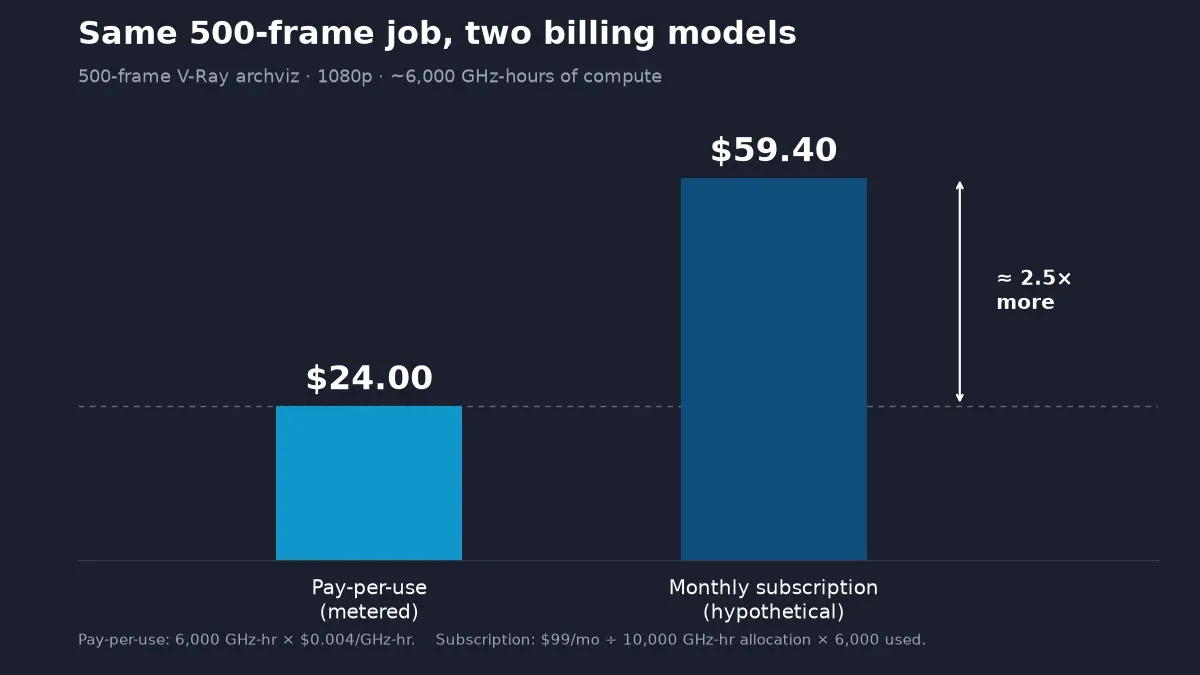 Bar chart: a 500-frame V-Ray archviz job costs $24.00 on pay-per-use metered billing versus $59.40 on a hypothetical monthly subscription — about 2.5 times more.
The metered model lands at $24.00 because you are billed for the 6,000 GHz-hours you used and nothing else. The hypothetical subscription costs roughly 2.5× more on this single job, and the gap widens with every quiet month: spread $99 across a slow quarter with one similar job, and the effective per-job cost climbs toward $148.50. This is the structural pattern — allocation-based plans overpay for capacity that does not roll forward.
For GPU-heavy jobs (Redshift, Octane, V-Ray GPU), the unit shifts from GHz-hours to OctaneBench-hours, billed on our farm at $0.003 per OBh. The structure is identical: a metered per-OBh bill tracks the compute a job actually burns, while an allocation-based plan bills the full block whether you use it or not. The exact figure depends on the scene's OBh profile rather than its frame count, so it is worth running your own scene through the calculator instead of trusting a flat per-frame estimate.
The Hidden Costs Buyers Miss
The headline rate is rarely the full story — on either side. Three cost categories show up in allocation-style and IaaS contracts and rarely in pure metered billing:
Unused allocation. The most common hidden cost of a fixed plan. A studio commits to 10,000 GHz-hours per month, uses 6,200 in an average month, and pays the full rate anyway. Over twelve months, that unused capacity is compute the studio paid for and never used — on a $99/month plan, roughly $450 a year in straight overpayment, before counting opportunity cost.
Overage rates. Allocation plans cap at the contracted volume; rendering beyond the cap typically incurs an overage rate well above the in-plan unit rate — often in the 1.5× to 3× range. A studio that occasionally needs a sprint week of double-volume rendering ends up paying premium rates for exactly the burst it would rather not pay premium for.
Idle and overhead time on machine rental. IaaS, remote-desktop, and per-node-hour models bill the clock, not the render. Boot, asset upload, setup, idle time between tasks, and download all run the meter. The practical effect is an overhead ratio — a 60-minute render can become a 90-minute billed session — and forgetting to shut a node down can quietly add real money to a bill. Metered, render-time-only billing sidesteps this category entirely.
A note on expiring credits, because the conventional wisdom here is mostly backwards. It is often assumed that prepaid render credits evaporate on a 30- or 90-day clock. In practice, paid balances at most major farms do not expire — several state explicitly that purchased credits roll over indefinitely. Where expiry is real, it usually applies to promotional, free-trial, or deposit-bonus credits — the credit you did not pay full price for — typically on a 30- to 90-day window. So the honest caution is narrow: read the expiry policy specifically for free and bonus credits, not for your paid balance. On our farm, both paid and trial credits never expire — including the $25 of free credit on a new account — which removes the one expiry case that does bite buyers elsewhere.
There is a fourth category that does not appear as a line item but shapes the contract: lock-in friction. Subscriptions and IaaS commitments often carry notice periods, minimum terms, or auto-renewal clauses. Pure pay-per-use does not. A studio whose project list changes mid-quarter can stop using a metered farm tomorrow and owe nothing further.
Hybrid Models: When They Make Sense
A small number of farms offer hybrid pricing: a low recurring fee that unlocks better per-unit rates, or a recurring fee that covers a baseline plus metered overage at a normal rate. These models are uncommon in 2026 and worth approaching carefully.
Hybrid pricing makes sense when the recurring fee is small enough that paying it during a quiet month does not change the studio's economics, and the per-unit discount it unlocks is large enough to justify the commitment over the volume the studio actually renders. In practice both conditions rarely hold together — the recurring fee is usually large enough to dominate the math in low-volume months, and the per-unit discount usually does not exceed what a volume-tier top-up would have delivered anyway.
The honest test for a hybrid offer: ask the farm to compute the break-even monthly volume at which the hybrid beats their own metered model. If the break-even sits below the studio's realistic floor every month, the hybrid wins. If it sits above the floor for even one or two months a year, the hybrid loses on the year.
A 5-Question Decision Checklist
These five questions, answered honestly, route most studios to the correct billing model without further analysis.
1. Do you render every month, without exception? If there is any month in a normal year when render volume drops below 30% of your average, pay-per-use almost certainly wins. Fixed plans bill you for the floor regardless of usage.
2. Is your monthly variance below 20%? If your highest-volume month is within 20% of your lowest, demand is predictable enough that a subscription allocation could match. If variance exceeds 20%, metered billing tracks the actual cost curve more closely.
3. Does your finance team require a fixed line item? This is a procurement question, not a billing question. If accounting cannot process variable opex, a subscription wins by default even when it costs more — the alternative is no rendering budget at all. Surface this conversation early in vendor selection.
4. Do you need contractually guaranteed turnaround? Most pay-per-use farms operate first-come capacity; queue position depends on current demand and the priority tier you choose. If a project has an SLA-style deadline that demands guaranteed priority, a subscription tier that includes it may justify the premium.
5. What does the worked math actually say? Take last year's actual render volume, compute it both ways, and compare. The exercise takes 30 minutes and produces a defensible number. Our cost-per-frame guide walks through the calculation with worked examples for archviz, VFX, and motion design workloads. Plenty of studios skip this step and overpay for years because the subscription pitch felt familiar.
If three or more of these point toward pay-per-use, the decision is effectively settled. In the studios we have onboarded, the answer is pay-per-use the large majority of the time. The exceptions have a real procurement or SLA constraint, and they should price the subscription premium against the value of that constraint — not against the raw compute cost.
FAQ
Q: Does Super Renders Farm offer a monthly subscription plan? A: No. We run a pay-per-use model, metered to the GHz-hours a job actually consumes, at a base rate of $0.004 per GHz-hour for CPU rendering. There are no plans or membership tiers, and every account pays the same base per-unit price; larger credit top-ups get an automatic volume discount of up to 30% off, applied at checkout with no code needed. There is no recurring fee, and render credits never expire. We chose against subscription pricing in 2017 because the workloads we serve — archviz, VFX, motion design, indie animation — rarely match a fixed allocation. The current rate card is on our pricing page.
Q: What does a 500-frame archviz job cost on a pay-per-use farm in 2026? A: For a mid-complexity 500-frame V-Ray CPU archviz scene at 1080p (roughly 6,000 GHz-hours of compute), metered billing at $0.004 per GHz-hour produces a bill near $24 on our farm, with V-Ray licensing included and no allocation or overage. The exact number depends on your scene, so it is worth running it through a cost calculator rather than trusting a flat per-frame quote.
Q: How do volume discounts on top-ups compare to a subscription discount? A: They produce an effective per-unit saving without a recurring fee, which is the appeal. But read the mechanics: a "bonus" is not a straight discount — a 100% credit bonus is a 50% effective saving, because you paid for half the credits you received. Bonuses also reset each top-up unless the farm uses a cumulative-spend membership tier. We do not run bonus tiers or subscription plans. Every account pays the same base per-unit price, and larger credit top-ups get an automatic volume discount of up to 30% off, applied at checkout with no code needed, so the saving is a straight discount rather than a bonus.
Q: Do prepaid render credits expire? A: It depends on the farm and, more importantly, on which credits. At most major farms, paid balances do not expire — several state that purchased credits roll over indefinitely. The expiry risk usually applies to promotional, free-trial, or bonus credits, often on a 30- to 90-day window. On our farm, both paid and trial credits never expire, including the $25 free credit on a new account — so read any expiry policy closely for the free and bonus credits specifically, since that is where the clock usually hides.
Q: When should an enterprise studio still choose a subscription model? A: When procurement requires a fixed recurring line item that variable metered billing cannot satisfy, or when the contract includes a guaranteed-turnaround SLA the studio's deadlines depend on. In both cases, the subscription premium buys a procurement or risk-transfer benefit rather than a lower compute cost. The rendering itself will almost always be cheaper on a metered model.
Q: What is the difference between a "subscription" and a volume-discount top-up? A: A true subscription is a recurring fee paid every month in exchange for an allocation or an unlimited-within-limits plan; unused allocation does not roll over, and overage is billed at a premium. A volume-discount top-up is a one-time deposit that unlocks a better per-unit rate on metered billing — no recurring fee, no allocation cap, no overage. Much of what is marketed as "subscription plans" in 2026 is actually a volume-discount top-up under subscription-flavored language, though a few genuine flat-rate plans do exist for specific single-engine workflows.
Q: Can I switch from a subscription to pay-per-use mid-contract? A: That depends on the subscription contract — notice periods, minimum terms, and auto-renewal clauses vary. The pay-per-use direction is always easier to switch into than out of, because there is no contract to exit. Studios planning a migration should align the switch with their renewal date to avoid paying for both models in parallel.
Q: How does metered billing change the math on short jobs? A: Metered GHz-hour billing charges for the compute a job actually uses rather than rounding up to a whole hour or a multi-hour rental block. On short revision passes — a few frames at a time, common in archviz client-review cycles — that avoids the rounding-up overhead and idle-time charges that whole-machine rental models impose. On long jobs the difference is small; on short, bursty work it adds up.
About Thierry Marc
3D Rendering Expert with over 10 years of experience in the industry. Specialized in Maya, Arnold, and high-end technical workflows for film and advertising.