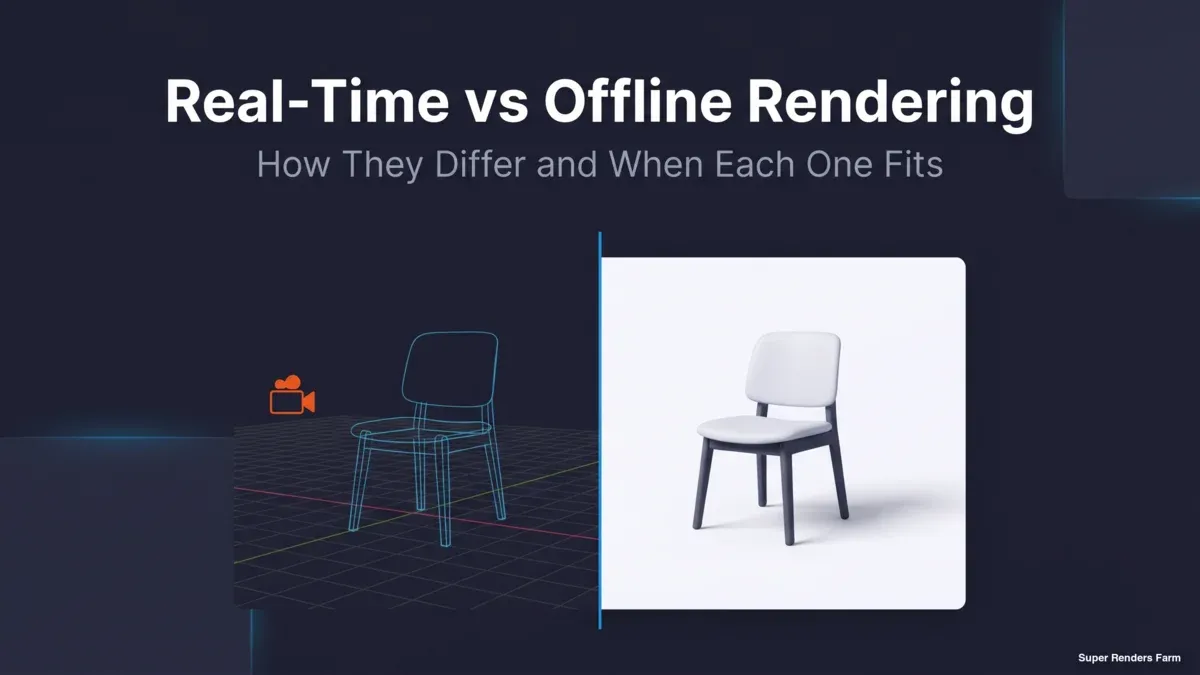
Real-Time vs Offline Rendering: How They Differ and When Each One Fits
Overview
Introduction
Real-time vs offline 3D rendering techniques differ in one basic way: how long the renderer may spend on each frame. A real-time engine has a few milliseconds, so you can orbit a model, swap a material and see the change at once. An offline renderer is allowed minutes or even hours per frame, and it spends that time on lighting that a live view cannot afford to calculate.
This guide is for designers, product visualization artists, archviz teams and 3D generalists choosing between real-time engines (Unreal Engine, Unity, Enscape, D5 Render, Lumion, Twinmotion) and offline renderers (V-Ray, Corona, Arnold, Redshift, Cycles, Karma, Octane). Games get one row, because our history of real-time ray tracing in games already covers that ground.
One honest point up front: real-time tools such as Enscape, D5 Render and Lumion render live on your own machine, and Super Renders Farm does not render their scenes. A render farm helps on the offline side, with heavy frames and long sequences.
Real-Time vs Offline 3D Rendering Techniques at a Glance
| Real-time rendering | Offline rendering | |
|---|---|---|
| Time per frame | Milliseconds (about 16.7 ms at 60 fps) | Seconds to hours, set by scene and quality |
| Core method | Rasterization, often with some ray-traced effects | Path tracing or other ray-tracing-based light simulation |
| While it runs | You move the camera and edit the scene live | You submit a frame or sequence and review it later |
| Typical output | Live views, walkthroughs, interactive apps, quick stills and videos | Final stills, animation frames, VFX plates |
| What limits quality | The frame budget | Render time, memory and schedule |
How Rasterization Draws a Frame
NVIDIA describes rasterization as building 3D objects from meshes of small triangles, converting those triangles into pixels on the screen, and then applying lighting and textures to set each pixel's color, with a depth buffer keeping the front-most objects visible (NVIDIA's explainer on ray tracing and rasterization, read 13 October 2026). Those steps suit specialized hardware, so a GPU can refresh a rasterized frame many times per second.
The price is that light is approximated rather than simulated: soft shadows, reflections and bounced light come from shortcuts such as precomputed lighting and screen-space effects. Blender's manual lists EEVEE as a real-time rasterization engine, fast and interactive, used for animation, previews, stylized rendering and real-time workflows (Blender manual, Render Engines, read 13 October 2026).
How Path Tracing Draws a Frame
Ray tracing works in reverse. NVIDIA describes it as following light backward from the viewer's eye into the scene, which naturally captures shadows, reflections and refractions, at a much higher computational cost (same NVIDIA explainer). Path tracing is the production form of that idea. Cycles uses unidirectional path tracing with multiple importance sampling and renders on both CPUs and GPUs (Blender's rendering features page, read 13 October 2026). Arnold and Karma are path tracers too, as the renderer table below shows.
The defining property is that the image converges. Each pixel is estimated from random light paths, so early results are noisy and more samples smooth them. Epic's Path Tracer in Unreal Engine shows this plainly: it progressively accumulates samples while the camera is still, and the accumulation resets when the camera moves or the scene changes (Epic's Path Tracer documentation, read 13 October 2026). Offline renderers use the same principle but let it run until the noise is acceptable for a final frame. Rasterization gives you an answer immediately and approximates it; path tracing gives you a better answer the longer you wait.
 Rasterization versus path tracing: rasterization projects triangles onto pixels and approximates light, path tracing follows light paths and averages many samples
What "Real-Time Ray Tracing" Means in 2026
The phrase covers a spectrum, not a single technique. Four points on it are worth separating.
- Rasterization with ray-traced effects. NVIDIA notes that ray tracing is often applied only where it helps most, with rasterization handling the rest. Unity's High Definition Render Pipeline works this way: it uses ray tracing to replace certain rasterized effects (screen space shadows, reflections and global illumination) and only through DirectX 12 (Unity's HDRP ray tracing documentation, read 13 October 2026).
- Dynamic global illumination. Epic describes Lumen as Unreal Engine's fully dynamic global illumination and reflections system, designed for next-generation consoles. It uses hardware ray tracing when available and falls back to software ray tracing otherwise (Epic's Lumen documentation, read 13 October 2026).
- Real-time ray-traced viewports. Chaos describes Vantage as a real-time ray-traced renderer built on the same technology as V-Ray. It needs no baking, produces stills and animations, and requires a DXR-compatible GPU (Chaos Vantage, read 13 October 2026).
- Progressive path tracing inside an engine. Epic calls its Path Tracer a progressive, hardware-accelerated mode suited to ground truth comparisons and production renders (Epic's Path Tracer documentation, linked above).
So when a vendor says "real-time ray tracing," ask which point on the spectrum they mean. Our games article explains the RT core and DLSS side of this.
Quality Ceilings: Where Each Approach Tops Out
Real-time is capped by its frame budget. At 60 fps there are roughly 16.7 ms to do everything: geometry, lighting, effects and display. Even Epic's Path Tracer lists limits: the HDRIBackdrop actor is incompatible, motion blur and Volumetric Clouds are only partially supported, and hair strands are marked experimental (Epic's Path Tracer documentation). Engines improve every release, so read such lists as snapshots.
Offline is capped by hardware and schedule. With no frame budget, a renderer can use more samples, bounces and heavier materials. NVIDIA notes that moviemakers can take as long as they like to render a single frame, so they render offline on render farms, and complex special effects can take days or even weeks to render (NVIDIA's explainer, linked above). GPU renderers add a memory ceiling: a scene performs best when it fits in video memory, and some engines, such as Redshift and Octane, can move part of the data out of core into system RAM at a speed cost. On our GPU nodes that means 32 GB per card, with VRAM not pooled across the two cards in a node.
Where the gap shows. For a clean product shot or a daylight exterior, a well-lit real-time image and an offline one can be hard to tell apart at normal viewing size. Differences tend to appear with difficult light, such as strong bounced light in interiors, glass and dense volumes, and in compositing control.
Time Per Frame: Milliseconds Against Minutes
A frame budget is simple arithmetic. At 60 fps, 1,000 ms divided by 60 gives about 16.7 ms; at 30 fps it is about 33.3 ms. An offline frame that takes 10 minutes is 600,000 ms, roughly 36,000 times the 60 fps budget.
The next example is arithmetic, not a benchmark. A 60-second animation at 30 fps is 1,800 frames. At 10 minutes per frame that is 18,000 minutes, or 300 hours: about 12.5 days of continuous rendering on one machine.
 Time per frame on a log scale: about 16.7 ms for a 60 fps real-time frame, about 33.3 ms at 30 fps, and 600,000 ms for a 10-minute offline frame
Time one representative frame and multiply by the frame count; our cost-per-frame guide shows the method and our render time optimization guide covers what moves the number.
Tools and Hardware on Each Side
Real-time tools
| Tool | What it is |
|---|---|
| Unreal Engine | Real-time engine with Lumen lighting and an optional Path Tracer (Epic documentation, linked above) |
| Unity | Engine whose HDRP can use ray tracing on DirectX 12 (Unity documentation, linked above) |
| Enscape | Real-time visualization inside design tools such as Revit, SketchUp, Rhino, Archicad and Vectorworks (Chaos Enscape, read 13 October 2026) |
| D5 Render | A production-level real-time rendering product for photorealistic visuals and interactive presentation (D5 Render, read 13 October 2026) |
| Lumion | Real-time 3D rendering software for architects, with LiveSync for CAD and BIM models (Lumion, read 13 October 2026) |
| Twinmotion | Live visualization built on Unreal Engine technology (Epic's Twinmotion documentation, read 13 October 2026) |
Offline renderers
| Renderer | Runs on |
|---|---|
| V-Ray | CPU, GPU or hybrid (Chaos V-Ray, read 13 October 2026) |
| Corona | CPU (Jon Peddie Research, read 13 October 2026) |
| Arnold | CPU and NVIDIA GPU, using unbiased, physically based Monte Carlo path tracing (Wikipedia's Arnold entry, read 13 October 2026) |
| Redshift | GPU, run on our GPU nodes only (Maxon's Redshift page, read 13 October 2026) |
| Cycles | CPU and GPU (Blender's rendering features page, linked above) |
| Karma | A path tracer with a CPU engine and Karma XPU, a hybrid that uses the CPU and the GPU (SideFX's Karma documentation, read 13 October 2026) |
| Octane | GPU, with RTX hardware ray tracing support (OTOY's OctaneRender page, read 13 October 2026) |
Real-time ray tracing needs a capable GPU: Epic's Path Tracer lists NVIDIA RTX cards and DXR-driver-enabled GTX cards on DirectX 12. Among offline engines, CPU renderers scale with core count and GPU renderers with video memory and card speed. On our farm, CPU engines account for the majority of jobs we render, on a fleet of 20,000+ CPU cores, and GPU jobs run on nodes with two NVIDIA RTX 5090 cards at 32 GB each, so plan scenes around 32 GB per card. Our GPU vs CPU rendering guide helps you choose.
Licensing and Cost Models
Both sides mostly sell subscriptions, with a few free or bundled exceptions. Enscape is sold as annual-billing plans with a 14-day free trial (Chaos Enscape, linked above). V-Ray and Corona are sold as subscription plans with named or floating licenses (Chaos V-Ray, linked above, and Chaos Corona, read 13 October 2026). Redshift is included with every Cinema 4D subscription (Maxon's Redshift page, linked above), and Blender, with Cycles, is described as free and open source (Blender's rendering features page, linked above). For Unreal Engine, Unity, D5 Render, Lumion and Twinmotion, confirm current terms on the vendor's site before budgeting.
On a managed render farm the licensing question changes shape. Render-engine licenses for V-Ray, Corona, Redshift and Arnold are covered in the usage rate, and Cycles needs none. Octane is ready on Cinema 4D and provisioned on request on the other host applications, with its license covered the same way; on those hosts, contact us to confirm before you upload. Billing is per use against prepaid credits; rates are on the pricing page, and the cost calculator turns a frame time and frame count into an estimate.
Hybrid Paths: Path Tracers in Engines, Real-Time Views of Offline Scenes
Many teams use both, in one of three ways.
A path tracer inside a real-time engine. Epic says the Path Tracer combined with Movie Render Queue allows substantially higher quality than could be achieved otherwise (Epic's Path Tracer documentation). The result is offline-style output with offline-style render times.
A real-time view of an offline scene. Vantage reads V-Ray, Corona and Enscape scene files and lets you explore them live (Chaos Vantage page, linked above); you judge composition interactively, then render finals offline.
Two engines in one application. Blender's manual points to Cycles for final output and to EEVEE or Workbench for interactive work and setup, and warns that switching engines can change how materials look (Blender manual, linked above). Our EEVEE vs Cycles comparison looks at the farm side of that choice.
 Hybrid workflow: iterate and review in a real-time view, then render approved frames offline, with a render farm for long sequences
One caution on engine-based farm rendering. Epic's command-line rendering documentation says the smallest unit of distributable work in Unreal Engine is a single camera cut, or Level Sequence Shot, rather than a frame, because the engine's real-time features rely on information from the previous frame and that data cannot be shared between machines (Epic's Movie Render Queue command-line documentation, read 13 October 2026). One long shot cannot be split frame by frame the way V-Ray or Arnold frames can.
Real-Time Rendering vs Offline Rendering for Product Design
Product design uses both ends at different stages. Early on, designers want variants, materials and cameras changed in seconds, and a real-time view makes review interactive. Epic's Product Configurator template for Unreal Engine shows how far that goes: it varies geometry, materials, visibility, camera and lighting, and builds its interface from variant data (Epic's Product Configurator template documentation, read 13 October 2026).
At the end, the deliverable is often a hero image, catalog shot or turntable that will be used for years. There the render time is cheap compared with a reflection or material that is slightly off, and an offline renderer such as V-Ray, Corona, Redshift or Octane is the usual choice. Our product visualization and VFX guide covers the production side.
Decision Table by Use Case
| Use case | Usually lean toward | Why | Where a farm helps |
|---|---|---|---|
| Product design review | Real-time | Fast iteration on materials, variants and camera | Not needed for live review |
| Product hero images and turntables | Offline | Maximum control and fidelity on a few frames | Heavy frames, many variants |
| Archviz stills | Offline for finals, real-time for client review | Quality on the final frame, speed during design | Large or complex final frames |
| Archviz animation | Either, by length and fidelity | Short flythroughs suit real-time; long, high-fidelity sequences suit offline | Long offline sequences |
| Film and VFX | Offline path tracers | Final-frame control and render-pass needs | Large frame counts |
| Games | Real-time | The image must be drawn as you play | Pre-rendered cinematics only, see our game cinematics guide |
| Configurators | Real-time | The customer changes options and expects an instant result | Pre-rendered image sets, if you choose that design |
Treat the table as a starting point, not a rule.
Where a Render Farm Fits, and Where It Does Not
What a farm does not do. Enscape, D5 Render and Lumion are built to render live on the workstation in front of you, and Super Renders Farm does not render their scenes. If a project lives entirely in one of those tools, a managed farm is not part of the answer.
What a farm does well. Offline frames and long sequences. A farm splits a sequence across many machines, so 300 hours do not run back to back on your desk. Our managed farm runs offline engines such as V-Ray, Corona, Arnold, Redshift, Cycles and Karma, and it also renders final frames with Blender's real-time EEVEE engine, though which engine runs on which host application varies and some pairings are provisioned on request, so check the supported software list and confirm with us before you upload. Fully managed means you do not install software or manage licenses, and new accounts receive $25 free render credits, which can time a representative frame before you commit to a sequence.
Unreal Engine. On our dedicated rental service you install your own Unreal Engine 5.x under your own license, Movie Render Queue works on the nodes, and Path Tracer output is supported with its known AOV limitations. That is a bring-your-own-license rental arrangement, not managed farm rendering of Unreal scenes; details are on the render farm rental page.
Our render farm industries page maps archviz, VFX and animation, motion design and product visualization to the engines and workflows involved, and what rendering means in computer graphics covers the fundamentals.
FAQ
Q: What is the difference between real-time and offline rendering? A: Real-time rendering draws each frame in milliseconds so you can interact with the scene, and it relies mostly on rasterization with some ray-traced effects. Offline rendering spends seconds to hours per frame simulating light with path tracing or similar methods, which is why it is used for final images and animation frames.
Q: Is real-time ray tracing the same as path tracing? A: Not necessarily. Real-time ray tracing ranges from a few ray-traced effects layered on rasterization to fully path-traced views. Path tracing is the method most offline renderers use, and some engines, such as Unreal Engine with its Path Tracer, offer it as a progressive mode that accumulates samples over time.
Q: Can real-time rendering match offline quality? A: For many clean, well-lit shots the results can be hard to tell apart. Offline renderers keep an advantage on difficult lighting, long sample budgets and render-pass control, because they have no frame budget. Test your own scene in both before deciding.
Q: Which is better for product design visualization? A: Use real-time rendering for design review, variants and configurators, and offline rendering for hero images, catalog shots and turntables where a few frames carry the message.
Q: Can a render farm render Enscape, D5 Render or Lumion scenes? A: Not on a managed render farm like ours. Those tools are built to render live on your own machine, and Super Renders Farm's managed service does not render their scenes. A managed farm is useful for offline engines such as V-Ray, Corona, Arnold, Redshift and Cycles, where frames are heavy or sequences are long.
Q: Can I render Unreal Engine sequences on a render farm? A: On our dedicated rental service you can install your own Unreal Engine 5.x under your own license and use Movie Render Queue and the Path Tracer, with the Path Tracer's known AOV limitations. It is a bring-your-own-license rental, not managed farm rendering, and Epic notes that the smallest distributable unit in Unreal Engine is a shot.
About Alice Harper
Blender and V-Ray specialist. Passionate about optimizing render workflows, sharing tips, and educating the 3D community to achieve photorealistic results faster.