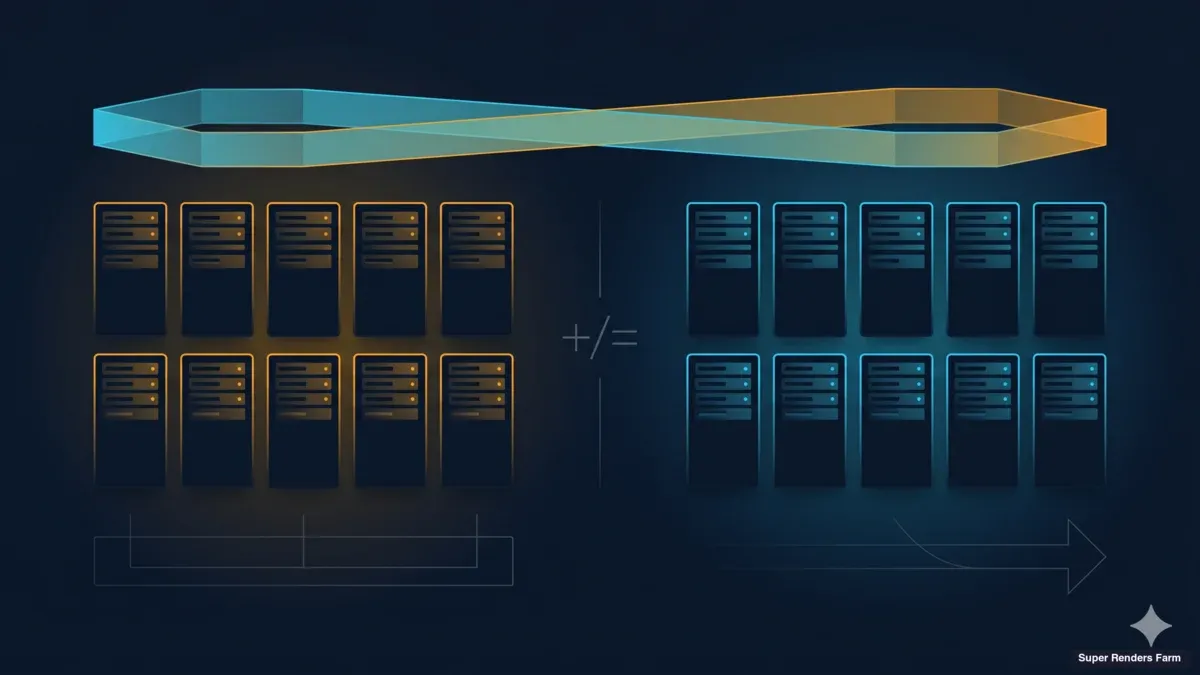
Hybrid Render Farm Infrastructure: Own + Rent for CapEx Flexibility
Overview
Introduction
Most studios evaluating a serious render-rendering infrastructure run into a familiar fork in the road. Owning a dedicated fleet of GPU nodes promises low long-run cost-per-frame and full IP control, but it locks several hundred thousand dollars of capital into hardware that depreciates whether the queue is full or empty. Renting from a managed render farm preserves cash flow and scales on demand, but a multi-year project at high utilization can eventually pay more in monthly rental fees than the owned hardware would have cost outright.
Hybrid render farm infrastructure is the third option that most CFOs eventually arrive at: own a baseline number of nodes sized to predictable load, and rent the rest on top to absorb peaks. The math is straightforward — a 50% / 50% own-to-rent split typically cuts upfront capital by half compared with owning the full fleet, while still delivering owned-node economics on the steady baseline. The harder work is deciding which workloads run on owned hardware, when to add rented capacity, and how to make a mixed fleet feel like a single render farm to the operators and artists using it.
This guide walks through how we think about hybrid infrastructure on our render farm — the model itself, the CapEx vs OpEx tradeoff math, the decision matrix for own vs rent, capacity planning patterns for ramp and scale-down, and the unified operational layer that lets a mixed fleet behave as one cluster from the user's perspective.
What Is Hybrid Render Farm Infrastructure?
A hybrid render farm combines a fleet of customer-owned (or studio-owned) GPU nodes with on-demand rented nodes from a managed render farm provider, all coordinated through a single network and management layer. The owned nodes typically handle baseline utilization — the day-in, day-out queue that you can confidently forecast — while the rented nodes flex up and down to handle project-level peaks, deadline crunches, and overflow.
In practical terms, a hybrid setup at the mid-size studio end might look like this: five to fifteen owned nodes installed in a colocation data center or on-premises rack, paired with another five to fifteen rented nodes provisioned through a dedicated cluster rental arrangement. Owned nodes are CapEx — they sit on the balance sheet and depreciate over three to five years. Rented nodes are OpEx — they appear as monthly line items, with no asset depreciation and no hardware risk on the studio's books.
What makes the model "hybrid" rather than "two separate farms" is the operational layer. Both groups of nodes register with the same render manager, sit on the same private network (over WireGuard tunnels), pull from the same shared asset cache, and appear in the same fleet dashboard. A render manager dispatching jobs doesn't see "owned vs rented" as two different queues — it sees one pool of available render slots, optionally labeled for capacity attribution but functionally interchangeable for most render workloads.
 Hybrid render farm topology — owned GPU nodes and on-demand rented nodes joined on one WireGuard network and shared asset cache, managed as a single fleet
Hybrid is distinct from "burst-to-cloud" in one important respect. Burst-to-cloud architectures typically keep most rendering local and only push overflow to a public cloud (often with significant data-transfer cost and DCC license complications). Hybrid render farm infrastructure treats the rented nodes as first-class members of the cluster — they are the same hardware class (for example, NVIDIA RTX 5090, 32 GB VRAM), often in the same colocation footprint or geographic region as the owned nodes, and they run continuously throughout the project rather than spinning up for short bursts.
CapEx vs OpEx Tradeoff Math
The choice between owning and renting render capacity comes down to a few cost components, and getting the math right matters because the numbers compound over multi-year horizons.
 CapEx versus OpEx for hybrid render farm infrastructure — owned-node capital cost compared with rented-node monthly operating cost across a project lifecycle
Owned node CapEx structure:
- Hardware purchase — GPU, chassis, motherboard, CPU, RAM, NVMe boot, network card. For a current-generation RTX 5090 workstation-class node, this is a meaningful upfront commitment per node.
- Data center hosting — rack space, power circuit allocation, cross-connects, and remote-hands service from a colocation provider. Charged monthly per U or per rack.
- Power consumption — RTX 5090 nodes draw roughly 500-600W at the wall under full render load. Power is billed by the colocation provider, typically as a base allocation plus metered overage.
- Maintenance and refresh — replacing failed PSUs, fans, drives, and GPUs over a 3-5 year service life. Some studios accrue a hardware reserve at 5-10% of original CapEx per year.
- Depreciation — for accounting, GPU rendering hardware is usually depreciated straight-line over 3-5 years. After year 5, the residual value on a render node is near zero (the GPU has been superseded by 2-3 generations).
Rented node OpEx structure:
- Monthly rental fee — covers the hardware, hosting, power, maintenance, and refresh in a single line item. No depreciation on your books, no hardware risk.
- Network and management — typically bundled into the rental price for a dedicated cluster arrangement. Pricing structures vary by provider — contact sales for current terms.
- Flexibility premium — the rental rate includes the provider's margin for absorbing utilization risk. Over a 3-5 year horizon at sustained high utilization, total OpEx will likely exceed equivalent CapEx.
The break-even question: at what utilization rate does owning outperform renting? The answer depends on hardware refresh timing, financing assumptions, IT overhead, and tax treatment, so it's worth running this analysis with your CFO using current vendor quotes rather than generic figures. The general pattern holds across most studios: sustained utilization above roughly 70% over a 3-year horizon tips toward owning; utilization below 50% with significant seasonality tips toward renting; the band in between is where hybrid wins.
50% Capital Savings Pattern
Here is the pattern that makes hybrid attractive to most mid-size studios, illustrated with generic numbers (not pricing).
A studio sizes its peak render need at 20 GPU nodes — enough to deliver weekly animation passes for a multi-project pipeline. Three procurement options exist:
| Option | Owned | Rented | Upfront capital | Cash flow profile |
|---|---|---|---|---|
| A: Fully owned | 20 | 0 | 100% baseline | Heavy upfront, low monthly |
| B: 50/50 hybrid | 10 | 10 | ~50% baseline | Moderate upfront, moderate monthly |
| C: Fully rented | 0 | 20 | 0% baseline | Zero upfront, higher monthly |
Option B — the 50/50 hybrid — cuts upfront capital roughly in half compared with Option A. The studio still owns enough nodes to handle baseline utilization at owned-node economics, but defers the second half of the capital outlay until project pipeline confirms it's truly needed. If the studio's project mix shifts and 20 nodes is more than they actually need, the rented half can scale down or terminate at the next billing cycle. If they grow and need 30 nodes, the rented half can scale up without a fresh capital approval.
The tradeoff is straightforward: ongoing OpEx is slightly higher long-term than Option A's pure-owned model, because the studio is paying the flexibility premium on the rented half. For most studios, the cash-flow benefit, the optionality, and the reduced hardware-obsolescence risk easily outweigh the OpEx premium.
There is one case where Option A still wins on pure cost: a studio with extremely predictable, sustained 90%+ utilization across a multi-year contract, with internal IT capacity to manage the hardware. That profile is rare — most studios overestimate their utilization confidence when they're sizing for peaks.
When to Own vs When to Rent
The own/rent decision is best framed as a matrix rather than a single break-even number. Four variables drive most of the answer:
| Variable | Owned wins when... | Rented wins when... |
|---|---|---|
| Utilization | Predictable, >70% sustained | Project-based, <50% or highly variable |
| Commitment horizon | Multi-year, locked-in pipeline | Single project or season, no long-term commit |
| IT capacity | In-house team to manage hardware refresh, monitoring, replacements | No internal IT or no desire to manage hardware |
| Upfront capital | Available; CapEx budget cycle aligns | Cash flow priority; no capital available this fiscal year |
Owned-node wins:
- Studio has 70%+ predictable utilization across a multi-year pipeline (long-running episodic, multi-season VFX, in-house archviz pipeline).
- ROI horizon of 3+ years justifies the upfront capital.
- Internal IT team can manage hardware lifecycle (or budget exists to colocate with a managed-services provider).
- Tax treatment favors capital depreciation over operating expense (jurisdiction-dependent).
Rented-node wins:
- Project-based business model where utilization swings between 30% and 90% across project cycles.
- Multi-month seasonal swings (creative agencies with quarterly campaign peaks, broadcast studios with episodic schedules).
- No internal IT capacity, or strategic decision to keep IT focused on artist-facing tools rather than render infrastructure.
- No upfront capital available, or CapEx approval friction makes capital deployment slower than project timelines.
Hybrid wins for most studios in between. A studio that's confident in baseline utilization for 8-10 nodes but uncertain about whether peak need is 15 or 25 has a textbook hybrid case: own the confident baseline, rent the uncertain peak. The own/rent ratio can shift over time as the studio learns its actual utilization curve.
Capacity Planning for Ramp + Scale-Down
A hybrid model works because it can flex against the typical project-cycle pattern. Most render workloads do not draw flat load across the week — they ramp up Monday and Tuesday as artists submit overnight work, peak Wednesday through Friday as deadline pressure builds, and scale down over the weekend (with the occasional all-hands sprint).
A studio running a project on a hybrid fleet typically sees a load curve like this:
- Monday morning: baseline load on owned nodes only. Rented capacity idle or released.
- Tuesday-Wednesday: load climbs as artists submit dailies and revisions. Rented nodes brought online to absorb the climb.
- Thursday-Friday: peak load. Both owned and rented fleets running at near-full utilization.
- Saturday-Sunday: load tapers. Rented nodes released or scaled down.
When a studio is running multiple overlapping projects, the rented portion absorbs the multi-project peak that exceeds owned capacity. This is where capacity planning gets interesting: the baseline of owned nodes is sized to handle one project's typical workload, while the rented headroom handles overlap from other concurrent projects.
The provisioning timeline on rented nodes matters here. With a dedicated cluster rental, nodes can typically be added in days rather than the weeks-to-months of CapEx procurement. This means the studio can react to actual workload signals (a new client win, a sudden deadline pull-in, a scope expansion) rather than guessing months in advance.
For scale-down, the principle is symmetric: when a project ends or pauses, the rented portion is released at the next billing cycle. The owned baseline stays in place, sized to the studio's sustained workload across all projects rather than the peak of any single one.
A common pattern is to keep the rented fleet sized at roughly 1x to 1.5x the owned fleet during active projects, then drop to zero rented nodes during pipeline gaps. The owned fleet handles maintenance work, R&D rendering, and any new project that fits within baseline capacity.
Operational Layer (Unified Management)
A hybrid fleet only works if the owned and rented halves feel like one cluster from the operator's and artist's perspective. That unification happens at four layers:
Network layer. Both fleets sit on the same private network, typically a WireGuard mesh. Owned nodes connect to the studio's WireGuard hub; rented nodes connect to the same hub via a site-to-site tunnel from the rental provider's edge. From any node's perspective, every other node is reachable on the same internal IP range. For more on the network architecture patterns for cross-country render farms that underpin this model, see our cross-country architecture deep-dive.
Cache layer. A shared asset cache (a single fast NVMe-backed SSD on a dedicated cache box) serves both fleets. Owned nodes and rented nodes mount the same SMB share, read assets at LAN speed, and never re-pull from the original cloud source after the first asset fetch. This is the same shared-cache pattern used in single-site dedicated clusters — the rented portion of the hybrid fleet inherits it transparently.
Render manager layer. The render manager (Deadline, Royal Render, or equivalent) sees both fleets as a single pool of slots. Node attestation labels (own vs rent) are available for capacity reporting and chargeback if the studio wants to separate cost accounting, but the scheduler does not need them — jobs dispatch to whichever slot is free first.
DCC and license layer. Whether nodes are owned or rented, the same DCC stack (for example, Cinema 4D + Redshift, Houdini, 3ds Max + Arnold, After Effects) runs on each node. License management — whether BYOL (bring-your-own-license) or rental-provider-supplied — operates the same way regardless of node ownership.
From the artist's perspective, submitting a job feels identical regardless of which node ultimately runs it. From the operator's perspective, fleet health, queue depth, and asset distribution are unified dashboards. The own-vs-rent distinction surfaces only in financial reports, not in operational workflows.
Use-Case Fit Matrix
Not every studio benefits equally from hybrid. The model fits best in a specific middle band of studio size and workflow pattern.
| Studio profile | Hybrid fit |
|---|---|
| Very small (1-5 artists, occasional rendering) | Poor — SaaS-only is simpler and cheaper |
| Small (5-15 artists, project-based) | Moderate — rental-only often sufficient unless utilization is sustained |
| Mid-size (10-50 artists, mixed pipeline) | Strong — classic hybrid sweet spot |
| Mid-size with seasonal swings | Strong — owned baseline + rented seasonal peak |
| Large (50-100 artists, multi-project) | Strong — hybrid scales well, often with 30/70 own/rent ratio |
| Very large (100+ artists, sustained pipeline) | Moderate — may justify fully-owned DC, but hybrid still works for overflow |
Strong hybrid fit:
- Mid-size studios (roughly 10-50 artists) with a mixed pipeline — animation, VFX, archviz, motion graphics — and project-based revenue. These studios usually have enough baseline work to justify some owned hardware, but enough project variance to need flexible top-up.
- Studios that have grown past the SaaS-only threshold (rental costs have become a meaningful line item) but not yet hit the scale where fully-owned DC ownership pencils out.
- Studios facing CapEx scrutiny — finance teams that want to defer capital commitments until utilization is proven.
Weak hybrid fit:
- Very small studios (fewer than 5 artists) where occasional rendering doesn't justify any owned hardware. SaaS-managed render farms or per-project dedicated cluster rentals are simpler.
- Very large studios (100+ artists) with sustained 90%+ utilization across a multi-year backlog. These often justify a fully-owned data center, though hybrid still works for overflow and disaster-recovery capacity.
The decision is less about "what size studio are you" and more about "how predictable is your render load." A small studio with rock-solid predictability can justify owning. A large studio with highly variable project intake might still want a meaningful rented portion.
FAQ
Q: What's the typical own/rent ratio for a hybrid render farm? A: There's no universal ratio, but most mid-size studios land somewhere between 30/70 and 70/30 own-to-rent. A studio confident in baseline load but uncertain about peaks often starts at 50/50, then adjusts after the first 6-12 months as actual utilization data accumulates. Studios with very stable pipelines drift toward owning more; studios with high project variance drift toward renting more.
Q: Can the own/rent ratio change mid-engagement? A: Yes. The owned portion is fixed at the studio's pace of hardware procurement, but the rented portion can scale up or down at each billing cycle. A studio that wins a large new project can add rented nodes within days; a studio that loses a project can release rented nodes at the end of the current month. The owned half provides stability; the rented half provides agility.
Q: Does the customer or artist know which nodes are owned vs rented? A: Operationally, no — the render manager treats both fleets as a single pool, and artists submit jobs without specifying node ownership. The distinction surfaces only in financial reports and fleet dashboards (where node attestation labels separate owned and rented for cost accounting). For most studios, this opacity is desirable: artists shouldn't have to think about infrastructure procurement.
Q: What if my utilization fluctuates 30-90% across the year? A: This is the textbook hybrid scenario. Size the owned fleet to the 30-40% baseline (the floor you can confidently forecast), and use rented capacity to ride the curve up to 90%. Over a full year, this typically produces 30-50% capital savings vs fully owned, with only a modest OpEx premium vs fully rented.
Q: How fast can rented nodes be added to a hybrid fleet? A: For a dedicated cluster rental with hardware available in the provider's inventory, additional nodes can typically be brought online in days rather than the weeks-to-months of fresh hardware procurement. Site-to-site WireGuard tunnel configuration and render-manager registration are the main steps; the actual hardware is already racked. Provisioning timing varies by provider — contact sales for current lead times.
Q: Is there a minimum ownership commitment for hybrid to make sense? A: Practically, the smallest hybrid setup is usually 3-5 owned nodes paired with rented capacity on top. Below that threshold, the operational overhead of managing owned hardware (replacements, monitoring, depreciation accounting) outweighs the savings. Studios at fewer than 3 nodes of confident baseline are usually better served by rental-only or SaaS-managed arrangements.
Q: What hardware specs should owned nodes match if I want them in the same fleet as rented nodes? A: Ideally, owned nodes match the rental provider's hardware class to keep render times consistent across the fleet. Current-generation NVIDIA RTX 5090 (32 GB VRAM) is the most common reference point in 2026 for production GPU rendering. Matching CPU, RAM, and storage class within reasonable tolerance keeps per-frame time predictable. See our RTX 5090 cluster performance guide for hardware specs for owned nodes.
Q: How is data security handled across owned and rented nodes? A: The unified network layer (WireGuard hub-and-spoke, host firewalls on each node, network segmentation per fleet) treats both ownership classes the same — nodes only see what they need to see, regardless of who owns the hardware. Customer-owned credentials (BYOC) for cloud storage and DCC licenses work identically on rented nodes, with end-of-engagement data wipe and reimage on the rented portion when the project ends.
About Alice Harper
Blender and V-Ray specialist. Passionate about optimizing render workflows, sharing tips, and educating the 3D community to achieve photorealistic results faster.