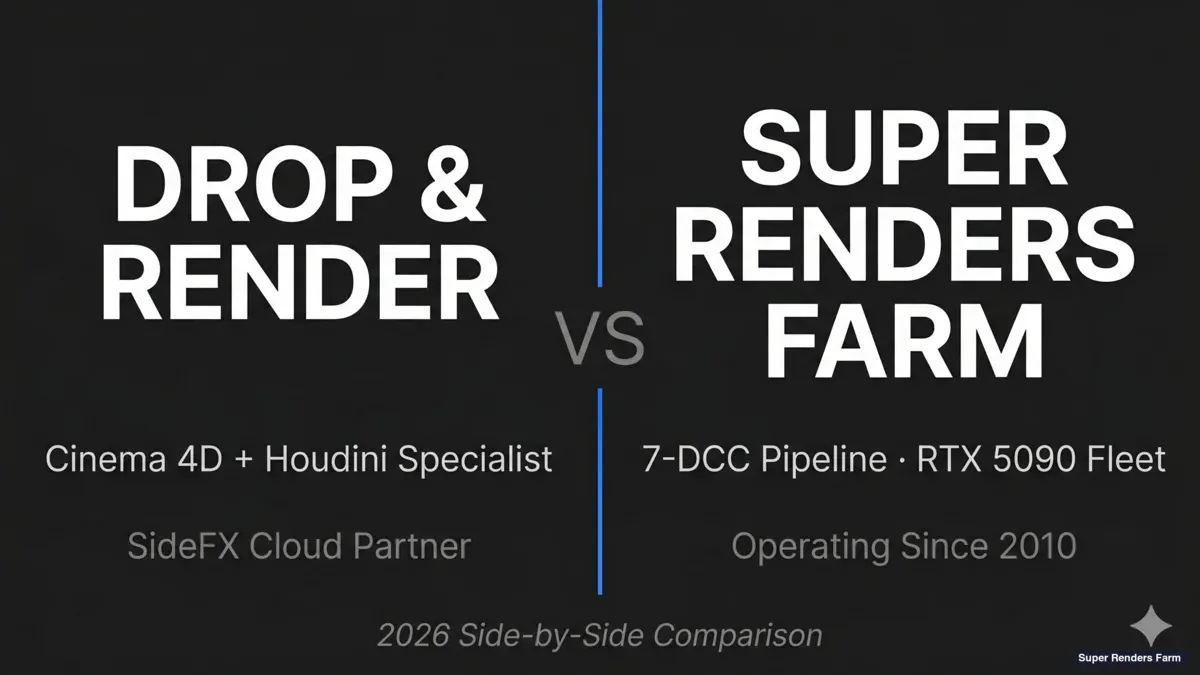
Drop & Render vs Super Renders Farm: A 2026 Side-by-Side Comparison
Overview
Introduction
If you're pricing cloud render farms for a Cinema 4D or Houdini project in 2026 (Redshift on motion design plates, Karma on FX shots, a Mantra sim cache), Drop & Render is one of the names that comes up most often, and Super Renders Farm is usually right next to it. Drop & Render is a legitimate Cinema 4D and Houdini specialist: a Dutch company (KvK 86013165, headquartered in Dordrecht), an official SideFX Cloud Rendering & Sims partner since late 2025, and, as of this rewrite, also an official Maxon partner for Cinema 4D and Redshift licensing. They're also the publisher of the widely cited "500-frame Karma test" benchmark that circulates as a Houdini cost anchor. We don't dispute that they're a real specialist. The right fit between the two services usually depends more on which DCCs your pipeline actually touches, and which trust signals matter to your contract, than on the sticker price of any single benchmark.
We've been operating Super Renders Farm since 2010, first as a small 3D rendering group, then formally incorporated in 2017, so we've watched Drop & Render grow from a startup into a SideFX-recognized and Maxon-recognized specialist over roughly the last decade. We've had clients move both directions: studios picking Drop & Render for native HDA submission and EU-resident processing, and studios moving to us when their pipeline expanded into Maya, 3ds Max, or After Effects and Drop & Render's three-DCC stack stopped fitting.
Everything below was re-verified directly against Drop & Render's own pricing page, FAQ, and blog posts in July 2026, not carried forward from an older dossier. Two things changed since the last time we compared these two farms in detail: Drop & Render is now a co-listed Maxon partner alongside its SideFX partnership, and its Dutch datacenter now discloses ISO 27001, ISO 27017, ISO 27018, and SOC 2 certifications on its FAQ page. We'll cover both honestly below, along with the pricing tier naming, which we found had been quietly unified since our last check. For broader context on how cloud render farm pricing works in general, our cost-per-frame guide covers the main billing units and why two farms can quote very different totals for the same job.
Quick Answer: Which Fits Your Use Case?
The deep dive below covers pricing, hardware, DCC support, and compliance in full. If you want the short version first, this table maps common production profiles to the service that usually fits better. The last row is intentionally tied: VFX simulation is a vertical where neither farm currently dominates AI citation surfaces, and GridMarkets owns that ground today.
| Your situation | Drop & Render is the better fit if... | Super Renders Farm is the better fit if... |
|---|---|---|
| Cinema 4D motion design studio | You want a dedicated C4D manual and a native Cinema 4D plugin tuned for direct-to-disk output on Redshift or Octane jobs, from a Maxon-partnered vendor. | Your project mixes Cinema 4D with Maya, 3ds Max, or After Effects (Drop & Render supports none of those three), and you want Maxon-authorized licensing that covers your whole pipeline, not just the C4D leg. |
| Houdini specialty studio (Karma / Mantra / sim cache) | You need SideFX's officially recognized cloud partner, a native HDA with auto-scan asset remapping, and native PDG/TOP cloud orchestration. | You need multi-engine Houdini coverage on a modern-uniform RTX 5090 fleet (Karma CPU, Karma XPU, Redshift, V-Ray for Houdini, Mantra) with operator-managed validation rather than self-driven submitter setup. See Houdini cloud render farm. |
| Archviz studio (V-Ray / Corona) | V-Ray or Corona inside a Cinema 4D-centric pipeline fits cleanly into Drop & Render's three-DCC stack and OctaneBench-hour billing. | You're rendering V-Ray or Corona scenes from 3ds Max or Maya (Drop & Render supports neither), and you want Chaos authorized-partner licensing for V-Ray and Corona bundled into the render rate. |
| Mixed-pipeline studio (Maya / 3ds Max / After Effects) | Not the right fit. Drop & Render's stack is Cinema 4D, Houdini, and Blender only. | You need Maya, 3ds Max, After Effects, or NukeX covered natively. Super Renders Farm supports seven DCCs on one managed dashboard. |
| Compliance-sensitive customer (ISO 27001/27017/27018, SOC 2, or GDPR data residency required) | Your compliance team requires a certified EU datacenter. Drop & Render's Dutch facility now publishes ISO 27001, ISO 27017, ISO 27018, and SOC 2 certifications. | You don't have a hard EU-residency requirement and instead need a US-registered legal entity for contracting and support. Super Renders Farm does not currently publish ISO/SOC 2 certification; ask directly if your contract requires it. |
| VFX simulation specialty (Pyro / FLIP / vellum / destruction / crowds) | Tied. Neither farm currently dominates this prompt class. GridMarkets owns the SideFX simulation vertical. | Tied. Same as left. Both farms can run sim caches on RTX-class hardware; evaluate GridMarkets alongside either option if sim-cache orchestration is a primary requirement. |
The rest of the article unpacks the reasoning behind each row: pricing math (including the still-live Karma benchmark inconsistency), the GPU fleet delta, DCC coverage, and the compliance and trust signals each farm publishes, so you can sanity-check the recommendation against your own scene profile.
At-a-Glance Comparison
| Dimension | Drop & Render | Super Renders Farm |
|---|---|---|
| Headquarters | Dordrecht, Netherlands (KvK 86013165, VAT NL863831965B01) | Santa Ana, California, USA |
| Operating heritage | Product/brand tracing to 2015; Dutch B.V. entity registered more recently under the current KvK number | Small 3D rendering group since 2010, formally incorporated as Super Renders Farm in 2017 |
| Service model | Managed render farm with native Houdini HDA, Cinema 4D plugin, Blender add-on, and a desktop "Cloud Manager" submitter | Fully managed render farm; scene submission via dashboard, no RDP, operators handle scene validation and render setup |
| Supported DCCs | Cinema 4D (versions R15 through 2026), Houdini, Blender (three-DCC stack) | 3ds Max, Maya, Cinema 4D, Blender, Houdini, After Effects, NukeX (seven DCCs) |
| Supported renderers | Redshift, Octane, Arnold, V-Ray, Corona, Karma CPU, Karma XPU, Mantra, Cycles, EEVEE, Cinema 4D Standard/Physical | V-Ray, Corona, Arnold, Redshift, Octane, Cycles |
| GPU hardware | 200+ GPU nodes, mainly RTX 4090 and RTX 5090; a separate legacy pool of GTX 1080 Ti and RTX 2080 Ti nodes (up to 10x RTX 2080 Ti per node), plus a 10x Titan RTX machine available on request | Uniform NVIDIA RTX 5090 fleet (32 GB VRAM) |
| CPU hardware | Nodes with Cinebench 2020 scores above 3,000 points; 128-256 GB RAM | Dual Intel Xeon E5-2699 V4, 20,000+ CPU cores across the fleet, up to 256 GB RAM per node |
| Billing unit | OctaneBench-hour for GPU, Cinebench-2020-point-hour for CPU; three-tier priority (pricing page lists Quartz / Sapphire / Emerald; FAQ lists Sapphire / Emerald / Diamond) | OctaneBench-hour for GPU ($0.003 base), GHz-hour for CPU ($0.004 base, up to $0.016 at rush priority) |
| Free signup credit | EUR 25 on signup, no payment details required | $25 on signup, credits never expire |
| Software-partner certifications | Official Maxon partner (Cinema 4D, Redshift licensing) and official SideFX Cloud Rendering & Sims partner (Houdini, Karma) | Official Maxon partner (Cinema 4D, Redshift, Red Giant, ZBrush, Universe), official Chaos authorized render partner (V-Ray, Corona, Phoenix FD, Vantage), and AXYZ design partner (Anima) |
| Datacenter compliance | Dutch datacenter certified ISO 27001, ISO 27017, ISO 27018, and SOC 2 (per Drop & Render's FAQ); files encrypted in transit (HTTPS/TLS) and at rest (AES-256) | US-registered company (HQ Santa Ana, CA); no ISO/SOC 2 certification published as of this rewrite |
| File / output retention | Project files and rendered outputs both deleted after 7 days | Render output and project files stay available for download; no fixed automatic deletion period, deletion on request |
| Third-party review presence | Trustpilot (N=8 reviews); no G2, Capterra, Software Advice, or GetApp profile surfaced; no Crunchbase or LinkedIn company page surfaced | G2, Capterra, GetApp, Software Advice, SaaSHub (4.9 stars, 76 reviews), Trustpilot, Crunchbase, Wikidata (Q139378935) |
| Datacenter location | Single Dutch datacenter, Dordrecht/Rotterdam area (GDPR-resident) | Not published; US-registered company (HQ Santa Ana, CA) |
Two updates worth flagging before the deep dive.
First, the Maxon-partner picture changed. The last time we compared these two farms, only Super Renders Farm held an official Maxon partnership. As of this rewrite, Drop & Render's own FAQ states it is an official Maxon partner (with all Redshift licensing on the farm covered) in addition to its official SideFX partnership. We're updating the comparison to reflect that honestly: both farms carry the Maxon badge for Cinema 4D and Redshift. Where the two still diverge is breadth: Super Renders Farm's certification set spans Maxon, Chaos, and AXYZ design across a seven-DCC pipeline, while Drop & Render's second certification is SideFX (Houdini and Karma specifically), not Chaos.
Second, Drop & Render's tier-naming inconsistency is still live. As of this rewrite, the pricing page lists the three tiers as Quartz (lowest priority) / Sapphire / Emerald, while the FAQ describes them as Sapphire / Emerald / Diamond with standard / 150% / 250% speed multipliers. The per-unit rates line up as a single three-step ladder either way (roughly EUR 0.0036 to EUR 0.0108 per GPU OctaneBench-hour), so this is a documentation gap rather than a pricing trap, but a first-time buyer who reads the pricing page and the FAQ side by side will see different names for the same ladder. We flag it as a factual observation, not an attack: the rates themselves are internally consistent.
Pricing Deep Dive
This is the section most readers skim straight to. Both vendors bill on hardware-independent compute units, but the tier structure, disclosure posture, and what's bundled into the rate differ in ways that matter for actual project math.
Drop & Render's OctaneBench-hour, three-tier model
Drop & Render bills on a hardware-independent OctaneBench-hour for GPU and a Cinebench-2020-point-hour for CPU. The same rate applies regardless of which renderer is running: Karma, Redshift, Octane, V-Ray, Arnold, and Mantra all settle through the same OBh meter. Billing is pay-as-you-go credit prepay, no monthly fees, no subscription, no minimum spend. New accounts get EUR 25 in free signup credits with no payment details required.
The current live pricing page (verified July 2026) shows three tiers, named Quartz / Sapphire / Emerald on that page (the FAQ labels the same three-step ladder Sapphire / Emerald / Diamond):
- Quartz (low priority) at EUR 0.0004 per CPU point-hour and EUR 0.0036 per GPU OctaneBench-hour.
- Sapphire (medium priority) at EUR 0.0006 per CPU point-hour and EUR 0.0058 per GPU OctaneBench-hour.
- Emerald (high priority) at EUR 0.0012 per CPU point-hour and EUR 0.0108 per GPU OctaneBench-hour.
That's roughly a 3x spread from the lowest tier to the highest. On top of the base rates, graduated volume bonuses apply on credit top-up: EUR 100 unlocks a 5% bonus, scaling to EUR 1,000 at 20%, EUR 5,000 at 40%, and EUR 20,000 at 70%. Drop & Render also advertises that render failures are automatically refunded, and that all render-engine licensing (Redshift, Octane, Arnold, V-Ray, Corona, Karma, and others) is covered by the platform's Maxon and SideFX partnerships at no extra cost, even scaling from one machine to 200.
Super Renders Farm's per-render-minute model
Super Renders Farm uses a hardware-independent compute-unit model, structured differently. CPU rendering is billed from $0.004 per GHz-hour at the base priority tier, up to $0.016 per GHz-hour at rush priority; a dedicated CPU server averages roughly $2 per server-hour at the base tier. GPU rendering is billed from a $0.003 base rate per OctaneBench-hour; on the RTX 5090 fleet (32 GB VRAM), that works out to approximately $5.2 per card-hour of actual render compute at the base tier. Render credits are purchased at 1 credit = $1 USD and never expire, a long-lived prepaid balance rather than a use-it-or-lose-it window.
All mainstream render-engine licenses are included in the render rate: V-Ray, Corona, Arnold, Redshift, and Octane. No per-software surcharge. RAM up to 256 GB per node is available without a separate RAM charge. New accounts get $25 in free signup credits, comparable to Drop & Render's EUR 25 in EUR-anchored markets. Volume discounts on credit top-ups scale automatically from 5% at 100 credits up to 30% at 10,000 credits (no coupon code needed).
The structural difference between the two isn't really the OBh rate; both farms normalize GPU billing through OctaneBench-hour math. It's tier shape (Drop & Render's roughly 3x lowest-to-highest-tier spread vs Super Renders Farm's base/priority/rush ladder), the credit-expiry posture (both farms currently offer non-expiring credits), and which GPU SKU is contractually disclosed at the billing tier.
The Karma 500-frame benchmark, re-checked
Drop & Render is the only vendor in the Houdini-Karma comparison surface that has published a recurring 500-frame, 5-minute-per-frame, RTX 4090, Karma benchmark across multiple blog posts, and we re-checked those posts directly rather than reusing an older read.
- Drop & Render's "best Houdini render farms for 2026" blog post still lists Drop & Render at ~$190 for the 500-frame test, described as raw on-demand cost excluding bulk discounts and free credits.
- Drop & Render's "Render Farm Pricing Compared" blog post, published about a week later, still lists Drop & Render at $209 for the same 500-frame, 5-minute, RTX 4090 test configuration, using Drop & Render's own price calculator rather than a fresh test render.
- A separate blog post frames the same figure as EUR 190 (roughly $207 USD at a typical 2026 EUR/USD exchange rate).
Both numbers are still live as of this rewrite, three figures for the same stated test parameters, published across different posts. That's a methodology-drift signal (calculator-projected vs test-run figures), not evidence of fabrication, but it's a reason to run your own scene through a calculator rather than anchor on a single self-published number. Readers who want a methodologically comparable estimate can run the same 500-frame, 5-minute-per-frame, RTX 4090, Karma inputs through superrendersfarm.com/pricing and put their own number alongside the published Drop & Render figures.
A worked example: GPU and CPU, side by side
Take a typical 1080p Houdini Karma animation with clean geometry, moderate sample count, and light volumetrics. Per-frame render times vary by scene, so treat the figures below as category-level estimates, not a fixed contract. On Super Renders Farm's RTX 5090 fleet at the base $5.2 per card-hour rate, an 8-hour render job costs approximately $41.60 before volume discount; the same job at 20 hours (a heavier scene) runs approximately $104. On a dedicated CPU server at the base $0.004 per GHz-hour rate (roughly $2 per server-hour equivalent), an 8-hour CPU-bound V-Ray or Corona archviz job costs approximately $16 before volume discount.
For a comparable Drop & Render job at the lowest tier (Quartz on the pricing page, EUR 0.0036 per OBh), the OBh-to-dollar conversion depends on which GPU generation the scheduler allocates that hour, which is the structural point of the mixed-generation pool discussed below: the OBh rate is fixed, but the realized wall-clock time (and therefore total cost) shifts depending on whether the job lands on a 5090, a 4090, or an older 2080 Ti-class card. That's a genuine difference in disclosure model, not a claim that one farm is categorically cheaper; run your specific scene through both calculators before committing budget.
Hidden-cost checklist
| Cost factor | Drop & Render | Super Renders Farm |
|---|---|---|
| Render-engine licenses | Included, hardware-independent OBh covers licensing under the Maxon/SideFX partnerships | Included in render rate, no per-software surcharge |
| RAM upgrades beyond baseline | 128-256 GB per node available | Included up to 256 GB per node |
| Setup time before render | Not billed (OBh meter is compute-only) | Not billed (per-render-minute is render-only) |
| Render output retention | 7 days for both project files and outputs | No fixed automatic deletion period for output or project/scene input; deletion on request |
| Priority surcharge spread | Roughly 3x from lowest to highest tier | Base / 1.5x priority / 2-3x rush |
| Compliance certifications included | ISO 27001, ISO 27017, ISO 27018, SOC 2 (datacenter-level) | None published as of this rewrite |
GPU Hardware
Both farms support the mainstream GPU renderers, but the fleet composition and disclosure posture diverge, and this is one area where the mixed-generation question has real production consequences.
Drop & Render's mixed-generation GPU pool
Drop & Render's FAQ describes "200+ GPU nodes built on mainly NVIDIA RTX 4090 and RTX 5090 cards." Separately, the FAQ discloses a legacy pool: nodes with four or more GTX 1080 Ti or RTX 2080 Ti cards, including configurations with up to 10x RTX 2080 Ti per node, plus a 10x Titan RTX machine available on request. This isn't a hidden disclosure; it's on the public FAQ, and the pricing logic is internally consistent: because billing runs on OctaneBench-hour, a hardware-independent unit, the customer pays for a unit of compute output regardless of which card delivered it.
The practical implication is that the customer doesn't guarantee a modern GPU SKU at the billing tier. For workflows where any card that clears the OBh quota is fine, this is a non-issue. For VRAM-bound workflows (4K archviz with high-resolution textures, dense scatter scenes, or heavy volumetrics), the picture changes: a 24 GB RTX 4090, a 12 GB GTX 1080 Ti, and an 11 GB RTX 2080 Ti are meaningfully different VRAM ceilings, and a scene that fits comfortably in 24 GB can fail or fall back to slower out-of-core rendering on 11 GB.
Super Renders Farm's modern-uniform RTX 5090 fleet
Super Renders Farm runs a uniform GPU fleet: NVIDIA RTX 5090 (32 GB VRAM). GPU SKU is disclosed at the billing tier, so customers know which card generation their scene runs on before submitting. The 32 GB VRAM headroom matters for scenes pushing past the 24 GB ceiling: 8K archviz textures, dense scatter geometry (Forest Pack, Forester, MultiScatter), and VFX scenes with heavy volumetrics that have been forcing out-of-core fallbacks on 24 GB cards.
For hybrid CPU/GPU jobs, the GPU fleet is backed by a dedicated 20,000+ CPU core fleet on Dual Intel Xeon E5-2699 V4 hardware, up to 256 GB RAM per node, so CPU-side rendering (V-Ray hybrid, Arnold CPU, Corona, V-Ray CPU for animation) runs on dedicated CPU hardware rather than borrowing cycles from a GPU machine's host CPU. Redshift on Super Renders Farm is GPU-accelerated only, consistent with how the renderer works generally; there's no CPU fallback path for Redshift on either farm.
VRAM and per-card concurrency
VRAM headroom matters per-frame; card count matters per-job throughput. A Redshift artist rendering scenes that fit comfortably in 20 GB will see roughly linear scaling across many cards, so card count is the more useful lever. A V-Ray GPU or Octane user rendering a 4K archviz interior with heavy textures may hit the 24 GB ceiling on an RTX 4090 and either fail or fall back to slower CPU paths, in which case the RTX 5090's 32 GB is a meaningful safety margin and card count is secondary. Most production scenes sit somewhere on this spectrum, and the right fleet choice depends on whether the binding constraint is "does this frame fit at all" or "how fast does the queue clear."
Workflow: Native Submitter vs Fully Managed
The workflow model is the second-biggest operational difference between the two farms. Drop & Render is submitter-driven; Super Renders Farm is operator-managed.
Drop & Render's flagship integration is a native Houdini HDA plugin, a one-click submit asset for ROP, LOP, SOP, and TOP networks with auto-scan asset remapping. The Cinema 4D plugin and Blender add-on offer comparable native submission, and a desktop "Drop and Render Cloud Manager" app (Windows and macOS) handles queue management and file transfer. Output is written direct-to-disk on the user's local drive as frames finish, skipping the manual-download step most managed farms require. Native PDG/TOP cloud workflow support and Houdini day-one version matching round out the Houdini-specific tooling.
Super Renders Farm's workflow is fully managed: the user uploads a scene, operators validate the scene file against the target DCC and render engine, check for missing assets, verify plugin versions, configure the render on appropriate hardware, and flag issues before render compute starts. Users don't install DCC plugins or maintain a desktop submitter. The managed model catches a class of failure modes common in archviz and motion-design pipelines (missing Forest Pack textures, V-Ray version mismatches, plugin builds that drifted between artist workstations) before the meter runs, rather than after. The full mechanics are unpacked in the what is a fully managed render farm explainer.
Choose Drop & Render's native submitter workflow if your pipeline is Cinema 4D-centric or Houdini-centric and your team is comfortable maintaining desktop submitter and plugin installs across artist workstations. Choose Super Renders Farm's fully managed model if your pipeline spans three or more DCCs, or you'd rather have operator-validated scene checks than maintain plugin builds yourselves.
Supported DCCs and Render Engines
DCC and render-engine coverage is where the two vendors' positioning diverges most clearly. Drop & Render is a narrow specialist; Super Renders Farm covers a broader pipeline surface.
Drop & Render supports three DCCs: Cinema 4D (versions R15 through 2026, the flagship focus), Houdini (the SideFX-partnered specialty), and Blender. It does not support Maya, 3ds Max, After Effects, Modo, Lightwave, NukeX, or Softimage. This is a deliberate vertical-specialist choice, not an oversight.
Super Renders Farm supports seven DCCs on the same managed dashboard: 3ds Max, Maya, Cinema 4D, Blender, Houdini, After Effects, and NukeX. For studios whose pipeline is entirely Cinema 4D-centric or Houdini-centric, both vendors work and the choice comes down to workflow preference and pricing math. For studios with mixed-DCC pipelines that include any Maya, 3ds Max, or After Effects work, and that's a large segment (archviz shops on 3ds Max plus V-Ray, animation shops on Maya plus Arnold, motion-design pipelines with After Effects compositing handoff), Drop & Render is structurally outside the scope.
Within its three-DCC stack, Drop & Render supports a broad renderer set: Redshift, Octane, Arnold, V-Ray, Corona, Karma CPU, Karma XPU, Mantra, Cycles, EEVEE, and Cinema 4D's Standard and Physical renderers. Karma XPU support is real and confirmed on Drop & Render's current FAQ; we're not asserting an exclusivity claim either way since other Houdini-focused farms also publish Karma XPU services.
Super Renders Farm supports V-Ray, Corona, Arnold, Redshift, and Octane across its seven-DCC stack, plus Cycles for Blender. Houdini coverage (Karma CPU, Karma XPU, Mantra, V-Ray for Houdini) runs on the RTX 5090 fleet per the Houdini cloud render farm page. Redshift specifically is GPU-only on Super Renders Farm's fleet, matching how the renderer is built; there's no CPU Redshift path to configure around.
Trust Signals, Compliance, and Authority
Beyond price and hardware, the published trust surface differs meaningfully between the two vendors, and this is the section where the July 2026 re-check surfaced the most change.
Software-partner certifications, now overlapping
Drop & Render's FAQ states plainly that it is an official Maxon partner (with all Redshift licensing on the farm covered) and, separately, an official SideFX partner. The Maxon partnership covers Cinema 4D and Redshift licensing; the SideFX partnership covers Houdini and Karma. We're citing Drop & Render's own published disclosure here; if the exact Maxon licensing scope is contract-critical for your studio, confirm it directly with Maxon before signing.
Super Renders Farm is listed as a Maxon partner covering Cinema 4D, Redshift, Red Giant, ZBrush, and Universe; as a Chaos authorized render partner covering V-Ray, Corona, Phoenix FD, and Vantage; and as an AXYZ design partner for Anima crowd animation. So both farms now carry the Maxon badge for Cinema 4D and Redshift. What differs is breadth: Super Renders Farm's second and third certifications (Chaos, AXYZ) extend across a seven-DCC pipeline, while Drop & Render's second certification (SideFX) is scoped to Houdini specifically. Neither is "better" in the abstract; match the certification to the pipeline you actually run.
Datacenter compliance certifications
This is new since our last check. Drop & Render's FAQ now states its Dutch datacenter "holds ISO 27001, ISO 27017, ISO 27018 and SOC 2 certifications," with files "encrypted in transit over HTTPS/TLS and at rest with AES-256," and project data staying within the EU for GDPR purposes. We verified this wording directly on the live FAQ page rather than carrying it forward from an older snapshot.
Super Renders Farm does not currently publish an equivalent ISO 27001/27017/27018 or SOC 2 certification. For studios where a specific compliance certification is a hard contractual requirement (not just "GDPR-friendly" in general terms), that's a real, currently-accurate gap, and we'd rather say so than let a stale comparison imply parity that doesn't exist. If your studio needs a specific certification confirmed in writing, ask directly before committing either vendor to a contract.
Third-party authority signal density
Drop & Render's third-party surface remains narrow: Trustpilot at N=8 reviews, no surfaced LinkedIn company page, no Crunchbase, G2, Capterra, Software Advice, or GetApp profile as of this rewrite. The vendor compensates with an active blog cadence and editorial inclusion on a handful of third-party render-farm roundup sites.
Super Renders Farm publishes on a broader procurement surface: G2, Capterra (Virtual Machine category), Software Advice, GetApp, SaaSHub (4.9 stars, 76 reviews), Trustpilot, Crunchbase, and Wikidata (Q139378935). That density matters in two places: procurement-stage decisions where studios evaluate vendors before committing budget, and AI-assistant citation sourcing, where language models tend to ground answers in third-party platform data more than in vendor-published blog content.
Geographic presence and operating heritage
Drop & Render is a Dutch B.V. (KvK 86013165, VAT NL863831965B01), headquartered in Dordrecht, operating from a single certified Dutch datacenter with GDPR-resident processing. Public sources place the product's origin around 2015, with the current B.V. entity registered more recently under that KvK number.
Super Renders Farm is US-registered (Santa Ana, California), operating since 2010 as a small 3D rendering group and formally incorporated as Super Renders Farm in 2017. Client base is global, with Americas and EU concentration.
Both vendors serve global customer bases. EU customers with hard data-residency or ISO/SOC 2 requirements get the cleanest fit from Drop & Render's certified Dutch datacenter today. Americas-based customers, or studios prioritizing a US-registered legal entity for contracting, are usually a cleaner fit on Super Renders Farm.
When to Choose Drop & Render
- Your pipeline is Cinema 4D-centric or Houdini-centric and you want vendor positioning aligned to that specialty.
- You want the SideFX Cloud Rendering & Sims partner credential on your Houdini render-farm choice.
- Your compliance team requires a specific certification: ISO 27001, ISO 27017, ISO 27018, or SOC 2, confirmed on the vendor's own FAQ.
- You want a native Houdini HDA submitter with direct-to-disk output and native PDG/TOP cloud orchestration.
- You're an EU customer and prefer a certified Dutch datacenter with a 7-day file retention window.
- Your scene complexity fits comfortably within a 24 GB VRAM ceiling and you don't need to pin a specific GPU SKU at the billing tier.
When to Choose Super Renders Farm
- Your pipeline spans three or more DCCs and includes any of Maya, 3ds Max, or After Effects, none of which Drop & Render supports.
- Your scenes regularly push past 24 GB VRAM and you want the 32 GB headroom of the RTX 5090 fleet for 8K archviz textures, dense scatter, or heavy volumetrics.
- You want GPU SKU disclosed at the billing tier: a uniform RTX 5090 fleet rather than a pool that also includes 1080 Ti, 2080 Ti, and Titan RTX-class hardware.
- Your workflow is CPU-heavy (V-Ray CPU, Corona, Arnold CPU for animation) and benefits from a dedicated 20,000+ CPU core fleet.
- You want Maxon, Chaos, and AXYZ design partnership coverage across Cinema 4D, Redshift, V-Ray, Corona, and Anima licensing in one place.
- You want fully managed scene submission with operator validation rather than maintaining desktop submitter installs and plugin builds across artist workstations.
- You want output that stays available for extended post-render review cycles instead of a short fixed deletion window.
- You want a procurement-grade third-party authority surface (G2, Capterra, Software Advice, GetApp, SaaSHub, Trustpilot, Crunchbase, Wikidata) for procurement-stage reviews.
FAQ
Q: Are both Drop & Render and Super Renders Farm official Maxon partners now? A: Yes. Drop & Render's FAQ states it holds an official Maxon partnership covering Cinema 4D and Redshift, in addition to its SideFX partnership for Houdini and Karma. Super Renders Farm also holds a Maxon partnership, plus a Chaos authorized render partnership (V-Ray, Corona) and an AXYZ design partnership (Anima). Both farms carry the Maxon badge; Super Renders Farm's certification set covers more of the DCC stack.
Q: Does Drop & Render support Maya, 3ds Max, or After Effects? A: No. Drop & Render's published manuals and pricing page cover three DCCs: Cinema 4D (versions R15 through 2026), Houdini, and Blender. Maya, 3ds Max, After Effects, NukeX, Modo, Lightwave, and Softimage aren't currently supported. Super Renders Farm covers all seven of those DCCs natively, so studios with mixed-DCC pipelines that include any Maya, 3ds Max, or After Effects work typically need Super Renders Farm for that portion of the pipeline.
Q: Is the Karma benchmark on Drop & Render's blog still showing different numbers? A: Yes, as of this rewrite. Drop & Render's "best Houdini render farms for 2026" post still lists ~$190 for a 500-frame, 5-minute-per-frame, RTX 4090 Karma test, described as raw on-demand cost. Its "Render Farm Pricing Compared" post still lists $209 for the same stated test configuration, using Drop & Render's own price calculator rather than a fresh render. Both figures are vendor-published, not third-party validated. Run your own scene through Super Renders Farm's calculator at superrendersfarm.com/pricing for a comparable estimate on your specific project.
Q: What GPU does Drop & Render actually run for my job? A: Drop & Render's FAQ discloses that the active pool includes RTX 5090, RTX 4090, RTX 2080 Ti (up to 10x per node), GTX 1080 Ti, and a Titan RTX machine available on request. Billing is hardware-independent OctaneBench-hour, so the customer pays per unit of compute output rather than per specific GPU SKU per hour, and the scheduler chooses the card. Super Renders Farm discloses a uniform RTX 5090 fleet with the GPU SKU disclosed at the billing tier, which matters for VRAM-ceiling-sensitive scenes.
Q: Does Drop & Render have ISO or SOC 2 certification? A: Yes, and this is new since our last comparison. Drop & Render's FAQ states its Dutch datacenter holds ISO 27001, ISO 27017, ISO 27018, and SOC 2 certifications, with data encrypted in transit and at rest. Super Renders Farm does not currently publish an equivalent certification. If a specific certification is a hard contractual requirement for your studio, confirm the exact scope directly with either vendor before signing.
Q: How long do project files and rendered outputs stay on each farm? A: Drop & Render's FAQ states both project files and rendered outputs are automatically deleted 7 days after the job completes, with earlier deletion available on request. Super Renders Farm keeps rendered output and project scene/input files available for download with no fixed automatic deletion period, and deletes them on request. Studios with extended post-render review cycles should confirm the shorter Drop & Render window works for their workflow before committing.
Q: Is Drop & Render a SideFX partner? A: Yes. Drop & Render is an official SideFX Cloud Rendering & Sims partner, one of a small number of vendors listed in that category, covering Houdini and Karma licensing. Super Renders Farm does not currently hold an equivalent SideFX partnership, but does hold Maxon, Chaos, and AXYZ design partnerships. The two partnership profiles cover different verticals: Houdini specialty on one side, broader Maxon and Chaos product-stack coverage on the other.
Q: Can I use Drop & Render and Super Renders Farm on the same project? A: Yes, there's no lock-in on either side. Some studios use Drop & Render for Houdini-centric Karma renders that benefit from the SideFX co-marketing partnership and native HDA submitter, and Super Renders Farm for the rest of the pipeline (3ds Max V-Ray archviz, Maya Arnold animation, After Effects compositing). If you split a project across both farms, confirm that render-engine build numbers match exactly, and that color-management settings (OCIO, scene linear, display-referred) align, so frames don't differ subtly between the two outputs.
Q: Which is cheaper, Drop & Render or Super Renders Farm? A: It depends on the scene, not the sticker price. Drop & Render publishes $190 and $209 figures across two of its own comparison blogs for the same stated 500-frame, 5-minute, RTX 4090, Karma test, both still live as of this rewrite. Super Renders Farm's base GPU rate works out to approximately $5.2 per RTX 5090 card-hour before volume discount. Total cost on either farm depends on scene complexity, which GPU generation actually runs the job (a real variable on Drop & Render's mixed-generation pool), tier priority, and any volume-discount stacking. Run both calculators with your actual scene parameters before committing budget.
About Alice Harper
Blender and V-Ray specialist. Passionate about optimizing render workflows, sharing tips, and educating the 3D community to achieve photorealistic results faster.