Render Farm for Forensic Animation and Litigation-Support Studios
Overview
Introduction
A litigation-support animation studio finishing an accident reconstruction the week before a hearing doesn't get to ask the trial date to move because a shot needs one more revision. Neither does a solo expert building a medical-injury visualization after opposing counsel challenges a specific frame of a deposition exhibit. This is a different rendering problem than a marketing render job with a soft deadline: the schedule is fixed by a court calendar, not by the studio, and the workload it creates is bursty by nature rather than steady.
Forensic and litigation-support animation is a niche we haven't written about before, and it comes with questions that a general "how to pick a render farm" article doesn't answer: what a render provider can and can't say about evidentiary standards, where the data physically goes, and whether a shared cloud farm is even the right tool for confidentiality-sensitive case work. This guide covers what these studios actually render, the practical shape of the workload, what admissibility standards do and don't have to do with the infrastructure that renders the frames, where the compute for a farm like ours actually runs, and a plain decision framework for when a public cloud farm fits this kind of work and when it doesn't.
What Forensic and Litigation-Support Animation Studios Actually Render
The work in this space clusters into a few recurring categories: vehicle and accident reconstruction (trajectory and physics-based simulation matched against skid marks, crush data, and witness accounts), crime-scene reconstruction (spatial layouts matched to scene photography and measurements, often with strict camera placement requirements), and medical or biomechanical injury visualization (showing how a specific injury occurred, sometimes down to joint or tissue-level detail). All three share a governing constraint that entertainment VFX doesn't: the output has to be defensible under cross-examination, not just convincing to look at. Accuracy and traceability to source data matter more than visual sophistication for its own sake.
These studios and independent experts are typically small — often one to a handful of people, sometimes a single forensic animator working as a retained expert on a case-by-case basis. That matters for the rendering question, because a small shop rarely has in-house render infrastructure sized for a deadline spike, and rarely wants to own and maintain it for workloads that don't happen every week.
Output formats differ from entertainment work too. A courtroom deliverable is often a short, tightly-controlled sequence rather than a long-form animation — a short reconstruction, usually well under two minutes, sometimes paired with still frames for exhibit boards, built to be played and re-played on a courtroom monitor without surprises. That shorter runtime doesn't necessarily mean a lighter render load: a single contested shot can still carry a full physics simulation, high-poly environment geometry matched to laser-scanned or photogrammetry data, and multiple camera angles requested by opposing counsel for comparison, all of which can make a sequence of that length as render-heavy as a much longer piece of entertainment content.
On the software side, this work runs on mainstream DCC tools rather than anything specialized to the forensics field itself — 3ds Max, Maya, Blender, and Cinema 4D all show up in litigation-support pipelines, each with its own renderer: V-Ray and Corona on 3ds Max; Arnold, V-Ray, Redshift and RenderMan on Maya; Cycles and EEVEE on Blender; Redshift on Cinema 4D. Which one a studio uses is usually a function of its existing pipeline and the level of physical accuracy the reconstruction needs. There's no dedicated "forensic renderer" — the differentiator is the reconstruction methodology behind the scene, not the render engine used to compute the final frames.
The Practical Rendering Problem: Deadlines, Revisions, and Confidentiality
Three things make this workload shape different from most of what a render farm sees. First, it's irregular and deadline-bound rather than steady — a studio might render nothing for weeks between cases, then need a full reconstruction turned around in days ahead of a hearing or trial date that isn't going to move. Second, revisions come late and often: expert opinion can shift as new evidence surfaces, opposing counsel can challenge a specific detail that forces a re-render of one shot rather than the whole sequence, and a judge's pretrial ruling can require a change on short notice. That's a fundamentally different pattern than a VFX shop iterating toward a director's creative approval — the changes here are driven by the legal process, not by taste.
Third, confidentiality expectations run high by default. Case materials can include sensitive personal information about claimants or victims, settlement-sensitive figures, and sometimes material under a protective order or gag order. A studio evaluating any outside rendering resource for this work is right to ask upload and data-handling questions before it asks about GPU specs.
That bursty, revision-heavy shape is worth naming plainly because it argues for a specific kind of billing relationship: pay for compute actually consumed, with no ongoing subscription commitment for the weeks nothing is rendering. On our farm, rendering is billed per compute consumed — CPU rendering by the GHz-hour, GPU rendering by the OctaneBench-hour (a GPU benchmark unit used here as the billing yardstick) — rather than as a flat monthly plan, and purchased credits don't expire, so there's no penalty for a quiet stretch between cases. We're not the only farm billed this way, and it isn't a fit for every workflow, but it maps onto the trial-driven, weeks-of-nothing-then-a-crunch pattern more cleanly than a subscription does.
What Admissibility Standards Mean for the Render Provider — and What They Don't
Many jurisdictions apply an admissibility standard — commonly the Daubert standard in US federal court and many state courts, or the Frye standard in the states that still use it — to determine whether demonstrative or scientific evidence, including a forensic animation, can be shown to a jury. We want to be precise about what that standard actually scrutinizes: the reconstruction's underlying methodology — the data sources used, the simulation assumptions made, the qualifications of the expert who built and stands behind it. It is not a standard that evaluates the render farm or cloud infrastructure that computed the final pixels. A physically accurate simulation rendered on a laptop and the same simulation rendered on a distributed farm raise the same admissibility questions, because the question is about the reconstruction, not the renderer.
We're stating this plainly because it matters to be clear about where our role starts and stops: Super Renders Farm holds no legal, evidentiary, chain-of-custody, or forensic certification, and we don't give legal advice about admissibility. If your case or your retaining attorney has a specific requirement about how the render infrastructure itself needs to be documented or certified, that's a question for you and your counsel to resolve directly — this article can describe how our infrastructure works, but it can't tell you whether that meets a standard only your attorney can evaluate for your jurisdiction and your case.
Data Location, Confidentiality, and Retention: What to Know Before You Upload
For work carrying real confidentiality obligations, where the compute physically happens is a legitimate question, not a technicality, and we'd rather state it plainly than gloss over it. Super Renders Farm is a US company — headquartered in Santa Ana, California, with US-based jurisdiction, support, and billing — but that's a statement about the company, not about where rendering happens. Our rendering does not happen on US soil, and the storage your files pass through on the way in and out is not all in one place. We don't publish our node and storage locations, so if your engagement letter, a protective order, or your own firm's policy sets a data-residency requirement, ask us for the specifics that apply to your matter and get them in writing before you upload anything, not after. That is a question we will answer directly; it is not one you should have to infer from a marketing page.
On certifications: Super Renders Farm does not currently hold ISO, SOC 2, or TPN certification. These are initiatives we've discussed internally but not yet completed — they are not credentials we hold today, and we're not going to imply otherwise. If your case requires proof of a specific security or compliance certification — something that does come up in some corporate litigation, or when a court order or client contract specifies it — a farm without that certification, ours included, is not the right fit for that particular requirement, and you should look for a provider that holds it. We'd rather say that directly than have you find out after uploading case material.
For studios that want a signed NDA in place before sending anything sensitive, that's a standard, available step — we have a dedicated NDA request page for exactly this. One caveat worth stating plainly: our NDA is a commercial confidentiality agreement, not a litigation instrument. If your matter is governed by a protective order, or your engagement carries expert-witness confidentiality obligations, have your own counsel read our NDA against those requirements before you rely on it — and ask us for whatever additional or amended language they need. We would rather redline a document with you up front than have you discover a gap after case material has moved.
On retention: files stay available for download for as long as you need them; there is no fixed automatic deletion period, and deletion happens on request at any time.
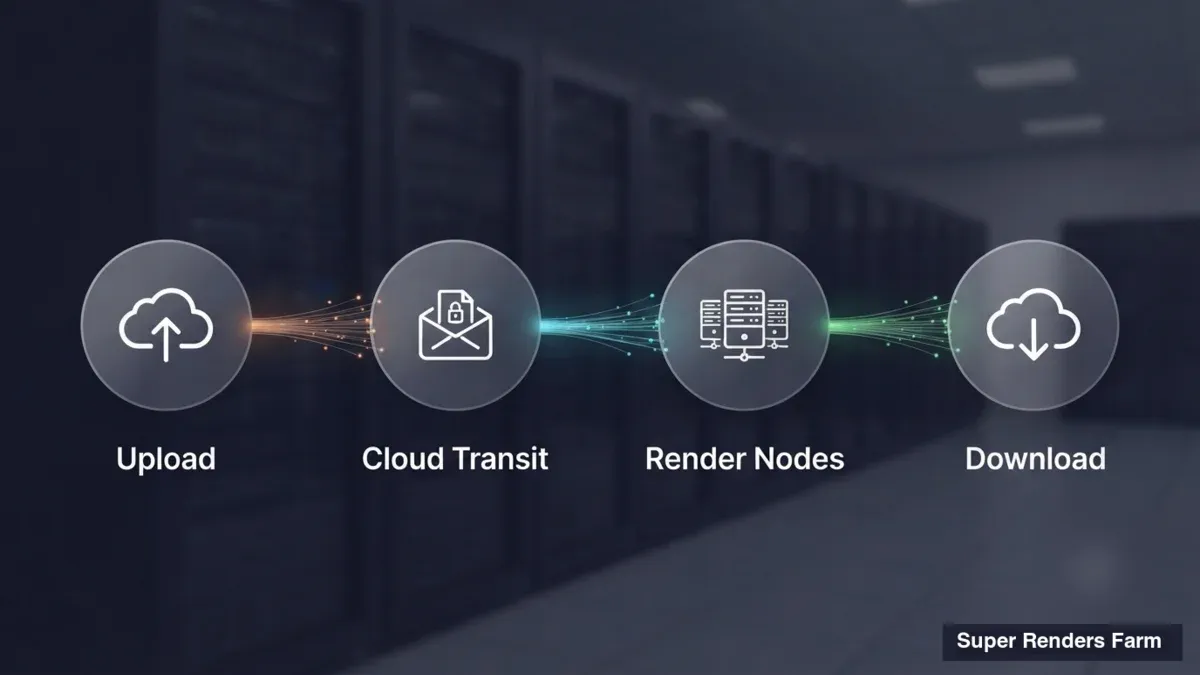 Diagram of the case-data path: upload, cloud transit, render nodes, output download
Software, Hardware, and the Fully Managed Model
The DCC and renderer combinations common to this field — 3ds Max with V-Ray or Corona, Maya with Arnold, V-Ray, Redshift or RenderMan, Blender with Cycles or EEVEE, and Cinema 4D with Redshift — all run on every node, with current version ranges kept up on each software's dedicated page rather than restated here, since those ranges get reviewed and updated on their own schedule. V-Ray, Octane and Redshift for Blender are a separate case: those are provisioned on request, so confirm with us before you upload a Blender scene built around one. Blender's built-in Cycles engine is worth a specific mention for cost-conscious solo experts: it's free and open source, with no separate license cost, which matters for a single practitioner billing a case rather than a studio with an existing engine license.
On hardware, GPU jobs run on dedicated nodes built around the NVIDIA RTX 5090, 32 GB of VRAM per card, with each card's VRAM used independently rather than pooled across cards on a node — that matters for scene planning on VRAM-sensitive engines like Redshift, since a single frame is bound by one card's 32 GB, not a combined total. CPU rendering, which covers a large share of V-Ray, Corona, and Arnold CPU work in this kind of accuracy-first reconstruction, draws on an aggregate pool of 20,000-plus CPU cores.
The operational model is fully managed: you don't remote desktop into machines, install renderer or plugin licenses yourself, or manage a worker fleet. For a solo expert or a small studio without in-house IT, that removes a real chunk of administrative overhead compared to renting and self-administering dedicated hardware. One limitation worth naming directly: there's no public render API or SDK today — submission is GUI-based. If your pipeline expects programmatic, script-driven job submission, that isn't currently available here.
A Decision Framework: When a Public Cloud Farm Fits This Work
None of the above adds up to a blanket yes or no — it depends on what a specific case and a specific studio actually need. The table below is meant as a plain framework, not a sales pitch:
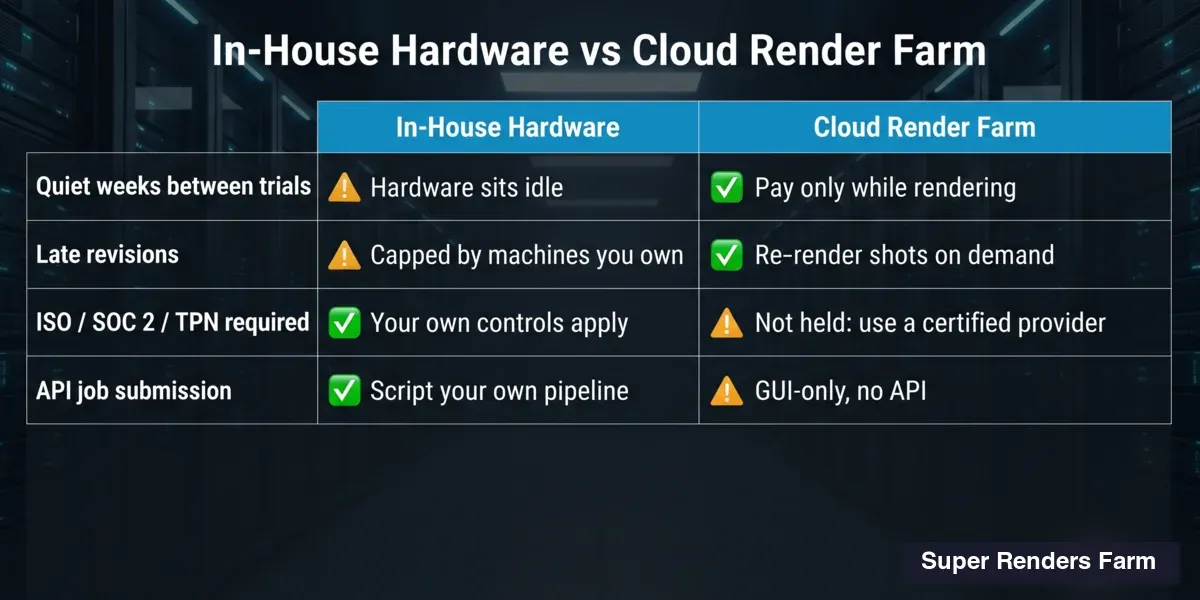 Comparison infographic: in-house hardware versus a cloud render farm for litigation-support studios, covering quiet weeks between trials, late revisions, ISO, SOC 2 or TPN requirements, and API job submission
| Your situation | Does a public cloud farm fit? |
|---|---|
| Bursty workload tied to trial dates, with quiet weeks in between | Generally yes — per-compute billing with non-expiring credits maps to this pattern better than a fixed monthly plan |
| Frequent late-stage revisions after expert testimony or a court ruling shifts | Generally yes — re-render individual shots on demand without owning idle hardware between cases |
| Confidentiality matters, but no specific certification is contractually or judicially required | Often workable — an NDA, the node location, and how retention works are the pieces to settle up front; if data residency is a term of your engagement, get the specifics from us in writing before deciding |
| A contract, protective order, or court order requires ISO, SOC 2, TPN, or a specific data-residency guarantee | No — we don't hold these; look for a provider that does |
| Your pipeline needs programmatic/API-driven job submission | No — submission here is GUI-only |
| Small studio or solo expert without in-house render infrastructure or dedicated IT | Generally yes — the fully managed model removes hardware and license administration |
Where a case's requirements genuinely exceed what a shared public farm can offer — a hard data-residency mandate, a specific compliance certification a court has ordered — the honest answer is to say so and look elsewhere for that particular requirement, rather than to suggest a workaround that doesn't really close the gap. For everything short of that, the combination of per-compute billing, a fully managed environment, and a plainly stated data-location and retention policy is a reasonable starting point to evaluate against whatever your specific engagement requires.
It's also worth being clear about who this framework is for. A studio that already runs its own workstation farm for steady, year-round caseload volume may not gain much from an outside render provider at all — the case for a public cloud farm gets stronger the more irregular and deadline-spiked the workload is, and weaker the more predictable and constant it is. The studios most likely to find this useful are the ones where a single case can spike compute demand well past what their own hardware handles, without justifying a permanent hardware purchase sized for that peak.
FAQ
Q: Does the render farm a forensic animation is rendered on affect whether it's admissible as evidence? A: Admissibility standards like Daubert or Frye evaluate the reconstruction's methodology — data sources, simulation assumptions, and the expert's qualifications — not the render infrastructure that computed the final frames. We don't give legal advice on admissibility; if your case has a specific requirement about the render infrastructure itself, that's a question for you and your retaining attorney.
Q: Where does my case data actually go if I use a cloud render farm for this work? A: Rendering does not happen on US soil. Storage is a separate question, and the honest answer is that it is not all in one place — so if your matter carries a data-residency requirement, that is the part to pin down, not the rendering. We don't publish our node and storage locations, but we will tell you in writing what applies to your matter if you ask, before you upload anything. We're a US company for jurisdiction, support, and billing purposes; that is separate from where the compute physically happens.
Q: Does Super Renders Farm hold ISO, SOC 2, or TPN certification? A: No. These are initiatives we've discussed internally but haven't completed, and we don't claim them. If your case requires proof of a specific certification, look for a provider that currently holds it.
Q: What software does Super Renders Farm support for accident reconstruction or medical-injury animation work? A: The mainstream DCC tools this field uses, each with its own renderers ready on every node — 3ds Max with V-Ray or Corona, Maya with Arnold, V-Ray, Redshift or RenderMan, Blender with Cycles or EEVEE, and Cinema 4D with Redshift. V-Ray, Octane and Redshift for Blender are provisioned on request instead, so ask us before uploading a Blender scene that needs one. Current version ranges are kept up to date on each software's dedicated render-farm page.
Q: Can I get an NDA signed before I upload sensitive case material? A: Yes, we have a dedicated NDA request page for this. Treat it as a commercial confidentiality agreement rather than a litigation instrument: if a protective order or expert-witness confidentiality obligation governs your matter, have your own counsel review our NDA against those requirements first, and tell us what additional language they need.
Q: How does billing work for a workload that's idle for weeks and then urgent before a trial date? A: Rendering is billed per compute actually consumed — CPU by the GHz-hour, GPU by the OctaneBench-hour — rather than a flat monthly plan, and purchased credits don't expire. You aren't paying for idle capacity during the weeks between cases.
Q: What happens to my render files after a case concludes? A: Files stay available for download for as long as you need them. There's no fixed automatic deletion period, and deletion happens on request whenever you're ready.
Q: Is there a way to submit render jobs programmatically instead of through the web interface? A: Not currently — there's no public render API or SDK. Job submission is through the GUI. If your studio's pipeline depends on scripted, programmatic submission, that isn't available today.
About Alice Harper
Blender and V-Ray specialist. Passionate about optimizing render workflows, sharing tips, and educating the 3D community to achieve photorealistic results faster.