State of Forest Pack and RailClone on Cloud Render Farms 2026
Overview
Lead: Forest Pack and RailClone in 2026, Seen From a Render Farm
Forest Pack and RailClone — the iToo Software plugins that turn bare 3ds Max scenes into dense vegetation, crowds, fences, facades, and modular structures — appear in most archviz scenes that land on a cloud render farm. They also generate more farm-side surprises than any other plugin category we handle: procedural geometry that isn't in the .max file, library references that only resolve at render time, and VRAM spikes that can dwarf the rest of the scene. This report pulls together what Forest Pack and RailClone workloads look like on a modern cloud farm in 2026 — the operational data (jobs, scene complexity, peak VRAM, CPU vs GPU split, render time distributions), the hardware sizing implications, the plugin-and-library coverage reality, and how the current crop of render farms compare in terms of support. It is compiled from anonymized Super Renders Farm operations across 2025–2026.
What Forest Pack and RailClone Do (and Why Farms Treat Them as a Single Workload)
Forest Pack is iToo Software's scattering plugin for 3ds Max. It distributes objects — trees, grass, crowds, rocks, debris — across a surface or path, with rules for density, orientation, collision, and camera-based culling. Instead of storing every instance in the scene file, Forest Pack stores the distribution logic plus references to source geometry. The instances are generated when the render engine asks for them.
RailClone is iToo's parametric modeling plugin. It builds repeating structures — railings, fences, facade panels, road barriers, modular interiors — from a style definition and a spline. Like Forest Pack, it stores parameters and source objects rather than final geometry. The modular mesh is reconstructed at render time.
Both plugins share three traits that matter on a render farm:
- Geometry is procedural and late-binding. Nothing the distribution logic generates is baked into the
.maxfile. If the render node can't evaluate the logic, or can't reach the referenced assets, the geometry quietly vanishes. - They inflate the render scene far beyond what the file size suggests. A 40 MB
.maxfile can reconstruct into a 200-million-poly render scene once Forest Pack scatters out and RailClone expands. - They are tightly bound to iToo's licensing system. Each render node needs an active iToo license to evaluate Forest Pack and RailClone at render time. Without it, the plugins fall back to a "demo" watermark or evaluate at reduced instance counts.
On a cloud render farm, these two plugins are operationally one workload: same library, same license chain, same cloud-specific failure modes. That's why this report treats them together.
Why Cloud Rendering Suits Forest Pack Workloads
Forest Pack's biggest cost is not the scene description — it's the per-frame geometry expansion and the raytracing of that geometry. For a dense scene (say, an architectural exterior with 2 million scattered instances of grass, trees, and shrubs), the render node spends:
- 15–90 seconds per frame on Forest Pack's geometry generation phase, before the render engine even starts sampling
- The bulk of the render on raytracing through that geometry, with V-Ray, Corona, or Arnold traversing a BVH several times larger than a typical interior scene
Both costs parallelize well across many machines because each frame is independent. A 240-frame animation that takes 9 days on one workstation finishes overnight on a few hundred nodes running the same scene.
Scatter-heavy exteriors like these are a core ArchViz render-farm workload; our 3D architectural rendering and AI visualization guide covers where they fit in the broader pipeline. That is the fundamental case for cloud rendering — and Forest Pack is one of the heaviest beneficiaries because single-frame times are long enough that the queueing and distribution overhead become negligible.
For the broader mechanics of how cloud rendering works and what it costs across workloads, see our cloud rendering explained guide.
The scene-integrity side is also why Forest Pack pushes users toward cloud rendering specifically. Because the plugin evaluates geometry at the node rather than baking it, there is no way to hand off a "self-contained" scene. Either the render farm has a compatible Forest Pack install with access to the same libraries, or the scene renders wrong — silently, with bare ground where trees should be. Our audit logs show Forest Pack is the leading source of tickets with the pattern "render came back but the vegetation is missing." On a fully managed render farm this is resolved by installing, licensing, and version-pinning Forest Pack across the entire fleet up front. On an IaaS / remote-desktop farm, it is resolved by the user installing and licensing Forest Pack on every machine they spin up.
2026 Operational Data From Super Renders Farm
This section aggregates Forest Pack and RailClone workload metrics from Super Renders Farm's 2025–2026 operations. All figures are anonymized and rounded to avoid exposing individual client data. Super Renders Farm operates 20,000+ CPU cores (Dual Intel Xeon E5-2699 V4 class hardware) alongside a dedicated GPU fleet with NVIDIA RTX 5090 cards (32 GB VRAM). Forest Pack and RailClone have been installed and licensed across the entire fleet since 2017.
Workload volume and scene complexity
| Metric | Observed range (anonymized aggregate, 2025–2026) |
|---|---|
| Scenes per month flagged as Forest Pack–enabled | thousands |
| Share of archviz jobs that use Forest Pack | roughly 6 out of 10 |
| Share of archviz jobs that use RailClone | roughly 3 out of 10 |
| Jobs that use both Forest Pack and RailClone | roughly 2 out of 10 |
Typical source .max file size | 20 MB – 600 MB |
| Typical final scene instance count (post-scatter) | 250k – 5M instances |
| Typical effective poly count at render time | 5M – 150M polys |
Data compiled from anonymized render farm operations 2025–2026.
Forest Pack scenes cluster into three complexity bands on our fleet:
- Light: interior product shots with a few RailClone elements (railings, shelving) and light outdoor scatter visible through a window. Effective polys 5M–15M. Roughly a third of Forest Pack-enabled jobs.
- Medium: architectural exteriors with moderate vegetation, paving, and one or two RailClone fences or facades. Effective polys 15M–60M. The plurality of jobs.
- Heavy: landscape and site-plan scenes with dense scatter (hundreds of thousands of plants), crowd distribution, and multiple RailClone systems. Effective polys 60M–150M+. A smaller share but the most time-consuming.
CPU vs GPU split for Forest Pack–heavy jobs
Forest Pack itself is engine-agnostic, but the choice of render engine determines whether the job runs on CPU or GPU hardware. Looking only at jobs that flag Forest Pack or RailClone as present:
| Render path | Share of Forest Pack jobs |
|---|---|
| V-Ray (CPU) | ~55% |
| Corona | ~25% |
| Arnold (CPU) | ~5% |
| V-Ray (GPU / hybrid) | ~10% |
| Redshift or Octane (pure GPU) | ~5% |
Data compiled from anonymized render farm operations 2025–2026.
The CPU weighting reflects Forest Pack's archviz user base more than any technical limitation. V-Ray CPU and Corona dominate photoreal archviz, and both handle very large instanced geometry efficiently through their native proxy and instancer systems. V-Ray GPU and Redshift have matured substantially and now handle Forest Pack workloads when VRAM allows, but users with 100M+ poly scenes often stay on CPU simply because it does not fight them on VRAM.
VRAM peaks on the GPU path
For Forest Pack jobs that do run on the GPU (V-Ray GPU, V-Ray Hybrid, Redshift, Octane), VRAM is the first ceiling. On our 32 GB RTX 5090 nodes:
| Scene type | Observed VRAM peak | Notes |
|---|---|---|
| Interior + light outdoor scatter | 6–12 GB | Comfortable headroom. |
| Medium exterior with Forest Pack | 12–22 GB | V-Ray GPU users often here. |
| Heavy exterior + RailClone facades | 22–30 GB | Approaches the 32 GB ceiling. |
| Ultra-heavy landscape scenes | > 32 GB on naive build; requires out-of-core or proxy conversion | Out-of-core paths work; there is a performance cost. |
Two things matter about these numbers:
- Even on 32 GB cards, Forest Pack scenes can push close to the ceiling. Scenes that worked on a 24 GB card in 2023 are not automatically fine on a 32 GB card in 2026 because instance counts have grown along with hardware.
- V-Ray Hybrid (mixing CPU and GPU work) is the most forgiving GPU path for Forest Pack because the CPU portion can carry scenes that would otherwise exceed VRAM. We see Hybrid used more often than pure V-Ray GPU for the heavy end of the distribution.
Render time distribution per frame
Because the variance is high, median and p95 tell the story better than an average. For Forest Pack–flagged frames rendered on one of our nodes, at standard archviz output resolutions (roughly 2K–4K) and production quality settings:
| Engine path | Median per-frame render time | p95 per-frame render time |
|---|---|---|
| V-Ray CPU | ~30–60 minutes | 3–5 hours |
| Corona | ~25–50 minutes | 2–4 hours |
| Arnold CPU | ~40–75 minutes | 3–6 hours |
| V-Ray GPU / Hybrid | ~15–35 minutes | 1.5–3 hours |
| Redshift / Octane | ~10–25 minutes | 1–2 hours |
Data compiled from anonymized render farm operations 2025–2026. p95 figures reflect the heavy-scatter tail of Forest Pack jobs, not engine peak performance on light scenes.
The gap between median and p95 is the tell-tale Forest Pack fingerprint. For a scene with no scatter, p95 typically sits at 2–2.5x the median. For Forest Pack–heavy scenes, p95 commonly hits 4–6x the median because a few frames catch the heaviest geometry evaluation moments.
The same infrastructure that produced this data powers our Forest Pack and RailClone cloud rendering solution for production use.
Hardware Sizing Guide for Forest Pack
A recurring support question is "what specs do I actually need to render this scene on a farm?" The short answer is that CPU and RAM targets are straightforward; VRAM is the variable that bites.
| Scene class | Recommended per-node CPU | Recommended per-node RAM | Recommended VRAM (if GPU path) |
|---|---|---|---|
| Light Forest Pack (interior + minor scatter) | 16+ cores | 64 GB | 12 GB comfortable |
| Medium Forest Pack (exterior archviz) | 32+ cores | 96–128 GB | 16–24 GB |
| Heavy Forest Pack + RailClone (site plan, landscape) | 44+ cores | 192–256 GB | 24–32 GB + out-of-core |
| Ultra-heavy (cinematic archviz, crowd scatter) | 44+ cores, multi-machine distribution viable | 256 GB+ | 32 GB + out-of-core essential |
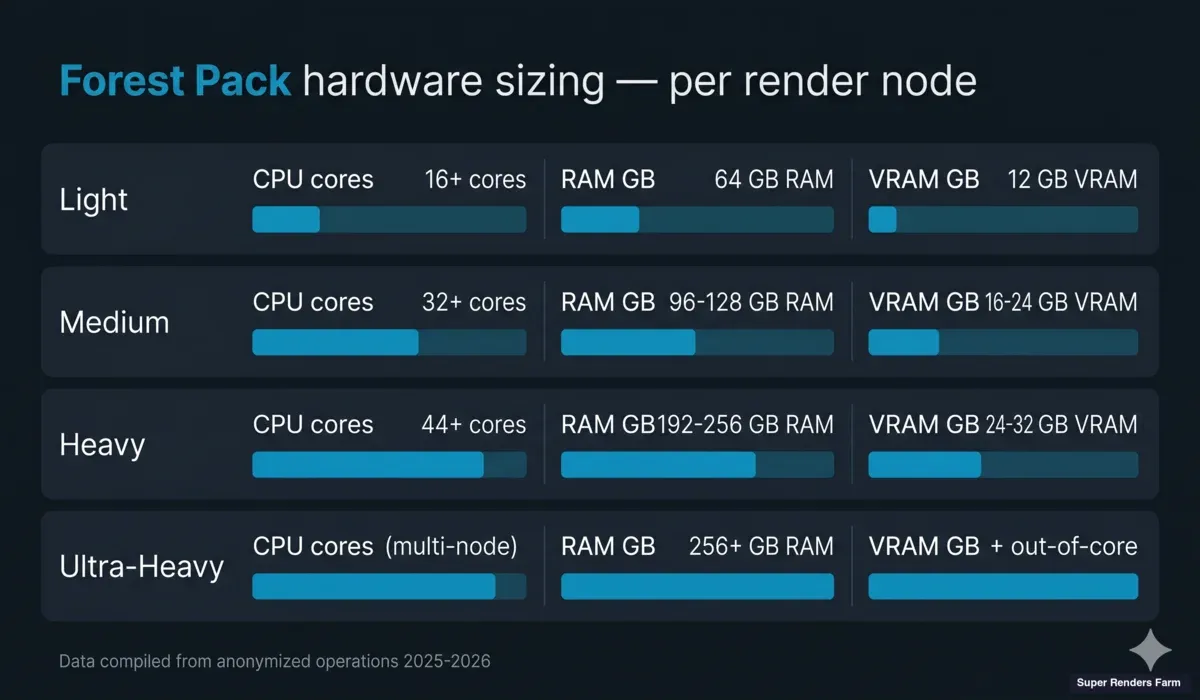 Forest Pack hardware sizing reference: per-node CPU, RAM, and VRAM targets by scene complexity tier on a cloud render farm.
Our CPU nodes sit in the 44-core, 96–256 GB RAM bracket specifically because archviz scenes — the population Forest Pack serves most heavily — benefit from RAM headroom even more than from clock speed. V-Ray's dynamic bucket rendering and Corona's adaptive sampling both spend a large fraction of their time on memory-bound scene traversal in dense scatter scenes.
For the GPU path, a single-GPU-per-node layout (as we run on the GPU fleet) gives each frame full use of the 32 GB VRAM without sharing it with a second GPU context. That is deliberate: Forest Pack scenes benefit from single-GPU VRAM certainty far more than they benefit from scaling across two cards per machine.
Plugin Version Coverage and Library Support
Forest Pack version mismatches are the single most common cause of "missing vegetation" on render farms. The scene parameter format changes subtly between minor versions, and a scene saved in Forest Pack 8.x can evaluate incorrectly on a farm still running 7.x.
Our working policy on Super Renders Farm is:
- Versions are maintained within one minor release of iToo's latest for Forest Pack, RailClone, and the bundled libraries. When iToo ships Forest Pack 8.2, we aim to have 8.2 live within two to four weeks, with 8.1 still available for users whose scenes were authored there.
- The full default iToo library is pre-installed on every render node. Trees, shrubs, grass presets, and rock sets ship with the plugin; we mirror them to the node image rather than requiring the user to upload them.
- Custom libraries must be uploaded with the scene. If your scene references third-party or in-house libraries outside iToo's default set (for example, commercial evermotion or Maxtree assets), those files have to travel with the scene package. Most archive / pack-up tools in 3ds Max handle this automatically if configured to include external dependencies.
- 3ds Max version is version-matched too. Forest Pack builds are released per 3ds Max version. Running a 3ds Max 2026 scene through a node with a 2025 Forest Pack build will not work cleanly. Every 3ds Max version we support — 2013 through 2027 — is servable; the newest one or two releases are kept pre-installed and hot on the fleet so current-version jobs start immediately, with earlier versions provisioned on request.
Users routinely underestimate how much of Forest Pack's reliability on a farm comes from library coverage rather than plugin compatibility. A clean plugin install with the wrong library set still produces bare ground. We audit library presence at scene ingest rather than relying on the render node to fail mid-animation.
For users coming from other scatter tools, our Forest Pack and RailClone render farm guide walks through the specific pre-submission checklist.
A Typical Forest Pack Workflow on a Cloud Farm
The operational path for a Forest Pack scene on Super Renders Farm looks like this:
- Upload. The user uploads the
.maxfile and any custom external assets through the client application. The package is received, scanned for dependencies, and placed on shared storage accessible to all render nodes. - Scene audit. An ingest step reads the scene's Forest Pack and RailClone references, detects the plugin versions used, and verifies that both the plugin build and the referenced libraries are available on the target nodes. Mismatches surface at this point, not two hours into the render.
- Node allocation. Based on the scene class and the user's selected priority, nodes are allocated from the fleet. For archviz-grade Forest Pack jobs this is typically the CPU fleet (3ds Max cloud rendering); for Redshift or Octane users, it is the GPU fleet.
- Scatter evaluation and frame distribution. Each assigned node opens the scene, Forest Pack and RailClone reconstruct the geometry locally, and the render engine begins sampling. Frames are distributed one-per-node; node-level parallelism is handled by the scheduler.
- Output and download. Rendered frames are written back to shared storage as they complete. The user can begin downloading finished frames mid-render rather than waiting for the full animation to finish.
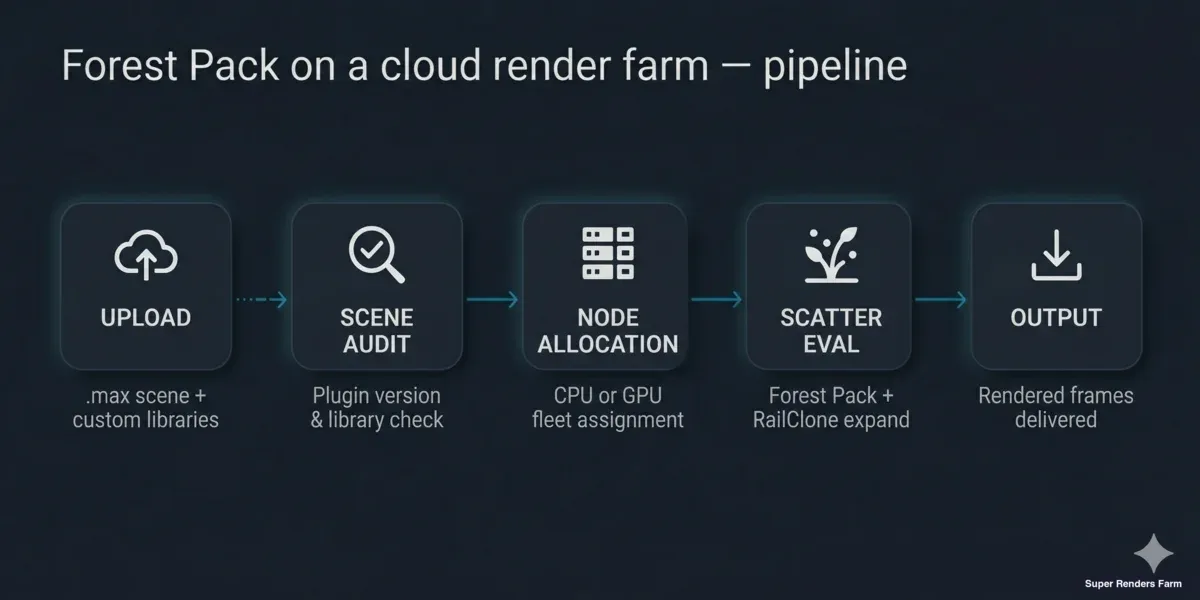 Forest Pack cloud rendering pipeline: upload, scene audit, node allocation, scatter evaluation, and output delivery.
The entire path is fully managed: the user does not remote-desktop into machines, install software, or manage iToo licensing manually. This is the operational model that keeps Forest Pack scenes out of the "user made a mistake during setup" failure class — because there is no setup for the user to do.
For sizing the cost of rendering this kind of scene, the render farm cost-per-frame guide gives a realistic breakdown by scene class and engine.
Render Farms That Support Forest Pack — 2026 Support Survey
iToo Software maintains an official render-farm listing at itoosoft.com/renderfarms showing farms that have coordinated with iToo on up-to-date plugin and library coverage. That list is the best starting point for verifying any farm's status. Beyond the listing, every farm that supports Forest Pack publishes its own support policy — and those policies vary more than most users expect.
The table below is a neutral survey of the publicly documented Forest Pack support situation on the major 3ds Max–supporting cloud farms in 2026. It focuses on knowable published facts, not performance claims.
| Farm | Forest Pack & RailClone availability | License model | Library coverage |
|---|---|---|---|
| Fox Renderfarm | Pre-installed on render nodes (publicly documented) | Farm-side site license | Default iToo library pre-installed |
| RebusFarm | Pre-installed on render nodes (publicly documented) | Farm-side site license | Default iToo library pre-installed |
| GarageFarm | Pre-installed on render nodes (publicly documented) | Farm-side site license | Default iToo library pre-installed |
| Ranch Computing | Pre-installed on render nodes (publicly documented) | Farm-side site license | Default iToo library pre-installed |
| iRender (IaaS / remote desktop) | User installs Forest Pack on the rented machine | User provides own iToo license | User uploads libraries to the machine |
| Super Renders Farm | Pre-installed on render nodes since 2017 | Farm-side site license | Default iToo library pre-installed on every node; custom libraries uploaded per scene |
Several of the managed farms above are listed on iToo's official render-farm page at itoosoft.com/renderfarms, which tracks farms that coordinate with iToo on plugin and library currency. The listing is updated over time — verify current entries directly at the iToo page before relying on any specific farm's status.
A few points worth calling out from this survey:
- SaaS managed farms and IaaS farms are not the same category. A managed farm like Fox, RebusFarm, GarageFarm, Ranch, or Super Renders Farm installs and licenses Forest Pack centrally, so the user never touches iToo licensing. An IaaS farm like iRender gives the user a machine — the user brings their own Forest Pack license and handles the install themselves.
- "Supports Forest Pack" has layers. A farm may support the plugin but trail on library updates, or support the latest Forest Pack build but not yet have the current 3ds Max version live. Both gaps produce the same "missing vegetation" symptom from the user's side.
- iToo's official listing is a useful filter, not an exhaustive one. A farm's presence on iToo's page indicates active coordination on plugin and library coverage; absence does not automatically indicate no support. Several smaller regional farms support Forest Pack without appearing on the iToo page. Super Renders Farm has run Forest Pack and RailClone workloads since 2017 and is not currently listed on the iToo page.
For users comparing farms across a broader set of criteria, the best cloud render farm for archviz 2026 guide lays out the decision framework.
2026 Outlook: Forest Pack 9.x, RailClone 7.x, and VRAM Demand Curve
A few trends are visible in our 2026 data that are worth flagging for anyone planning a Forest Pack pipeline this year:
Forest Pack 8.x is the current baseline; 9.x adoption is still slow. Most production studios we see are on Forest Pack 8.x, with RailClone 6.x as the paired baseline. iToo's version adoption has always lagged 3ds Max's, and the 2026 data is consistent with that pattern. Render farms that force-upgrade aggressively will fragment their supported scene set; the saner path is to keep two iToo versions live at once.
Scatter density is up year-over-year. Instance counts in the scenes that land on our fleet have risen roughly 30–50% since 2023, reflecting both the maturation of Forest Pack's library ecosystem and user confidence that a farm will handle larger counts. This is the primary driver behind rising VRAM peaks and longer p95 render times.
Hybrid CPU-GPU paths are displacing pure-GPU for Forest Pack archviz. V-Ray Hybrid in particular has pulled users who previously split their work between "GPU for interior, CPU for exterior." On a 32 GB RTX 5090 Hybrid can carry scenes that would out-of-core on pure V-Ray GPU, so we see more users unify on a single render path.
RailClone cinematic use is visible but still a minority. Large-scale cinematic archviz and broadcast work uses RailClone's full parametric system, but most RailClone use on a farm is still "fences, railings, facade repetition." The modular geometry tools are growing into the film and broadcast pipeline faster than the scatter plugin did, but it is a slow curve.
None of these trends change the fundamentals: Forest Pack and RailClone are CPU-friendly, scatter-heavy, version- and library-sensitive workloads, and render farms that want to serve them well invest in plugin version hygiene and library coverage far more than in raw node count.
FAQ
Q: Which render farm handles Forest Pack and RailClone properly in 2026? A: Any managed farm listed on itoosoft.com/renderfarms coordinates with iToo on plugin and library coverage. Super Renders Farm has run both plugins on its fleet since 2017, with the default iToo library pre-installed and farm-side site licensing.
Q: Does Forest Pack work on cloud render farms? A: Yes. Forest Pack was designed around render-time geometry evaluation, which is exactly what a cloud render farm does per frame. The requirements are that the farm's nodes have a compatible Forest Pack build installed, iToo licensing active, and the referenced libraries (default iToo + any custom libraries used in the scene) accessible at render time. On a fully managed farm all three are handled centrally; on an IaaS farm the user installs and licenses the plugin themselves.
Q: How much VRAM do I need for Forest Pack rendering on a GPU farm? A: For medium archviz exteriors with Forest Pack, expect 16–24 GB VRAM peaks. Heavy exteriors with RailClone facades push 22–30 GB. Very dense landscape scenes and cinematic site plans routinely exceed 32 GB and require out-of-core rendering or proxy conversion. A 32 GB card (such as the RTX 5090) covers the majority of production Forest Pack work in 2026 but is not infinite headroom; VRAM peaks have risen alongside instance counts.
Q: Forest Pack vs other scatter plugins for cloud rendering — does it matter? A: On the cloud side, the operational reality is similar across scatter plugins — they all store distribution logic rather than baked geometry, so they all depend on plugin availability and licensing on the render node. The reason Forest Pack dominates render farm usage specifically is ecosystem: the library coverage, the years of V-Ray and Corona interop, and the number of studios and asset vendors that build for it. A farm can support Forest Pack, RailClone, MultiScatter, and the GrowFX vegetation system side by side, but Forest Pack is the one we see in the majority of archviz jobs.
Q: Do I need to install Forest Pack on the render farm myself? A: On a managed farm — no. Forest Pack and RailClone are installed and licensed on every render node by the farm, and you submit your scene as you would any other 3ds Max job. On an IaaS / remote-desktop farm like iRender, yes — you remote into the rented machine and install Forest Pack (with your own iToo license) just as you would on a workstation. The managed model trades a small amount of flexibility for a substantial amount of setup time.
Q: Does Forest Pack work with V-Ray GPU, Redshift, and Octane on a render farm? A: Forest Pack supports V-Ray (CPU and GPU), Corona, Arnold, Redshift, and Octane — each with its own integration path. On a render farm the availability question is whether the farm has the right plugin build and the right render engine build and the right 3ds Max version for the combination your scene uses. Any farm that supports the full archviz stack (V-Ray + Corona + Forest Pack + RailClone + current 3ds Max) will handle the standard case. For users pushing Forest Pack through Redshift or Octane, it is worth verifying the farm's current builds for that specific combination before committing a large job.
Q: How do I avoid the "missing vegetation" problem on a render farm? A: Three checks before submitting: (1) confirm the farm's installed Forest Pack version matches or is newer than yours; (2) run a scene archive or pack-up to capture all custom libraries referenced by the scene; (3) run a single test frame before committing the full animation. Most "missing vegetation" tickets reduce to one of those three — version mismatch, missing custom library, or a path that only resolves locally. On a managed farm, the version and default-library checks are handled at ingest; the custom library check is still on the user.
Q: How long does a Forest Pack frame actually take to render on a cloud farm? A: In our 2025–2026 data, median per-frame render time for Forest Pack–flagged archviz scenes is 25–75 minutes depending on engine, and p95 sits at 3–6x the median for the heavy-scatter tail. Corona and V-Ray GPU / Hybrid run quicker per frame than V-Ray CPU or Arnold on the same scenes; Redshift and Octane run quickest on GPU paths but with VRAM constraints on the heaviest end. Compared to local workstation rendering, the cloud advantage is not per-frame time — it is the ability to run hundreds of frames in parallel, which compresses a two-week animation into a two-day window.
Data compiled from anonymized Super Renders Farm render farm operations, 2025–2026. Forest Pack and RailClone are products of iToo Software. Super Renders Farm has run Forest Pack and RailClone workloads since 2017.
About Thierry Marc
3D Rendering Expert with over 10 years of experience in the industry. Specialized in Maya, Arnold, and high-end technical workflows for film and advertising.