Ray Tracing Thời Gian Thực Trong Games: Tiến Hóa từ Quake đến 2026
Tổng quan
Năm 2018, NVIDIA phát hành cái gì mà có vẻ bất khả thi: Quake II RTX, một bản làm lại thời gian thực của tác phẩm huyền thoại 1997, được kết xuất bằng full path tracing trên một single GPU. Quake II nguyên bản, đột phá cho thời đó, sử dụng pre-baked lightmaps và basic rasterization. GPU hỗ trợ RTX giờ có thể tính toán light bounces tương tác, biến đổi diện mạo của game từ flat polygons thành lighting photorealistic.
Demo này đơn lẻ đã đánh dấu một bước ngoặt. Ray tracing thời gian thực, từng bị hạn chế ở offline rendering trong films, đã lao vào games. Tám năm sau đó, vào 2026, ray tracing là chuẩn trong AAA titles. Sự hội tụ của công nghệ real-time và offline rendering gần như hoàn thành — techniques phát triển cho film đang ship trong games, và game optimization methods lại thông báo cho film rendering.
Guide này truy dấu sự tiến hóa đó: làm sao chúng ta từ Quake II RTX như một kỳ tích kỹ thuật sang full path tracing như một graphical baseline, và cái đó có nghĩa gì cho industry.
Quake II RTX: Bước Ngoặt Lịch Sử
Quake II RTX là một proof of concept, nhưng nó là một concept mạnh mẽ. Một game 24 tuổi, tái tưởng tượng với modern light transport simulation, cảm thấy hoàn toàn mới. Reflections là physically correct. Shadows từ multiple light sources tích hợp seamlessly. Materials ứng xử thực tế: metal phản ánh environment, glass truyền light mà không banding của fake refraction.
Demo chạy trên RTX 2080 Ti hardware ở 1080p, 60 frames per second. Điều này đáng chú ý vì nó sẽ phải impossible. Path tracing một scene với multiple bounces, tạo noise yêu cầu denoising, tất cả trong milliseconds — cái này vi phạm assumptions về rendering complexity.
Cái innovation chính: RT cores của NVIDIA. Những specialized hardware units này tăng tốc ray-scene intersection, bottleneck trong ray tracing. Kết hợp với DLSS của NVIDIA (Deep Learning Super Sampling), cái sử dụng AI để reconstruct high-resolution images từ lower-resolution rendering, RTX đã làm ray tracing khả thi trong real-time.
Impact của Quake II RTX là psychological cũng như technical. Gamers thấy photorealistic lighting trong một real-time game. Conversation chuyển từ "Can we do ray tracing in real-time?" sang "When will everything use ray tracing?"
Sự Tiến Hóa Của RTX Series
NVIDIA's RTX GPU lineage tiến bộ trong ba generations:
RTX 2000-Series (2018-2019): RTX 2080 Ti nguyên bản có limited RT cores và tensor cores (cho DLSS). DLSS 1.0 là neural network-based upsampling. Results là tốt nhưng đôi khi có artifacts.
RTX 3000-Series (2020-2021): RT cores nhanh hơn đáng kể, more transistors, và DLSS 2.0. DLSS 2.0 chuyển từ game-specific training sang temporal reconstruction: nó render ở lower resolution, feed multiple frames cho AI, và reconstruct high-quality images. Artifacts phần lớn biến mất. DLSS 2.0 là một massive leap.
RTX 4000-Series (2022-2023): Thậm chí more RT cores, more memory, và DLSS 3.0 với frame generation. Frame generation không chỉ upscale; nó generates entirely new frames giữa rendered frames, effectively doubling frame rate. Một game render ở 30fps có thể present ở 60fps thông qua frame generation.
RTX 5000-Series (2024-2026): Latest hardware với even more capability. Frame generation là standard, và AI acceleration đã multiply.
Mỗi generation làm ray tracing nhanh hơn và more practical. Bởi RTX 4000, ray tracing không phải aspirational — nó là baseline cho AAA games.
Games Chủ Yếu và Industry Adoption
Một số AAA titles exemplify real-time ray tracing's maturation:
Cyberpunk 2077 (2020): Một landmark cho ray-traced reflections và lighting trong massive open world. Initial performance là rough (toàn bộ game struggled on launch), nhưng once optimized, nó demonstrated rằng complex ray-traced scenes khả thi. Cyberpunk 2077 với ray tracing ở high settings showed rằng interactive photorealism là real.
Alan Wake 2 (2023): Có lẽ ambitious nhất ray-traced game. Full path-traced global illumination (không chỉ reflections), complex volumetrics, và intricate shader networks. Alan Wake 2 runs trên RTX 3000 và 4000 hardware ở 1080p-1440p với reasonable frame rates thông qua DLSS 3 và frame generation. Image quality là genuinely photorealistic.
Portal RTX (2024): Một free remaster của Portal, fully ray-traced. Cái remarkable là how simple core gameplay vẫn — bạn vẫn place portals và solve puzzles — nhưng visuals là utterly transformed. Ray-traced reflections trong portal surfaces, physically accurate lighting, photorealistic materials. Portal RTX demonstrates ray tracing's transformative power thậm chí trong conceptually simple games.
Unreal Engine 5's Lumen: Không phải một game per se, nhưng một rendering technology shipped trong UE5. Lumen là một real-time global illumination system dùng ray tracing (GPU-accelerated, nhưng không hardware-accelerated RT cores) để compute lighting dynamically. Developers có thể skip pre-baked lightmaps entirely. Đây là một fundamental shift trong how real-time games render.
Hiểu Biết Khoảng Cách Công Nghệ
Cho những người đến từ offline rendering, real-time ray tracing's constraints là important:
Sampling và Denoising: Một film renderer có thể cast 1,000 samples per pixel. Một real-time renderer cast 1-8 samples per pixel và denoise heavily. Denoiser (thường là AI-based) reconstructs một high-quality image từ sparse samples. Cái này hoạt động bởi vì temporal information (previous frames) và spatial information (neighboring pixels) constrain denoiser.
Frame Generation vs. Frame Rendering: Render 60 frames per second trong ray tracing là expensive. DLSS 3's frame generation renders every other frame (30fps) và AI-generates in-between frames (presenting 60fps tới player). Cái này controversial — một số argue rằng generated frames introduce latency hay artifacts. Trong practice, modern frame generation là convincing.
Path Tracing vs. Hybrid Approaches: Full path tracing (every bounce computed bởi ray tracing) là rare trong games bởi vì nó slow. Hybrid approaches là standard: screen-space reflections cho nearby surfaces, ray-traced reflections cho distant objects, baked ambient occlusion, ray-traced global illumination. Những hybrids này deliver 80% visual quality ở 20% cost.
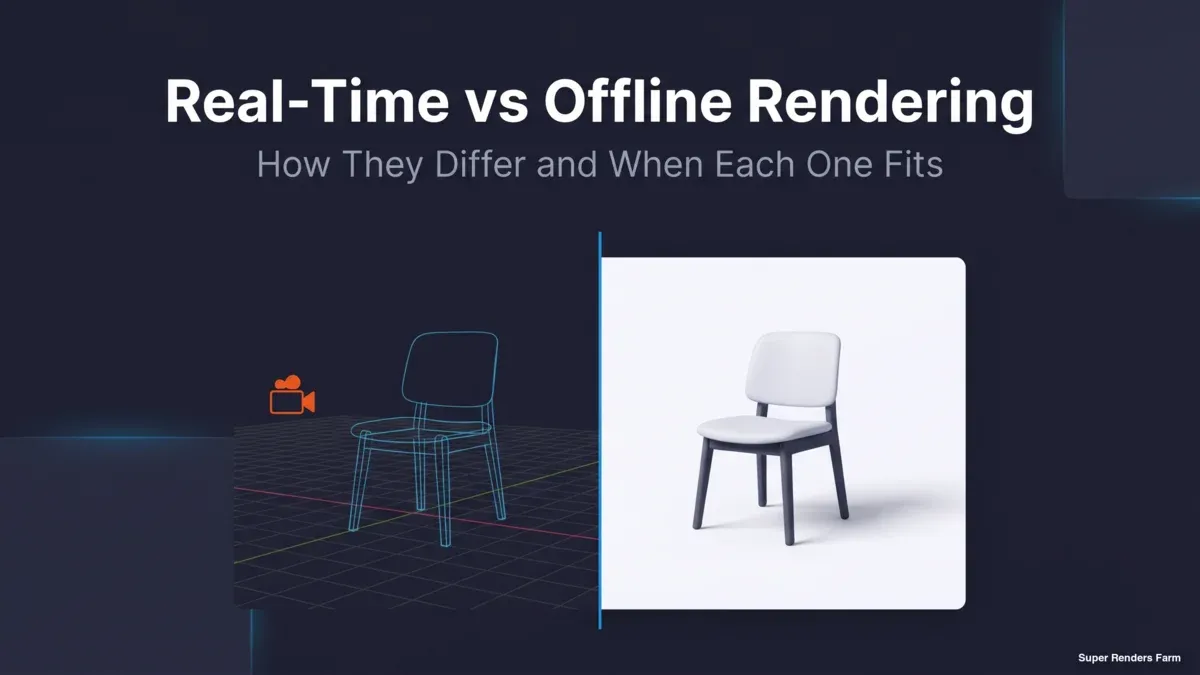
Offline vs. Real-Time: Offline renders có thể spend seconds per frame. Real-time renders cần milliseconds. Một 60fps game có 16ms per frame cho rendering, AI upscaling, frame generation, và everything else. Constraint này drive different algorithm choices. Offline film rendering là computationally luxurious by comparison.
Sự Hội Tụ của Real-Time và Offline
Đây là cái fascinating: techniques phát triển cho games giờ được dùng trong film rendering, và vice versa.
Từ Games tới Film:
DLSS-like AI upsampling giờ được dùng trong render farms. Nếu bạn render ở 50% resolution với denoising và AI reconstruction, bạn có thể render twice as fast với minimal quality loss. Chúng tôi đã thấy commercial render farms adopt similar strategies cho V-Ray và Arnold.
Frame generation concepts ảnh hưởng tới animation rendering pipelines. Motion estimation và interpolation, core tới frame generation, là useful cho temporal coherence trong animation rendering.
Real-time path tracing optimization techniques thông báo cho offline rendering. Fast sampling methods, adaptive sampling strategies, và denoising pipelines phát triển cho games được adapted cho offline use.
Từ Film tới Games:
Full path tracing, từng exclusive tới offline, giờ xuất hiện trong games (Alan Wake 2). Advanced shader networks và material complexity được adopted từ offline rendering.
Asset quality và detail từ film production đang ship trong games. Scanned materials, high-polygon models, và physically-based shading là game standard now.
Temporal reconstruction techniques từ denoising được adapted tới frame generation.
Vào 2026, boundary giữa real-time và offline rendering là blurred. Chúng ngày càng trở thành same technology, applied với different performance constraints.
Hiện Trạng Full Path Tracing Trong Games
Vào 2026, một vài games là fully path-traced (every bounce computed bởi ray tracing):
- Portal RTX (simple geometry, manageable)
- Alan Wake 2 (với DLSS 3 và frame generation enabling high visual quality)
- Emerging indie titles khám phá pure path tracing
Nhưng most AAA games vẫn hybrid. Ray-traced reflections và shadows, nhưng baked global illumination hay screen-space approximations. Cái này sensible — hybrid approaches deliver 90% visual quality ở 50% cost.
Full path tracing ở 60fps, 1440p+ resolution, với no denoising hay frame generation, vẫn impractical. Cho điều đó, ray-traced reflections cộng other approximations vẫn là standard.
Vai Trò của DLSS và Frame Generation
DLSS xứng đáng có section riêng bởi vì nó critical tới real-time ray tracing's success.
DLSS renders ở lower resolution (typically 67-75% của native), sau đó AI reconstructs missing pixels. DLSS 2.0 dùng temporal data; DLSS 3.0 extends cái này với frame generation.
Performance impact: một game chạy ray-traced reflections ở native 1440p có thể get 30fps. Với DLSS, render ở ~950p với reconstruction, nó achieve 60fps với visually equivalent quality.
Controversially, một số argue rằng DLSS introduces latency (một frame delay giữa input và output). Trong practice, latency là minimal trong modern DLSS, nhưng competitive gaming communities debate fairness của nó.
Cho casual games và visual quality, DLSS là một win: better visuals, higher frame rates. Cho competitive esports titles, latency tradeoff là debated.
DLSS's success spawned competitors: AMD's FSR, Intel's XeSS. Những alternatives này lack neural network training của DLSS nhưng more open. Bởi 2026, tất cả major GPUs có some form của AI upsampling.
Hardware Requirements và Market Impact
Real-time ray tracing yêu cầu recent GPU hardware. RTX 3000-series hay newer từ NVIDIA, RDNA2+ từ AMD, hay Arc từ Intel enables practical ray tracing.
Cái này có market implications: older GPUs không thể play modern ray-traced games ở quality levels. Gap giữa "minimum specs" và "high-quality" specs đã widen. Một 1080 Ti (released 2017) struggles với modern ray-traced games. RTX 2080 Ti (2018) có thể handle chúng. RTX 3080+ là comfortable.
Cho console gaming, PlayStation 5 và Xbox Series X có ray tracing hardware (custom NVIDIA/AMD designs), enabling ray tracing trong console games. Game developers giờ assume hardware ray tracing support across target platforms của họ.
Tương Lai: Path Tracing và Beyond
Vào 2026, full path tracing trong real-time là emerging nhưng không standard. Trajectory là gì?
Moore's Law và Hardware: GPUs tiếp tục improve 20-30% annually. Trong 5 năm (2031), real-time path tracing ở quality settings có thể routine. Full path tracing ở 60fps, 4K, với minimal compromises có thể viable bấy giờ.
AI Reconstruction: AI upsampling chỉ improving. Nếu denoising và reconstruction tiếp tục advance, bạn có thể render path-traced scenes ở very low sample counts và reconstruct high-quality images. "Good enough" sample count có thể drop từ 4 sang 1, unlocking 4x speedups.
Compression và Streaming: Cloud gaming và game streaming đang evolve. Nếu games có thể render trong datacenters và streamed tới clients, local hardware constraints vanish. Ray tracing trên cloud render farms (similar tới offline rendering) có thể streamed trong real-time. Cái này technically challenging nhưng conceptually viable.
Offline-Like Rendering trong Real-Time: Sự hội tụ cuối cùng: render farm technology applied tới real-time games. Distribute rendering across many GPUs, aggregate results, stream tới players. Cái này sẽ enable visuals approaching offline film quality trong interactive contexts.
Cái này speculative, nhưng direction là clear: more ray tracing, more path tracing, more AI reconstruction, less distinction giữa real-time và offline.
Ý Nghĩa Cho Content Creators
Cho game developers, real-time ray tracing giờ là required consideration. AAA games được expect hỗ trợ ray tracing. Điều này có nghĩa understand ray tracing performance, learn DLSS/upsampling tools, và optimize accordingly.
Cho 3D artists, cái này có nghĩa understand physically-based shading ở deeper level. Materials mà trông tốt dưới rasterization show artifacts dưới ray tracing. Artists cần calibrate materials cho ray-traced contexts.
Cho studios render offline content, real-time ray tracing techniques offer optimization paths. Tại sao render một sequence offline 24 giờ khi real-time rendering cộng temporal reconstruction achieve similar quality trong seconds?
Ý Nghĩa Cho Render Farm
Tại Super Renders Farm, ray tracing và real-time techniques ảnh hưởng tới infrastructure của chúng tôi:
Chúng tôi hỗ trợ GPU-heavy rendering pipelines. Clients render Unreal Engine 5 với Lumen hay ray-traced content cần GPU capacity, cái mà chúng tôi cung cấp ở scale.
AI reconstruction và denoising là routine steps trong render farm pipelines now. Chúng tôi integrate DLSS-like tools vào post-processing.
Một số clients đang explore hybrid approaches: render scenes với real-time techniques, output tới offline render farms cho final polish. Boundaries genuinely blurring.
FAQ
Câu Hỏi 1: Ray Tracing Có Thực Sự Là Thời Gian Thực Vào 2026, Hay Nó Chủ Yếu Là Denoising Tricks?
Ray tracing thực sự là thời gian thực trong 2026, nhưng với caveats. Modern ray-traced games thực sự ray-trace reflections, shadows, và global illumination. Nhưng chúng heavily optimized: lower sample counts, denoising, và AI reconstruction là essential. Final image là genuine ray tracing cộng intelligent reconstruction. Nó không "fake" rendering — nó optimized real-time path tracing. Compare nó tới film rendering, cái là optimized denoising cộng heavy sampling. Different scale, same philosophy.
Câu Hỏi 2: Tôi Nên Mua GPU Cho Ray Tracing Gaming Không?
Nếu bạn đang mua modern GPU cho gaming, có — ray tracing là present và worth enabling. RTX 3060 và higher từ NVIDIA, RX 6600 XT và higher từ AMD. Những cái này enable ray tracing ở reasonable settings. Cho maximum quality, RTX 4070+ hay equivalent. Ray tracing visibly improve image quality; nó worth investment.
Câu Hỏi 3: DLSS 3 Frame Generation Có Worth Latency Không?
Depends trên game. Cho single-player, story-driven games (Alan Wake 2, Cyberpunk), frame generation excellent — doubles frame rate với minimal latency. Cho competitive multiplayer, input lag là debatable. Professional esports players thường disable nó. Cho casual multiplayer, nó fine.
Câu Hỏi 4: Path Tracing Sẽ Completely Replace Rasterization Không?
Unlikely trong next 5 năm. Hybrid approaches (rasterized geometry với ray-traced reflections/shadows) sẽ vẫn standard bởi vì chúng faster. Full path tracing là visually superior nhưng expensive. Khi hardware improve, balance sẽ shift toward more path tracing, nhưng rasterization như một foundational step có lẽ persist.
Câu Hỏi 5: Tôi Có Thể Dùng Real-Time Ray Tracing Techniques Cho Offline Film Rendering Không?
Có, và increasingly studios làm. Render ở lower sample counts cộng AI reconstruction có thể accelerate offline rendering. Tuy nhiên, offline rendering prioritizes quality over speed, vì vậy cái này trades time cho potential artifacts. Nó useful cho previews và iterative work, less so cho finals demanding perfect quality.
Câu Hỏi 6: Sự Khác Biệt Giữa Hardware Ray Tracing và Software Ray Tracing Là Gì?
Hardware ray tracing dùng specialized GPU units (RT cores) cho ray-scene intersection, significantly accelerating nó. Software ray tracing dùng standard GPU compute. Hardware là 10-50x faster. Tất cả modern GPUs (RTX, RDNA, Arc) có hardware ray tracing.
Tài Nguyên Liên Quan
Cho comprehensive information về real-time rendering và GPU technology, GPU Cloud Render Farm guide của chúng tôi cover hardware selection cho modern rendering workloads. Chúng tôi cũng hỗ trợ Unreal Engine 5's Lumen và ray-traced rendering trên infrastructure của chúng tôi.
Cho game developers explore ray tracing, Blender Cloud Render Farm guide của chúng tôi cover ray-traced rendering trong một different context, nhưng principles transfer.
Sự Hội Tụ Tăng Tốc
Vào 2018, Quake II RTX là một novelty: "Nhìn, chúng ta có thể ray-trace trong real-time!" Vào 2026, ray tracing là một expectation. Novelty đã chuyển: full path tracing, frame generation, AI reconstruction — những cái này là new frontier.
Cái most interesting là philosophical shift. Trong decades, real-time và offline rendering là separate domains. Game engines và film renderers dùng different algorithms, different hardware, different optimization strategies. Sự tách biệt đó đang collapse.
Vào 2026, advanced real-time game engines dùng techniques từ film rendering. Established film render farms dùng optimization strategies từ games. GPUs handle cả hai contexts. Materials và shaders được shared giữa real-time và offline.
Sự hội tụ này sẽ accelerate. Những năm tiếp theo sẽ thấy more path tracing trong games, more real-time techniques trong offline rendering, và fewer clear boundaries giữa hai cái.
Cho artists và developers, cái này có nghĩa skills của bạn ngày càng transferable. Learn ray tracing, path tracing, DLSS, và denoising trong một context, và chúng valuable trong another. Industry đang move tới một unified rendering philosophy: physically-based, ray-traced, AI-enhanced, và pragmatically optimized cho context.