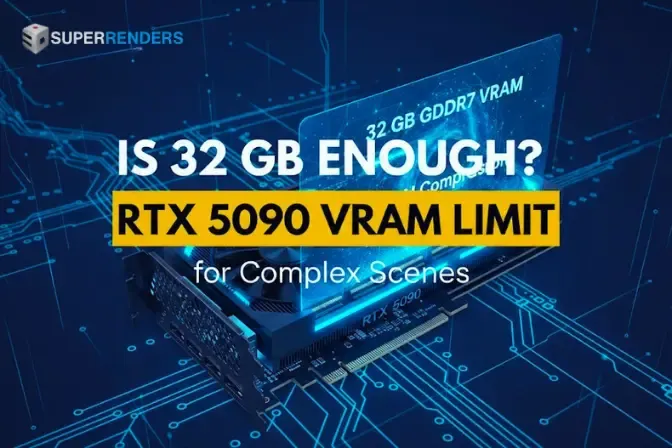
Les 32 GB suffisent-ils ? Limite de VRAM RTX 5090 pour scènes complexes
Aperçu
Introduction
L'NVIDIA RTX 5090 est livrée avec 32 GB de VRAM GDDR7 — le double des 24 GB de la RTX 4090, connectée via un bus mémoire 512-bit livrant jusqu'à 1,79 TB/s de bande passante. Pour les infographistes 3D et les studios évaluant le rendu GPU, la question immédiate est pratique : 32 GB suffisent-ils réellement pour les scènes de production complexes ?
Nous exécutons des GPU RTX 5090 sur notre ferme de rendu GPU depuis début 2026, traitant des milliers de tâches de rendu GPU via Redshift, Octane, V-Ray GPU et Arnold GPU. Cela nous donne un ensemble de données réel qui dépasse les benchmarks synthétiques — nous voyons ce que les scènes de production réelles consomment en VRAM, où elles atteignent leurs limites, et quelles techniques d'optimisation font la différence entre un rendu réussi et un crash mémoire insuffisante.
Cet article présente ces données opérationnelles aux côtés de benchmarks vérifiés pour vous donner une réponse pratique à la question des 32 GB.
RTX 5090 vs RTX 4090 : Comparaison Performance et VRAM
Avant de plonger dans les spécificités VRAM, voici comment la RTX 5090 se compare à sa prédécesseure dans les charges de rendu :
| Spécification | RTX 4090 | RTX 5090 |
|---|---|---|
| VRAM | 24 GB GDDR6X | 32 GB GDDR7 |
| Bus mémoire | 384-bit | 512-bit |
| Bande passante mémoire | 1 008 GB/s | 1 792 GB/s |
| Cœurs CUDA | 16 384 | 21 760 |
| Architecture | Ada Lovelace | Blackwell |
| Cœurs RT | 3e gén. | 4e gén. |
| Cœurs Tensor | 4e gén. | 5e gén. |
| TDP | 450 W | 575 W |
L'augmentation de 33 % de la capacité VRAM (24→32 GB) compte, mais l'augmentation de 78 % de la bande passante mémoire est probablement plus impactante pour le rendu. Une bande passante plus élevée signifie que les textures et la géométrie peuvent être déplacées dans et hors de la VRAM plus rapidement, ce qui bénéficie directement à la performance de rendu hors-cœur quand les scènes dépassent la mémoire disponible.
Les benchmarks de Puget Systems et Chaos Group confirment que la RTX 5090 surpasse la RTX 4090 de 30 à 40 % dans les tests de rendu en conditions réelles. Dans les scènes Blender et Maya lourdes, l'utilisation VRAM atteint régulièrement 20+ GB, et les scènes d'archviz ou VFX de production grimpent fréquemment au-dessus de 28 GB.
Quelle est la consommation VRAM réelle des différents moteurs de rendu ?
La consommation VRAM varie considérablement selon le moteur de rendu, la complexité de la scène et l'efficacité avec laquelle le moteur gère la mémoire GPU. Voici ce que nous observons sur notre flotte GPU :
| Moteur | Scène typique | Utilisation VRAM | Notes |
|---|---|---|---|
| Redshift | Intérieur archviz, textures 4K | 14–22 GB | Hors-cœur efficace ; gracieux en cas de débordement VRAM |
| Redshift | Extérieur dense avec végétation | 24–30 GB | Les instances Scatter sollicitent fortement la VRAM |
| Octane | Visualisation de produit | 10–18 GB | Modèle mémoire compact pour scènes simples |
| Octane | Scène VFX avec volumétrie | 22–28 GB | Les volumétries consomment beaucoup de VRAM dans Octane |
| V-Ray GPU | Intérieur avec matériaux mixtes | 16–24 GB | V-Ray GPU gère bien le hors-cœur |
| V-Ray GPU | Extérieur urbain dense | 26–32 GB | À la limite — peut nécessiter optimisation |
| Arnold GPU | Personnage avec SSS + cheveux | 12–20 GB | Efficace pour scènes à géométrie de surface |
| Arnold GPU | Scène forestière avec déplacement | 24–32 GB | Les subdivisions de déplacement consomment VRAM rapidement |
La réponse pratique : 32 GB couvre environ 85-90 % des scènes de production que nous traitons sans nécessiter d'optimisation spéciale. Les 10-15 % restants — extérieurs urbains denses, shots VFX 8K gourmands en textures, simulations volumétriques lourdes — peuvent nécessiter optimisation ou bénéficieront du support de rendu hors-cœur.
Architecture Blackwell : Compression de texture neurale
L'architecture Blackwell de la RTX 5090 introduit la compression de texture neurale (CPN), qui utilise des réseaux de neurones exécutés sur les cœurs Tensor pour compresser les textures jusqu'à aussi peu que 4-7 % de leur empreinte VRAM d'origine tout en maintenant la fidélité visuelle.
Ce que cela signifie en pratique :
- Une scène avec 20 GB de données texturales pourrait théoriquement consommer moins de 2 GB de VRAM pour les textures avec CPN activée
- La décompression s'exécute sur des cœurs Tensor dédiés, elle ne rivalise donc pas avec le calcul de rendu sur les cœurs CUDA et RT
- La CPN est plus efficace avec les cartes diffuses, normales et de rugosité — moins applicable aux textures procédurales générées au moment du rendu
Statut actuel (mars 2026) : NVIDIA a publié la CPN dans son SDK, et les développeurs de moteurs de rendu — y compris Maxon (Redshift), OTOY (Octane), Chaos (V-Ray GPU) et Autodesk (Arnold GPU) — travaillent sur l'intégration. Nous attendons un support moteur plus large dans le courant de l'année 2026.
Les améliorations mémoire Blackwell supplémentaires incluent les upgrades du contrôleur GDDR7 et l'ajustement dynamique de tension, qui réduisent tous deux la latence d'accès mémoire et améliorent la bande passante soutenue sous charges de rendu lourdes.
Stratégies d'optimisation VRAM pour scènes complexes
Quand votre scène approche ou dépasse 32 GB, ces stratégies d'optimisation — tirées de notre expérience de dépannage — peuvent faire la différence :
Gestion des textures
Les textures sont le plus grand consommateur VRAM dans la plupart des scènes. Étapes pratiques :
- Convertir en formats natifs du moteur — .tx pour Arnold, .rstexbin pour Redshift, .orbx pour Octane. Ces formats utilisent le mipmapping en carreaux qui charge uniquement le niveau de résolution nécessaire par pixel, réduisant drastiquement l'utilisation VRAM.
- Auditer la résolution texturale — une conclusion commune dans les scènes que nous dépannons : objets de fond utilisant des textures 8K quand 2K serait visuellement identique. Un audit systématique de texture peut libérer 30-50 % de VRAM.
- Utiliser UDIM judicieusement — les workflows UDIM avec de nombreuses tuiles par objet multiplient l'utilisation VRAM. Consolider où possible.
Optimisation de la géométrie
- Utiliser les instances, pas les copies. Une ferme de rendu traite cette distinction au niveau du moteur — 1 000 arbres instanciés utilisent la VRAM d'un arbre, tandis que 1 000 arbres copiés utilisent 1 000× la VRAM. C'est l'optimisation la plus impactante pour les scènes riches en végétation.
- Réduire les niveaux de subdivision. La subdivision adaptative peut générer des millions de polygones au moment du rendu. Abaisser le niveau de subdivision max d'un cran peut réduire de moitié l'utilisation VRAM de géométrie avec un impact visuel minimal.
- Objets proxy pour plugins scatter. Forest Pack, Chaos Scatter et GrowFX supportent tous le chargement proxy au moment du rendu. Assurez-vous que les proxies sont utilisés plutôt que la géométrie complète pour les objets dispersés.
Paramètres spécifiques au moteur
- Redshift : Activez le mode « Out-of-Core » dans l'onglet Mémoire. Redshift gère le débordement VRAM plus gracieusement que la plupart des moteurs — il bascule en RAM système avec une pénalité performance gérable (généralement 20-40 % plus lent, pas un crash).
- Octane : Utilisez l'option texturale « Out of Core » et activez « Compact Global Textures ». Le hors-cœur d'Octane est moins mature que celui de Redshift, donc garder les textures sous VRAM est préférable.
- V-Ray GPU : Activez « Resident Textures Limit » pour plafonner la quantité de VRAM que les textures peuvent consommer, forçant des niveaux de mipmap de résolution inférieure pour les textures distantes.
- Arnold GPU : Activez le rendu hors-cœur (disponible depuis Arnold 7.2). Arnold bascule les textures et la géométrie quand la VRAM est dépassée.
Quand 32 GB ne suffisent pas
Certaines charges de travail nécessitent genuinely plus de 32 GB, et aucune optimisation ne changera cela :
Simulations volumétriques extrêmes. Les simulations fluides, feu ou fumée à grande échelle en cache en tant que séquences VDB peuvent consommer 40-60 GB de VRAM. Ces workflows sont encore principalement rendus par CPU pour cette raison.
Sortie 8K complète avec textures 8K partout. Un rendu 8K avec textures source 8K sur des dizaines de matériaux et géométrie dense est un cas exceptionnel qui peut dépasser 32 GB. La plupart du travail de production en résolution 4K avec résolutions texturale mixtes reste bien dans les limites.
Scènes d'entraînement machine learning. La génération de données synthétiques pour entraîner les réseaux de neurones nécessite parfois le rendu de grands lots avec variation maximale — ces scènes sont intentionnellement complexes et gourmandes en mémoire.
Pour ces cas, les options sont :
- Rendu CPU — notre flotte de rendu CPU avec 20 000+ cœurs et 96–256 GB RAM par machine gère les scènes limitées VRAM sans contraintes mémoire
- GPU professionnels — l'NVIDIA RTX PRO 6000 (48 GB VRAM) et les GPU data center A100/H100 offrent des pools mémoire plus grands à un coût significativement plus élevé
- Optimiser et re-rendre — la plupart des scènes peuvent être ramenées sous 32 GB avec les techniques décrites ci-dessus
Retours utilisateur du monde réel
Les retours des communautés professionnelles (r/Blender, r/vfx, r/NVIDIA, forums CGArchitect) s'alignent avec nos données opérationnelles :
Les artistes travaillant en archviz et visualisation de produit rapportent régulièrement que 32 GB gère confortablement leurs projets typiques. L'espace VRAM supplémentaire par rapport aux 24 GB de la RTX 4090 élimine la plupart des erreurs « mémoire insuffisante » qu'ils rencontraient précédemment.
Les artistes VFX travaillant avec des simulations de particules lourdes et volumétries rapportent que 32 GB aide mais ne résout pas complètement leurs contraintes VRAM — ces workflows restent partagés entre rendu GPU et CPU selon les exigences de scène.
Le consensus est que 32 GB représente le sweet spot pratique pour 2026 — suffisant pour la vast majorité du travail de production, avec la compression de texture neurale étendant davantage sa capacité effective à mesure que le support moteur mûrit.
Rendu sur RTX 5090 via une ferme de rendu cloud
Pour les artistes qui ont besoin de la performance RTX 5090 mais ne veulent pas investir 2 000+ € dans un GPU local :
Sur notre ferme, nous exécutons des nœuds GPU RTX 5090 dédiés avec 32 GB VRAM chacun, supportant Redshift, Octane et V-Ray GPU pour le rendu de production ; Arnold GPU est disponible pour le lookdev, les previews et les rendus finaux adaptés au GPU jusqu'à environ 28 GB VRAM par image, Arnold CPU étant recommandé pour les rendus finaux lourds, la sortie deep-EXR et les shaders personnalisés. La ferme gère la gestion des pilotes, la compatibilité CUDA/OptiX, et la configuration TDR timeout — tous les détails opérationnels qui peuvent causer des échecs de rendu sur les machines locales.
Un workflow pratique : testez votre scène localement sur le GPU que vous avez, notez la consommation VRAM, et si elle est inférieure à 28 GB vous pouvez être confiant qu'elle rendra correctement sur nos nœuds RTX 5090. Si elle dépasse 28 GB, appliquez les techniques d'optimisation ci-dessus avant de soumettre — ou utilisez notre flotte de rendu CPU pour les scènes qui dépassent les limites mémoire GPU.
Pour les données de performance sur les moteurs et types de scènes spécifiques, consultez notre article détaillé sur la performance RTX 5090 du rendu cloud GPU RTX 5090.
FAQ
Question : 32 GB VRAM sur la RTX 5090 suffisent-ils pour le rendu archviz ? Réponse : Oui. Basé sur nos données de production, les intérieurs et extérieurs archviz typiques utilisent 14–26 GB de VRAM selon la résolution texture et la complexité géométrie. 32 GB offre une marge confortable pour la vast majorité des scènes archviz sans optimisation. Les extérieurs à végétation dense peuvent approcher la limite mais la dépassent rarement.
Question : Que se passe-t-il quand une scène dépasse 32 GB VRAM ? Réponse : Le comportement dépend de votre moteur de rendu. Les moteurs avec support hors-cœur (Redshift, V-Ray GPU, Arnold 7.2+) basculent les données vers RAM système, ce qui prévient les crashes mais ralentit le rendu de 20-40 %. Les moteurs sans support hors-cœur peuvent crasher avec une erreur « mémoire GPU insuffisante ». Optimiser les textures et utiliser les instances sont les façons les plus efficaces de réduire la consommation VRAM.
Question : Comment la compression de texture neurale affecte-t-elle la limite 32 GB ? Réponse : La compression de texture neurale (CPN) d'NVIDIA peut réduire l'utilisation VRAM texture de jusqu'à 90 % en compressant les textures sur les cœurs Tensor dédiés. Quand pleinement intégrée aux moteurs de rendu, cela étend effectivement la capacité VRAM utilisable de la RTX 5090 considérablement. En mars 2026, NVIDIA a publié la CPN dans son SDK et les développeurs de moteurs de rendu — y compris Maxon (Redshift) et autres — travaillent activement sur l'intégration, avec un support plus large attendu dans le courant de l'année 2026.
Question : Devrais-je choisir RTX 5090 ou RTX PRO 6000 professionnelle pour le rendu ? Réponse : Pour les scènes qui tiennent dans 32 GB VRAM, la RTX 5090 offre une performance de rendu comparable à une fraction du coût. La RTX PRO 6000 (48 GB VRAM) a du sens quand vos scènes nécessitent régulièrement plus de 32 GB, ou quand vous avez besoin de mémoire ECC et de support pilote certifié pour les pipelines de production critiques. La plupart des infographistes 3D trouvent la RTX 5090 suffisante.
Question : Puis-je utiliser plusieurs GPU RTX 5090 pour combiner la VRAM ? Réponse : Pas directement. Les moteurs de rendu GPU ne peuvent généralement pas mettre en commun la VRAM sur plusieurs GPU — chaque GPU doit contenir les données de scène complètes dans sa propre VRAM. Plusieurs GPU accélèrent le rendu en divisant les frames ou seaux sur les cartes, mais chaque carte a toujours besoin de suffisamment de VRAM pour la scène complète. Certains moteurs (comme Octane) supportent le rendu multi-GPU où chaque GPU contient une copie des données de scène indépendamment.
Question : Comment la VRAM RTX 5090 se compare-t-elle à la RTX 4090 pour le rendu ? Réponse : Les 32 GB de la RTX 5090 représentent une augmentation de 33 % par rapport aux 24 GB de la RTX 4090, et sa bande passante mémoire 78 % plus élevée (1,79 TB/s vs 1,0 TB/s) améliore la performance de rendu hors-cœur. En pratique, les scènes qui causaient des erreurs mémoire insuffisante sur la RTX 4090 se rendent souvent proprement sur la RTX 5090 sans modifications de scène.
Ressources connexes
- Performance de rendu cloud GPU RTX 5090 — benchmarks détaillés sur V-Ray, Redshift, Arnold et Octane
- Ferme de rendu cloud GPU — service de rendu GPU de SuperRenders Farm
- Erreurs de rendu GPU : Corriger les 5 crashes les plus courants — dépannage des crashes VRAM, timeouts TDR et problèmes de pilote
- Spécifications NVIDIA RTX 5090 — spécifications officielles d'NVIDIA
Dernière mise à jour : 2026-03-20
About Alice Harper
Blender and V-Ray specialist. Passionate about optimizing render workflows, sharing tips, and educating the 3D community to achieve photorealistic results faster.